Its authors transported the play's action to 20th-century Europe: from Wawel, “the Acropolis of Poland,” to the “cemetery of the tribes”, that is, the reality of the concentration camps. This performance, despite inspiring numerous debates and interpretations, is still in many ways undefined. “We came to Opole and saw Akropolis, it was a great shock to us”, Maria Zmarz-Koczanowicz recalled years later in a documentary film, while Prof. Grzegorz Niziołek, author of the book The Polish Theatre of the Holocaust (Polski Teatr Zagłady), explained on dwutygodnik.com:
Akropolis is not just the images of concentration camps, but is also a very strongly articulation of the subject of Shoah, even if expressed in a strange, liminal form. […] Performances by both Grotowski and Kantor are actually very hard to interpret, it is difficult to comprehend what is actually happening in them. In my opinion, the certain kind of disrupting strategies of representation in art that they represent is quite intricately related to the experience of the Holocaust, this tremendous taboo within the collective consciousness. In both cases, the spectator is put in a new situation, exposed to dealing with something which is located “beyond the pleasure principle,” as I described it in the case of Akropolis. I think that the experience of shock, some kind of emotional and cognitive disturbance that arose in it, is very significant.
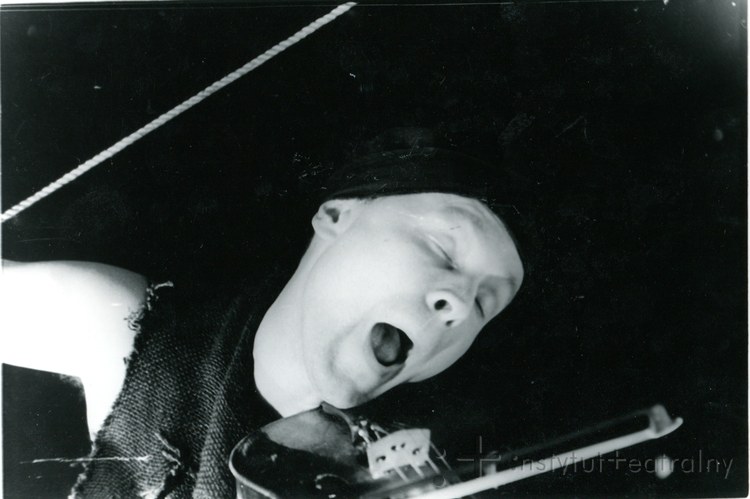
Zygmunt Molik in Akropolis, photo courtesy of the Laboratorium Theatre/The Grotowski Institute Archive
The protagonists were deprived of their individual identities and collectively enacted a drama of the degradation and profanation of values, a drama elevated to the level of a giant civilizational crisis.
The action of Wyspiański's play is set in Wawel, which is to Poles what the Acropolis is to Europe. On the night of the resurrection, figures walk out of decorative tapestries, and reenact famous myths, and ancient, biblical motifs […]. In Akropolis, the viewer sees the graveyard of European and national civilization, its collected inspirations and themes. And this graveyard of traditions meets the graveyard of European nations and culture of the 20th century—the catalogue of the “civilization of furnaces,” the reality of the death camps. [Zbigniew Osiński, Grotowski in His Laboratory / Grotowski i jego Laboratorium, Warsaw, 1980)
