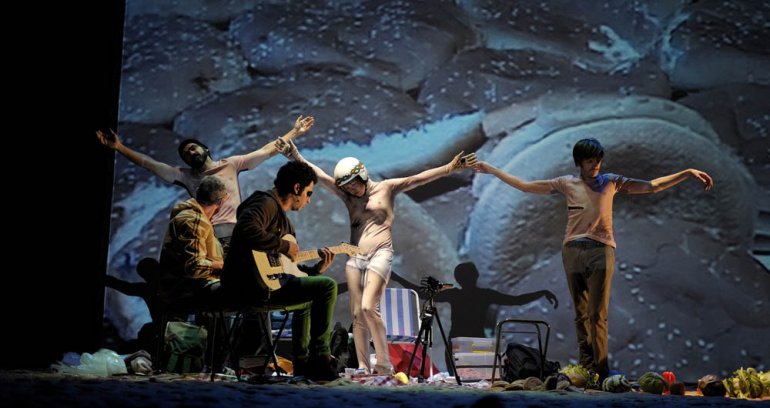
His legend as an artist excommunicated by the Catholic Church has been following Grotowski for a quarter of a decade. In 1976, during a sermon at an open-air service in Skałka, Kraków, Cardinal Stefan Wyszyński, known as the Primate of the Millennium, shouted out words of contempt for the founder of Laboratorium Theatre, and called his Apocalypsis cum figuris “true muck” which was demoralising the Polish nation as badly as alcoholism. What was it that shocked the Church authorities? In an article for the Teatr magazine, the great theatre scholar and essayist Konstanty Puzyna noted that the performance was an unprecedented event on a world scale:
"In Apocalypsis, there is almost no literary script. In reading, the text is a chaotic mixture of quotes from the Bible, church songs, Dostoyevsky’s writings, Eliot, and Simone Weil. They seem to have nothing in common. Vague lines of associations barely surface on this collage, one can only grasp that when Simon-Peter speaks, he employs the lines of the Great Inquisitor from the Karamazov Brothers, and when Ciemny (the Dark One) defends himself, in a pathetic and bitter way, he speaks with the poems of Eliot. These texts make up no plot at all, they are a tool, a prop. Grotowski’s scenic poem is built in its entirety out of actions and the actors’ experiences, they are the only things that carry both the plot and the topics of the performance. Both are unclear, complex, and equivocal. Laws of poetry reign here, and not those of prose, the laws of distant associations, of layering metaphors, and of a constant transformation of one image into another, one action into another action, and of one sense into another. It alludes to biblical scenes, as well as contemporary rural customs, liturgical symbols and a hooligans’ drinking spree, a dandy from the suburbs and David facing the Ark.
Grotowski, who experimented with the Christian tradition and the Gospels was fiercely criticised by the Polish right-wing circles, who saw him as a charlatan and blasphemer.
Find our more in The Grotowski Glossary
Różewicz the perverse
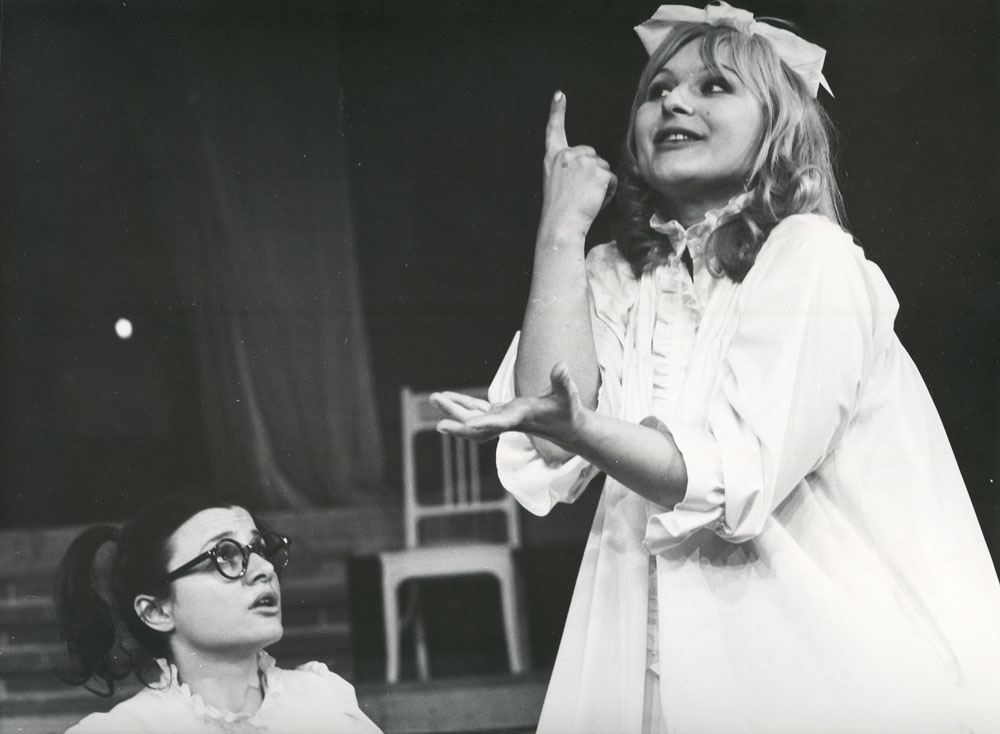
Scene from the "Białe małżeństwo" (The White Marriage) performance, directed by Tadeusz Minc, 1973. From left: Anna Chodakowska, Barbara Sułkowska, photo: Renard Dudley/ Archiwum Artystyczne Teatru Narodowego
That same sermon had the Primate call another controversial title – Białe małżeństwo (The White Marriage) by Tadeusz Różewicz - a “disgusting performance”. For its author, it was a piece that constituted a theatrical dream about sex. The show became loudly commented on long before its first staging in 1975. A moral scandal was already in the air. In a talk for Tygodnik Powszechny, Różewicz said
Someone must have handed Dialog [a theatre monthly] to the Cardinal in order to do me a favour. Anyway, I was mentioned alongside Grotowski during the Cardinal’s sermon on Skałka, which is a magical place because of the people buried there. Wyspiański is buried there. And the last one is Miłosz, right?
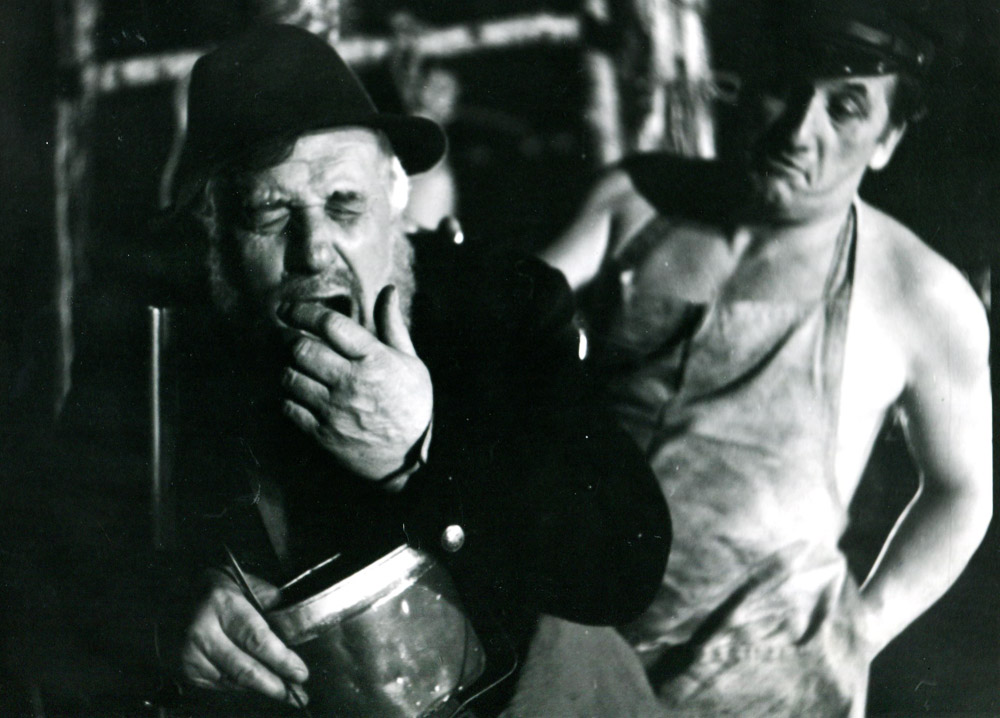
Scene from the "Do piachu" (To The Sand) performance, directed by Tadeusz Łomnicki, 1979, photo: Renata Pajchel / Teatr na Woli
Heated with warnings cast from church pulpits, the atmosphere of a great scandal which came to surround the play worked like a magnet for theatre audiences. Art lovers from across the whole country came in crowds, beating all records for attendance. This story is important for yet another reason. It led to an unprecedented and unique case in the history of the Communist People’s Republic of Poland, wherein church authorities took part in secret negotiations with the communist authorities as they surveyed the possibility of condemning Rożewicz with censorship bans. It was an issue that was also raised with the play titled Do Piachu (To The Sand), staged at the Teatr na Woli. The reason for this was that Rożewicz used his rare first-hand expertise in his depiction of the partisans’ life, a description devoid of patriotic intoxication. According to Janusz R. Kowalczyk:
Instead, he depicted the rest, usually kept secret – the mud, the dirt, the lice, and the blood, as well as awful food, being cut away from family, a poignant lack of women, and severe discipline. Waluś, a village simpleton who dreamt of visiting Kraków and Częstochowa after the war’s end, had returned to the fighting unit after a burglary escapade. He went off with two superiors, who, unlike him, disappeared together with the loot. The chiefs’ rage concentrated on the young boy who returned. Treated worse than a dog, the boy fails to understand his own guilt – after all, he had been listening to his superiors. Różewicz created an anti-epos about anti-heroes. His piece depicted the absurdity of war and the dehumanisation that it engenders. It showed the failed sacrifice in the name of a restrictive law and addressed the issue of responsibility for one’s neighbour, for his pain, suffering, and death. He questioned what is worth dying for, and where to draw the line of human abjection”.
Strong reactions from combatant circles which surfaced after two first showings of the play made Różewicz restrict his decisions to authorise subsequent stagings. After the staging by Tadeusz Łomnicki in 1979 and that of Kazimierz Kutz in 1991, the only other ones to have succeeded were Janusz Opryński and Witold Mazurkiewicz from the Teatr Provisorium and Kampania Teatr from Lublin, who staged Do Piachu in 2003.
Dejmek’s Forefathers’ Eve: "Eh, you, mister, smell provocation everywhere!"
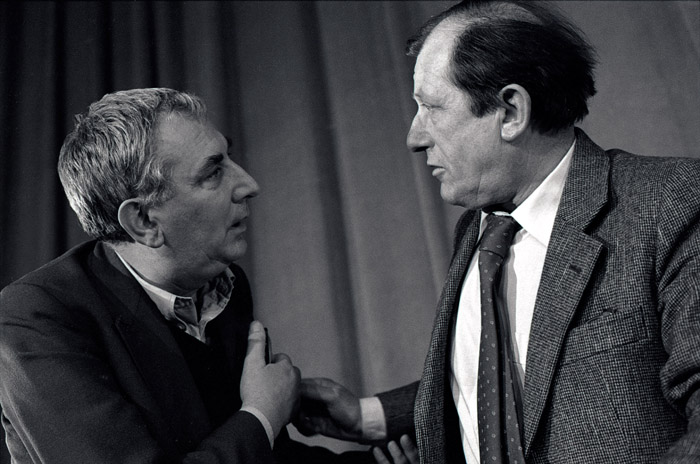
Gustaw Holoubek and Kazimierz Dejmek, photo: Janusz Fila / Forum

On the 30th of January, 1968 the National Theatre in Warsaw staged the last, thirteenth staging of the legendary Dziady production. Directed by Kazimierz Dejmek and featuring acting icon Gustaw Holoubek in the main role, the piece was taken down as an “anti-soviet” play. The ban on stagings of Dziady became the impetus for a wave of students’ protests, the so-called March ‘68 events. The production met with sharp criticism of the PZPR Communist Party authorities. After the first four evenings, Dejmek was informed that the piece could only be shown once a week, and that school youth was to be sold no more than 100 tickets, with no fee reduction, and the director was instructed to take notes on the audience’s reactions.
Kazimierz Dejmek was urgently called to the Central Committee of the party, and he was informed by Wincenty Kraśko, the head of the cultural department, that his staging was “anti-Russian, anti-Soviet and religious”. Gomułak called the piece “a knife stabbed into the back of Polish-Soviet friendship”. The last showing, which took place on the 30th of January, 1968, gathered huge crowds, with shouts such as “Independence with no censorship!”, “We want Dziady!”, and “Dejmek! Dejmek!”. After the showing was over, a procession of people was formed and walked up to the Adam Mickiewicz statue shouting “Free art! Free theatre!”. Due to the intervention of communist police, 35 people were arrested for allegedly “disturbing public order”.
Swinarski's Curse
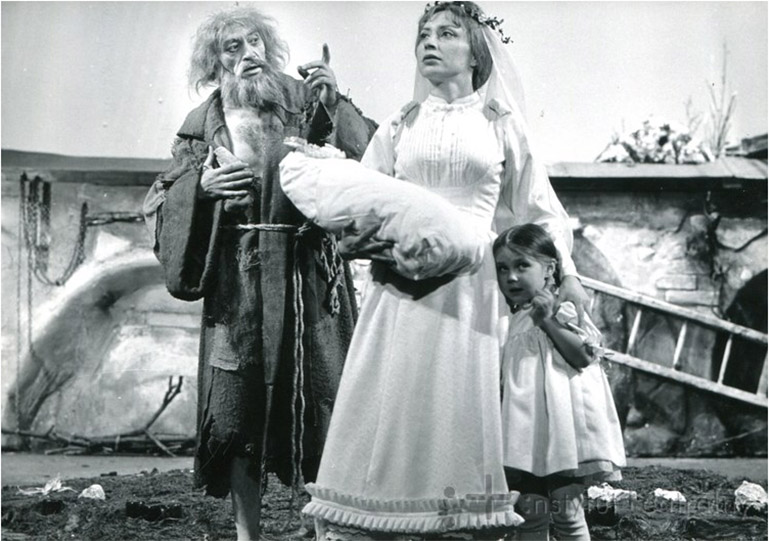
A photograph from the showing of Klątwa (The Curse), directed by Konrad Swinarski, photo: Wojciech Plewiński / source: Instytut Teatralny
Konrad Swinarski’s staging of Stanisław Wyspiański’s The Curse and The Judges constituted a reaction to the events of March, 1968. Swinarski, one of the most acclaimed theatre directors in the history of Polish theatre, triggered especially heated reactions with his stagings of Klątwa (The Curse). The vision of a fanatical Polish village, and a mob which stones a girl who lives with a priest to death was far too shocking for many, crossing the boundary of what was acceptable in theatre.
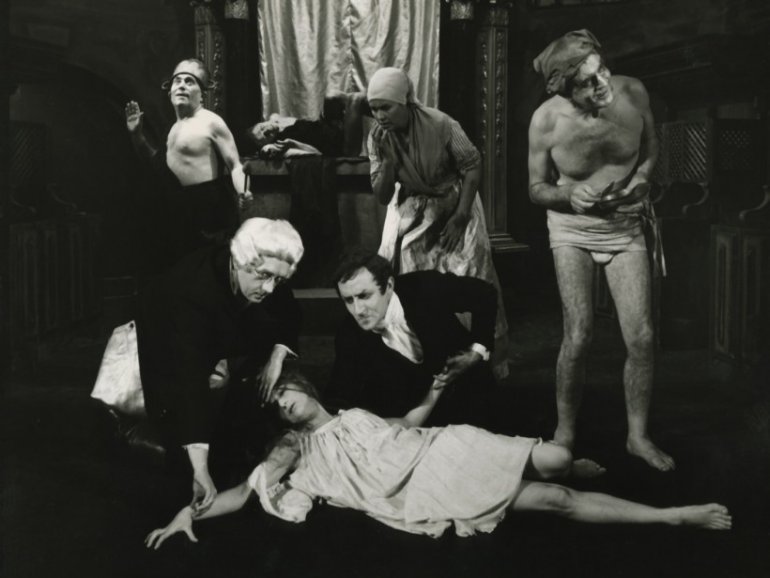
A scene from the "Nie-Boska komedia" directed by Swiniarski, source: e-teatr.pl
Swinarski’s Nie-boska komedia (The Un-divine Comedy) was also heavily criticised by the audience, as well as his Wyzwolenie (Liberation), staged at Teatr Stary in Kraków. Janusz R. Kowalczyk remembers,
I went to see it more than a dozen times, I had such a strong need to have contact with a virtuoso staging. I was taking in the living word, I admired the actors’ creations, with the genius Jerzy Trela cast as Konrad. Wyspiański’s drama inscribes itself in the series of works which mercilessly ask questions about the conditions of a Polish artist and member of the intelligentsia. And yet it’s saturated with irony, a kind of coming to terms with our customs and our eternal Polish impotence.
Swinarski himself was often accused of antisemitism. But these are his comments about the rehearsals of Woyzeck
Pious actors had scruples when they were supposed to say “Let’s piss on the cross, maybe some Jew will die”. They discussed for half an hour whether one can say from the stage “Let’s piss on the cross”. But none of them thought about whether it’s OK to say “Maybe some Jew will die”.
An Interrupted Performance
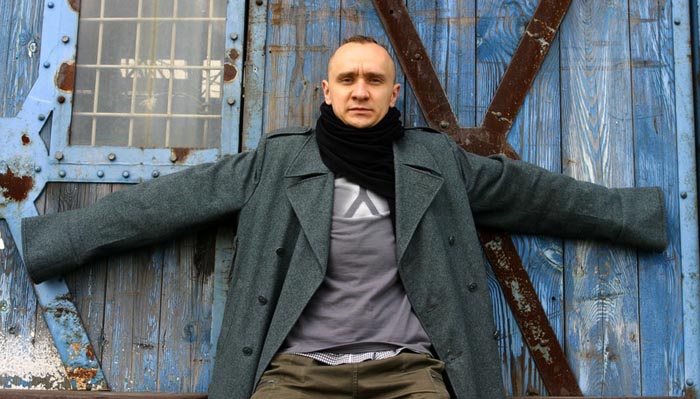
Jan Klata, photo: Marek Zawadka / Newsweek Polska / Reporter /East News
Decades later, during a year dedicated to the commemoration of Swinarski’s work, the same national stage hosted Olivier Frljić, a Croatian director invited to the theatre by Jan Klata. He had to stop his work on the Nie-boska komedia (Un-divine Comedy), a play written by Zygmunt Krasiński, when seven out of the 18 actors cast in the production resigned from the project, including Anna Dymna, Bolesław Brzozowski, Mieczysław Grąbka, Tadeusz Huk, Ryszard Łukowski, Jacek Romanowski and Krzysztof Zawadzki. They explained that Frljic’s staging had nothing to do with the Romantic author’s text and the famous 1965 staging of his tragedy by Swinarski.
After a series of critical “reviews” published by right-wing media before the premiere, and a series of threats and warnings sent to the theatre, Jan Klata decided to suspend the rehearsals, arguing that the media’s paranoia and persecution around the performance rendered creative work impossible. “We don’t want the content of the play to give reason for violence, aggressive behaviour and mobs”, Klata declared. In a talk with Miłada Jędrysik published in the Tygodnik Powszechny, the Croatian director Frljic explained:
They always try to interrupt me, to block the premiere showing. This time the pressure was successful. I am sorry that what was not thus far possible in Serbia, Bosnia, or Slovenia was achieved in Poland. No society wants or likes to confront problems. Poland is no exception here. And this is not just about the choice of themes, but also about the artistic language which is capable of touching sensitive points. All the low comments about the Szczątki performance result from a lack of understanding of the kind of theatre that I make (…)”
It was not the first time that the Croatian artist had received a tense welcome from Polish audiences. Frljic also recalls the reception of his production which was shown as part of the Dialog festival in Wrocław:
"During the culminating scene, one lady started to shout out over the actors, she got up and called for the other spectators to also leave the audience. She did not like the fact that in one of the previous scenes, an actor presented a conspiracy theory wherein Kaczyński’s plane in Smoleńsk was downed by Russians, she didn’t like the attempt to address a very important issue in Poland, that of Catholicism”
Further Klata affairs