Karpiński, a very conscious citizen, not only deeply experienced the first partition of Poland by Prussia, Austria and Russia, which occurred in 1772 but also, when he was later writing Bóg Się Rodzi, he sensed that things weren’t getting any better for his homeland. That’s why in the song he asks for help from above. Unfortunately for Poland, his intuitions proved correct and a year after the carol was published a second partition took place, followed by a third shortly afterwards which effectively wiped Poland off the map. Following this final shock, Karpiński became silent as a poet and withdrew from civic life, settling in a small village outside Puszcza Białowieska.
During the following 123 years of bondage, carols became a focal point of national identity for many Poles. With its patriotic lyrics, Bóg Się Rodzi gained status as one of the most important. There was even a time when it was considered as a choice for Poland’s national anthem. For instance, the late-19th-century poet Jan Lechoń wrote about Karpiński’s carol:
If anybody would want to make this carol our national anthem, it would express, better than any kind of occasional poetry, that which determines the unity of a people – the very essence of feeling.
In the end, however, Bóg Się Rodzi remained what it was meant to be, a deeply religious and poetic carol.
The Pope’s favourite
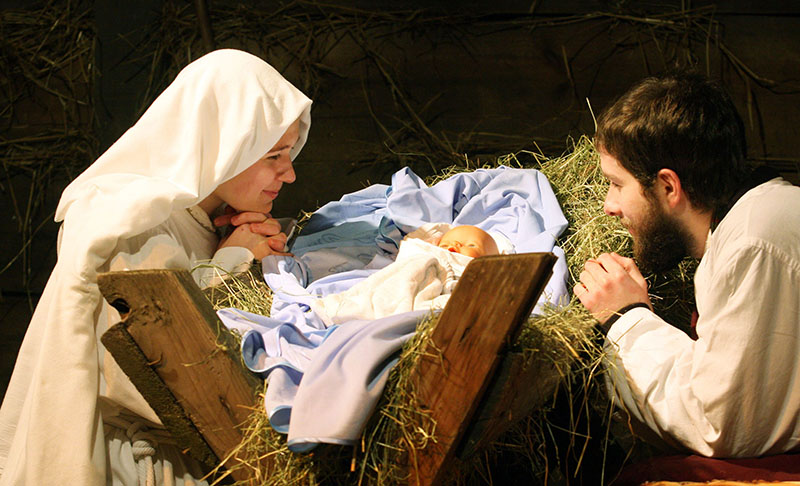
A live nativity recreation held annually by a Franciscan church, photo: Anna Kaczmarz/Dziennik Polski/Reporter