In the next parts even more myths come up, but Nowicki patiently explains their source and gets the meaning straight. The Sociological Record owes its title to a particular professor. Rydet herself, as it turns out, had no idea how to call the project, so she happily agreed to the scholar’s concept. This way she hoped to conjoin photography and erudition. Nowicki quotes one of Rydet’s old friends:
Some professor from Katowice came up with the title, and Zosia liked how scholarly it sounded.
However, the author notices that the adjective ‘sociological’ doesn’t really fit here. Rydet’s work does, indeed, flirt with ethnography or anthropology, but it is far from being sociology. Why? The photographer didn’t do research on a representative sample. In one village she would take several dozens of photographs, and bring just one picture from the other. She travelled through Poland selectively, limited by her pension and age. This is why Nowicki decided to put just two words on the book cover: Rydet. Record.
He zaps the monument constructed by numerous critics, saying that the greatness of Rydet’s project is by no means based on a sociological approach.
In the photos of Record, a human becomes part of the scenography and is like a mug, chair or a tiled stove – a still, static, immanent part of the room.
Struggling with matter
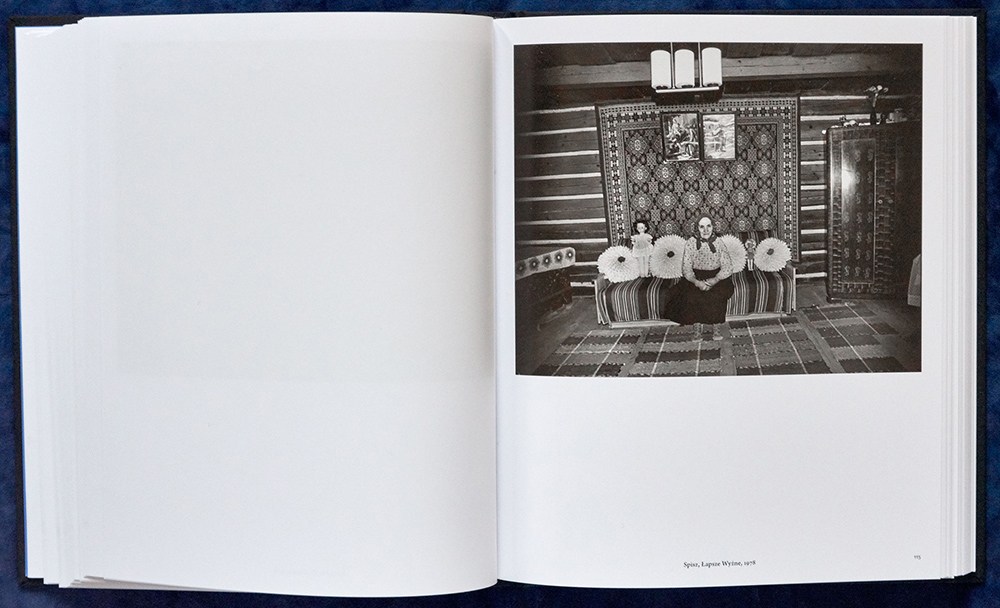
Spread from the book Zofia Rydet. Zapis socjologiczny 1978-1990 [Zofia Rydet. The Sociological Record 1978-1990, author: Wojciech Nowicki, 2016, published my Museum in Gliwice
Nowicki also sincerely analyses the artist’s technical skills. He notices her flaws. Overexposed photographs she would later try to rescue in the darkroom. Broken perspective, diverging from the initial idea, giving in to the temptation of photographing everything. The author points out Rydet’s imperfections like a professor does to a student during an exam. Halfway through the introduction it may seem like Nowicki didn’t even like Rydet too much. As if her craft and approach irritated her. But it’s enough to turn a few pages.
At the end of the text, Nowicki explains and justifies all of these imperfections. He recaps:
Yes, the perspective is messed up, the flash doesn’t work the way it should, but in each picture just the thing that is crucial to see catches the eye.
It turns out that in his strictness and honesty Wojciech Nowicki builds up a new image of Zofia Rydet. The artist, who was previously referred to as a mythical figure, suddenly becomes a real human being. She’s old and tired, she travels to places where she has a friend or an opportunity to stay at, she uses only one small flash, because her tired joints wouldn't be able to carry a dozen kilos of additional equipment.
At the top of things, from the introduction to the world of Record emerges a relentless Rydet, who unyieldingly visits more and more houses. Although some take her to be a weirdo, Rydet is truthful to herself. She values the message more highly than the means of expression. The author quotes the photographer in the introduction:
I live it and I forget about everything else. It works like opium.
One percent
When Zofia Rydet first set out to the Polish countryside to depict its inhabitants, she was almost seventy. At that point, she already published the album Little Man which granted her recognition and a position in the world of contemporary Polish photography. During her journey, the artist took over 20,000 negatives. Wojciech Nowicki chose less than 200. His is selection is, however, masterful, allowing the viewer to both feel the vastness of the project and its unevenness. As Nowicki explains in the introduction:
I came across a photograph from The Sociological Record accidentally, then I saw another picture, then another, and I was engrossed by them like a child is engrossed by music, or a book read at night under the sheets.
This fascination gave rise to faithful representation. Although the album comprises just one precent of all the photographs taken as part of Record, its an unusually accurate choice. In a way, Nowicki gives the control back to the author herself. He doesn’t include the grey scans available on the Zofia Rydet Foundation website (zofiarydet.com), but images altered by the artist. There is not greyness or perforation scanned by a machine. The photographs are framed and developed by Rydet herself.
The rural and urban interiors from a several decades back are interpreted by the author as if she had planned the book together with Nowicki. They together show people surrounded by the material possessions they’ve been accumulating their entire lives. The models are surrounded by objects serving as proof of their social status. These include TVs, pictures of Christian saints, mugs, carpets, clothes, or photographs of their spouses.
Zofia Rydet in ultramarine
Witold Siemaszkiewicz is responsible for the visual layout of the work. He chose the intense hue of ultramarine as the main motif. It’s hard to image Rydet herself in colour. She created in black-and-white and she was also depicted that way. The intense colour gives the publication a modern form. The album is very vivid: black jacket made of chalk overlay paper, big sans-serif font, and inside: over three hundred white pages on which subsequent photographs from Record can freely resonate.
At the end of a book Nowicki included a timeline of Rydet’s life, illustrated with portraits of her, documents, book covers, and fragments of her notes. The chronological record doesn’t, however, end with the artist’s death in August of 1997. It continues, up until today.
The album Zofia Rydet. The Sociological Record 1987-1990 is a complete work. History is connected with modernness, just like Nowicki’s voice is connected with the voice of Rydet, becoming its best advocate.
Originally written in Polish by Dagmara Staga, translated by NS, February 2017.
