In Toksymia, Rejmer presents the life stories of a few inhabitants of Praga Południe (the less modernized part of Warsaw which has recently been experiencing intense gentrification) whose paths cross. Yet, the secret link between them is their entanglement in toxic, deadly relationships with their loved ones. Critics have mentioned that Polish contemporary literature had not seen such a concentration of macabre and ugliness, and, moreover, humour in years - thanks to which the story turned into a terrifying but nevertheless playful grotesque.
Toksymia was published by Lampa publishing house, which was responsible for Dorota Masłowska's famous début back in 2002 (White and Red). These two novels have several things in common: they reveal their authors’ interest in the so-called Poland B (the unofficial term used to refer to the economically less developed part of Poland), the lives of the lower classes, and the ‘world of asbestos and dirt’, whose representatives (the novels’ characters) missed the benefits of the political transformation of the 1990s.
Rejmer said about the origins of her novel:
If we live in the era of the abundance of diaries written by celebrities, babysitters, plain Janes and dancers, where everything is presented as ‘rich’ then it also seems legitimate to write about the ‘needy'
In Toksymia, the interest in the ‘needy’ is related to the parody of the media image of social exclusion. That is yet another – besides the creative, stylized language – link between Rejmer and Masłowska.
An ugly book about ugly people
Toksymia shocks with images of the macabre, abominable ugliness present in everything: people, places, landscapes and internal monologues. Yet, this ugliness is not a fantasy:
Many people read Toksymia and say: Yuck! What an ugly book about ugly people and ugly places, meanwhile three quarters of this novel is built on ‘photographs” of Grochów, on things which I saw, heard or that I was told – said Rejmer in 2010.
Toksymia is indeed filled with pictures of ugliness in all its abhorrent richness, affecting all of the human senses:
At the end of the tram, Ada sticks to the handrail. Where to look, what to glance at? Sweat, like white worm grubs, crawls on the bald head of a man standing nearby. A group of young gypsies, lively and rumbling, shout at each other, one of them throws pieces of a song into the air. Ada smiles at her own luck: she's standing in the least stinky place.
Even death in Toksymia is presented as ugly. The obsession with death seems to be one of the most characteristic features of Rejmer’s debut.
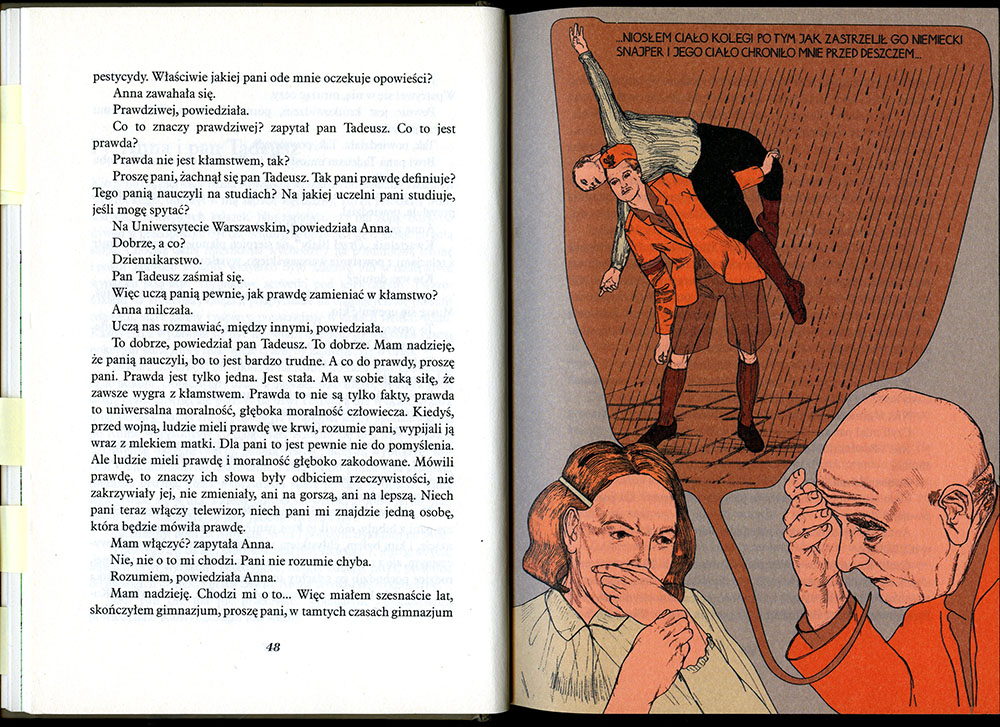
Małgorzata Rejmer, Toksymia, Polish edition, illustrated by Maciej Sieńczyk
Toxicity and exclusion
Ugliness in Toksymia even sneaks into people’s relationships. They are stigmatized by psychical violence and suffocating oppression which cannot be escaped. A husband is his wife’s oppressor, a father nags at his daughter and an aged insurgent hero stalks his student.
If ugliness is the element of Toksymia, then toxicity is the most important metaphor and the key to the novel’s reality: relationships are toxic – literally (see Ada who poisons her father), reality itself seems to produce a toxic miasma which poisons and imprisons them in the vicious circle of the past (by thoughts, language and habits) and exclusion, from which there is no escape.
The Polish edition of Toksymia was illustrated by Maciej Sieńczyk. It seems fair to say that the artist's surreal and macabre style matches the social horror of Toksymia perfectly – possibly delivering the ultimate depiction of Rejmer's Toksymia.
Author: Mikołaj Gliński, January 2014, Translated by W.O., April 14th 2014. Excerpt from the book translated by Olga Drenda.
