These are practical questions, which could be easily answered with help of the internet, however it is much better to hear them first hand. After the first round of questions, Jeziorek turns to the interviewee:
It was an impulse, you arrived here. What happened next?
The conversation departs from the technical facts related to the possibility of infection and the doctor's work. They get into the otherwise avoided topics, like the problem of marriage between lepers, or the difficulties with sending their children to schools. One of the excerpts from the conversation inspired the book's title:
He just looks at him like through the glass. He can't see or hear. That's what it's about. It is unimaginable. The lepers are imperceptible. Invisible.
The doctor's tale is concluded with a short text by Father Marcin Iżycki, who states in the final paragraph:
The problem of leprosy in the 21st century, of a disease that should have long ago become just part of the history of medicine, is a great scandal and accusation. I would like to express my gratitude to everyone who supports the missionaries in their service for the lepers, as well as the missionaries who devote their skills, knowledge, time, life, and most of all their love, to the diseased.
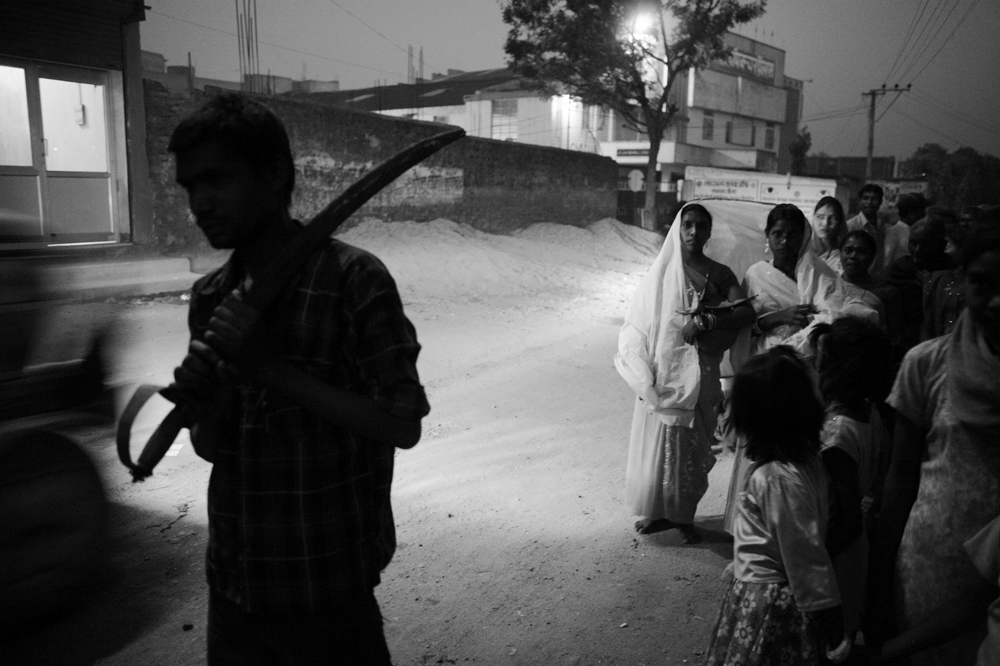
Jeziorek selected and edited the photographs in collaboration with Maciek Nabrdalik and Adam Lach. The arrangement is virtually ideal. The cover photo shows a hand of a little girl, drawing an outline of a silhouette on the sand. A few ambiguous photographs at the beginning act as an introduction to the reality of the leper camps in India. One will find men combing their hair in front of a mirror, girls dancing in an empty school room, a man rolling up clean bandages, and animals accompanying the residents of the centres. Each page with a photograph is followed by a white sheet stating the name of the town in which it was taken. A picture, a breath, a picture, another breath.
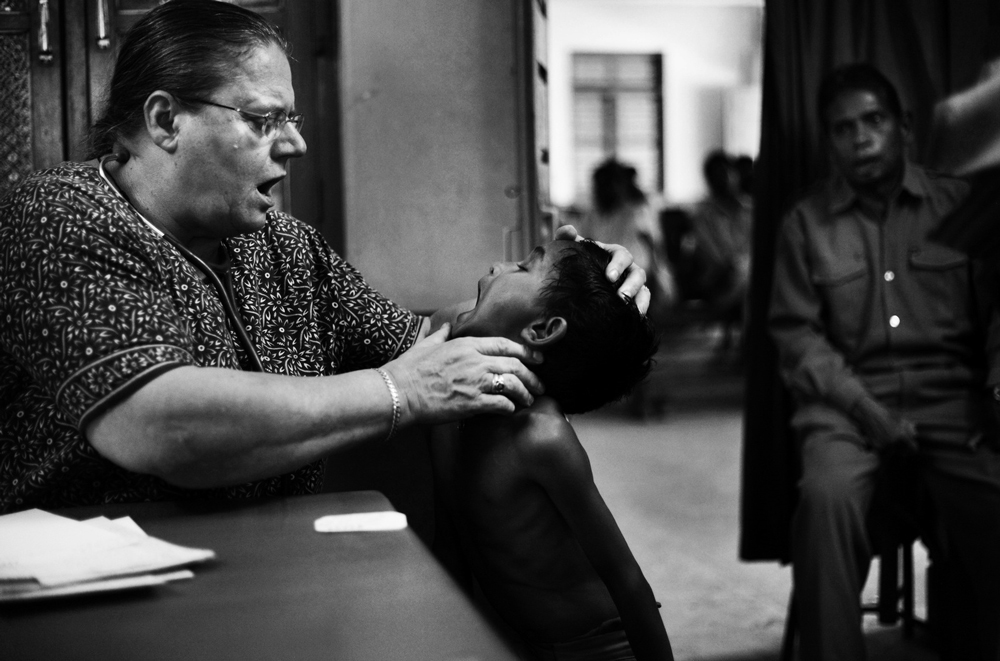
The Jeevodaya Social and Leprosy Rehabilitation Centre in Gatapar, Raipur District, India, photo: Maciej Jeziorek / Napo Images
Through the Glass does not overwhelm with the physical suffering which is normally associated with leprosy. Maciej Jeziorek's photographs are about ordinary life, even if it is life tainted by rejection, about social ostracism, and existing in a niche and a void.
The album's layout, designed by Kasia Kubicka, reflects the problems raised in the interview with Helena Pyz. It offers room for reflection over the problem of leprosy, as well as a lot of solitude that haunts the lepers.
One hundred and twenty pages, thirty-nine photographs, one conversation, three rehabilitation centres, and several thousand human stories behind them.
* Maciej Jeziorek returned from India with several project, two of which (Streets of India and Through the Glass) have been made public thus far. The next part of the photographer's work from India will be contained in the book 300 Days to Mars, to premiere later in 2015.
Sources: own materials, www.maciejjeziorek.com, Napo Images, Świat Obrazu, ed. D.S., 30.07.2015., transl. Ania Micińska, August 2015