CD Project’s The Witcher prototype was greeted frigidly by potential publishers. Originally, the protagonist was not Geralt but another witcher (rescued from harm by Geralt from time to time). Technical issues multiplied and so did the differences between the creators’ visions. The names of the people involved in the project changed like a kaleidoscope. The game, which originally was supposed to have a short development period, was eventually released after five years, at the end of October 2007.
The Polish premiere of The Witcher was a great event, and it received rapturous acclaim. It turned out that in spite of the turbulent development process, CD Projekt Red managed to tap into the source material in a much better way than the creators of the film. Sapkowski’s admirers were relieved. The game’s story is set just after the original saga’s finale. The protagonist suffers from amnesia and has no idea how he got back to the Witcher stronghold in Kaer Morhen, and after that, to the Wyzim city area. The Witcher was a breath of fresh air in the world of computer RPGs, up until then dominated by clear good and evil moral divides. The player was suddenly supposed to make a choice between two evils – often not even knowing which was the lesser one because the creators intentionally stalled the consequences of important decisions, so that the player could not simply load a previous save state and try another route. An additional appeal to the Polish audience (and the reason behind The Witcher’s success in Russia, for example) were local motifs – the landscape surrounding Vizima is evidently Eastern-European, with thatched roofs resembling those in Polish villages or mysterious stone statues, the so-called baby pruskie on the side of the road.
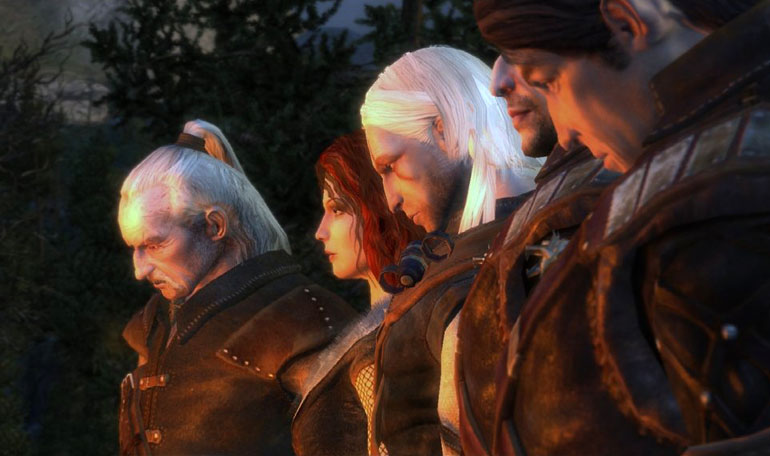
Still from The Witcher, photo: developer's press release
Reception of The Witcher in the West has been a little more cautious, primarily because of a not very successful English translation, which censored the crude language of the original, full of bungled wording and delivered by actors unsure of their lines. The reviewers also complained of numerous technical issues, effectively hamstringing the game, and cards depicting naked women, which Geralt collected after his amorous conquests. At the same time, because of its exoticness, bravery in displaying the darker side of a fantasy world, and boldness in talking about themes such as racism (which other games kept at a distance), The Witcher started to gain the acclaim of being an unpolished albeit fascinating game – a true rarity for the genre’s connoisseurs. When the game’s expanded edition was released, improving on the English version among other things, The Witcher was ready to conquer the world.
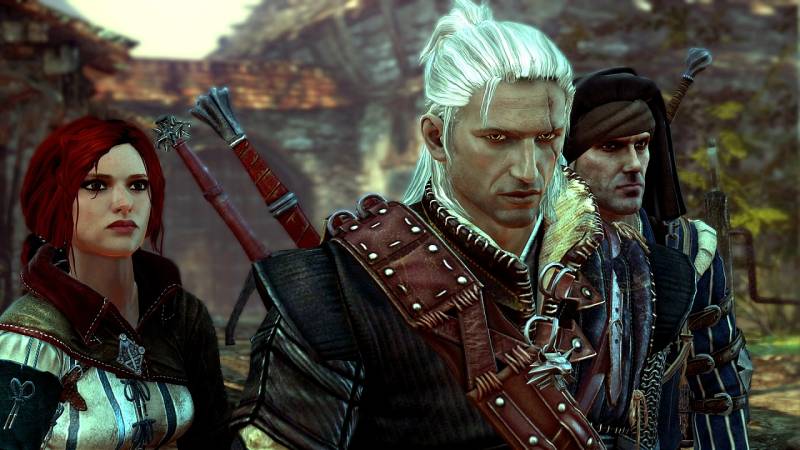
Still from The Witcher 2: Assassins of Kings, photo: developer's press release
The second instalment of the series, Assassins of Kings (2011), was clearly more oriented towards English-speaking players. Folksy, Slavic vibes were replaced by more universal fantasy conventions. The story, which in the first game clearly showed signs of a difficult development process, got a lot more structured. Geralt, who in the first instalment saved Vizima from a murky organization called Salamandra, now defends several kingdoms against a mysterious murderer killing succeeding kings. The direction in which the web of complicated political intrigues evolves depends on the choices made by the main character – a multi-track story which greatly differentiates the second Witcher from other cRPGs. It reaches so far that the players playing out a particular route would not be able to visit some locations at all – unless they start anew and pick another direction.
The third instalment, Wild Hunt (2015), is the most important release in the history of Polish video games, but also one of the biggest international hits in the difficult and costly genre of RPGs. After the second game, intimate and limited only to a few key locations, Wild Hunt throws the players into a vast, open world divided into a few areas full of mountains, forests, villages, and cities (the biggest one of them, Novigrad, marvels with its size and diversity). While creating such a huge space, CD Projekt Red stepped into one of the most demanding video game formulas, and even though the company did not have any previous experience in the field, it performed flawlessly. In Assassins of Kings Geralt preoccupied himself mainly with politics (which, as some critics said, was too overpowering), but the story of Wild Hunt treats it mainly as a background for more personal motifs – Geralt’s chase after his step-daughter and the rekindling of a romance with an old flame, the sorceress Yennefer. Perhaps it was exactly this combination of the game’s epic momentum and its focus on very humane, often tragic stories of the characters are the biggest achievements of the last part of the trilogy. One of the most memorable fables in the game is that of the Bloody Baron – a local tyrant demoralised by war, who flounces between his brutality (stoked by alcohol) and love of his wife and daughter (sometimes toxic and sometimes touching). There is no happy ending to this tale, just as in the story of the land conquered by subsequent lords, where the Baron tries his best to govern.
