The themes of pregnancy and motherhood have often emerged in Agnieszka Holland’s work. It is worth mentioning that the excellent Jesus Christ’s Sin (1970), filmed by the director during her university years in FAMU Film School in Prague, told the story of a woman who was supposed to bear an angel’s child, but accidentally squashed the emissary with her belly. Holland came back to the pregnancy motif in her feature debut, but this time she wanted to show the issue in a non-religious social context.
Sunday Children’s first scene, showing a glimpse of a wedding party, is very characteristic. The newly-weds – Andrzej (Ryszard Kotys) and Barbara (Zofia Charewicz) – are shown in the background, from behind the backs of guests sitting around the table. Such a shot has an explanation – there is no place for intimacy, as the event has the nature of a collective ritual. The lyrics of a folk song intonated by the groom’s mother during the ceremony are symptomatic: ‘Long live, long live the newly-weds / Once a daughter, once a son to make it fun’. As it later turns out, the life of Sunday Children’s characters has no spontaneity, it is based on signing off subsequent parts of their biography and fitting into the social scheme: marriage after three months of acquaintance, a flat together after a year, and then a child. The problem is that the woman has issues with fertility and pregnancy is not an option. All that is left is adoption, but there are two problems. First – one has to bypass the prolonged institutional procedures. Second – it must not be known that Barbara is not the mother. The couple decides to make a deal with a young single mother (Krystyna Wachelko-Zaleska) to ‘buy’ her unwanted child.
In Sunday Children, Holland takes the context of maternity at social gunpoint and points out that pregnancy is often treated as an obligation or a task which the wife must fulfil to attest to her womanhood. To conceal her ‘lack of value’, Barbara fakes her pregnancy in front of acquaintances. She hides a bundle of material underneath her clothes to imitate an enlarged belly. Holland acutely observes characters who do not even try to stand up against the sanctified traditions and meekly accept the terror of social norms. Watching the character simulate pregnancy is amusing but also demeaning, making viewers reflect on the idea of having a child. Pregnancy in Sunday Children becomes a spectacle – a phenomenon defined mostly by cultural factors. The mother is the actress here, society is the audience and it is tradition that writes the screenplay.
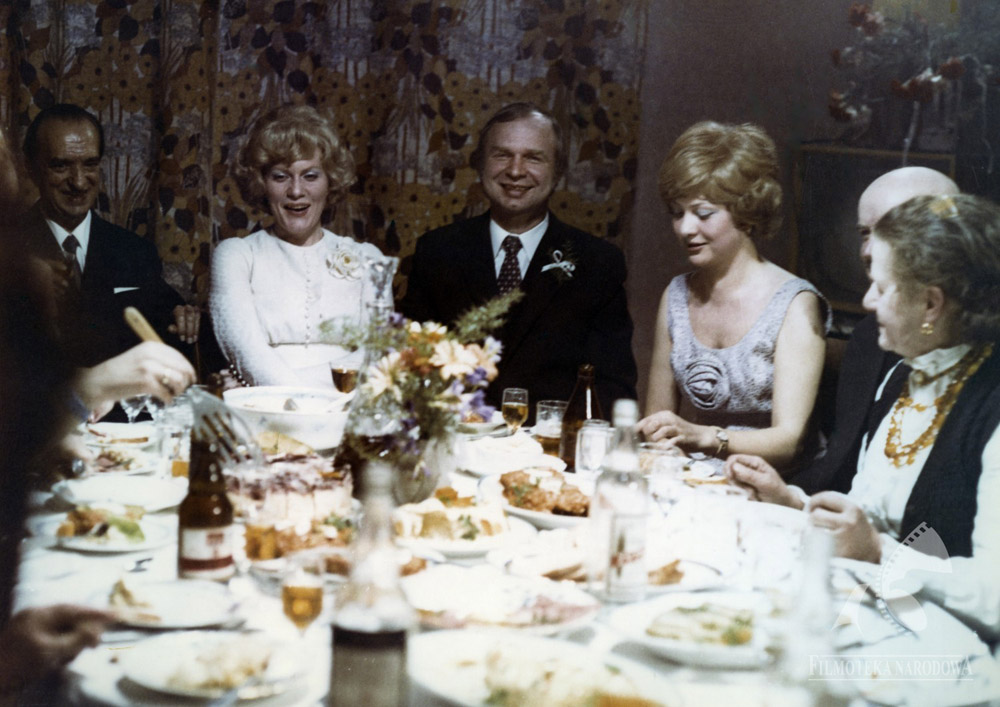
Sunday Children by Agnieszka Holland, 1976, photo: Filmoteka Narodowa / fototeka.fn.org.pl
Holland’s film is often classified as part of the Polish cinema of moral anxiety, which deals with the later era of Edward Gierek (a Polish politician during the communist regime) in a bitter way. The director stigmatises the ineptness of the bureau, which only makes adoption more difficult, but also the general lack of sensibility and intolerance to all that is different. Children from the orphanage are objectified both by biological and foster parents and they are usually scapegoats in institutions such as schools. Although Sunday Children is not devoid of bitter humour, the image of society emerging from the film is remarkably grim. The characters, dealing with their rough everyday life, do not have time to reflect on their feelings or needs. Holland lays bare the ugliness of Gierek-era Poland without a second thought. The deliberately crude film style – shot with a handheld camera, barely audible sound, sloppy montages, and unattractive interiors – makes the feature more realistic and brings it closer to non-fiction. However, Sunday Children is not only a documentary of its era; it could be also read as a universal critique of social life which limits and overwhelms the individual. It is worth noting that Holland would later retrace the pregnancy theme again in Rosemary’s Baby – a mini-series about a woman supposed to give birth to the Antichrist.
Sunday Children, Poland 1976. Directing and screenplay: Agnieszka Holland. Cinematography: Jacek Stachlewski. Scenography: Wojciech Krzysztofiak. Cast: Zofia Charewiz (Barbara), Ryszard Kotys (Andrzej), Krystyna Wachelko-Zalesko (Jolanta), Dorota Stalińska (Jolanta’s friend), Krzysztof Zaleski (Marek) and others. X Film Group. Colour, 73 minutes.
Originally written in Polish by Robert Birkholc, September 2017, translated by Patryk Grabowski, October 2017.
