Today’s designers operate in an entirely different world than their predecessors. And though the Polish design tradition of the 1950s and 1960s is full of remarkable achievements, the fact remains that it was a phenomenon largely unknown outside of Poland. Conversely, Polish designers today are part of a global circuit, educated at the world’s foremost institutions and working in collaboration with reputable international brands. They deftly combine handicraft tradition with cutting-edge technology and local inspiration with modern aesthetics. Polish Design: Uncut attempts to capture the era in which Polish designers joined the forefront of the international design scene for good.
Authors Czesława Frejlich and Dominik Lisik employ a formula that combines the attributes of an album, an encyclopaedia and an analytical volume. They have grouped the designers’ works into seven categories: furniture, means of transport and public space, domestic and special-use items, lighting; glass and ceramics, textiles, clothing and toys; and experiments. Each entry includes photographs, a short description of the project and a bio of the designer. Among the items featured are Oskar Zięta’s famous Plopp "blow-up" stool, Agnieszka Bar’s "On Finger" tableware set, rugs by Joanna Rusin and Agnieszka Czop and sofas by Tomasz Rygalik. In all of their diversity, the designs compiled in the book form an extensive picture of Polish design in the 21st century in a global context: as green as the Malafor duo’s "Trunk" stool, as unafraid of experimentation as Bogdan Kosak’s "Alfa" urns, as comfortable as Renata Kalarus’s sofas and chairs. And, just as importantly, many of these whimsical forms make us smile, Karina Marusińska’s ceramic "Cores" or Bartosz Mucha’s gold-bar-shaped brush.
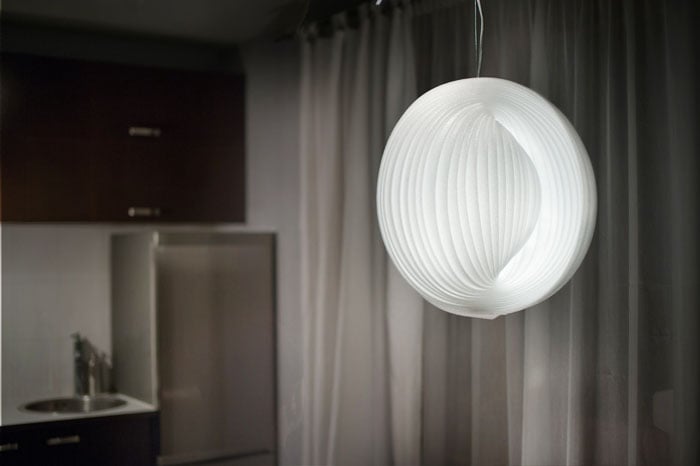
Daria Burlińska, Onion lighting decorations, 2007,photo: Przemek Szuba / www.przemekszuba.pl
As for state of the art design, Agnieszka Fujak's FELIX 8X8 presents a an air emergency rescue vehicle designed in 2011 and produced by the Warszaszek ISS company. It won Design of the Year 2012 awarded by Poland's Ministry of the Economy. It combines all the necessary functions of such a vehicle in a futuristic form that could easily have been inspired by the Transformers series. Fujak first began working on the concept with fellow student Sebastian Spłuszka as part of their M.A. project at the Department of Industrial Design at the Academy of Fine Arts in Kraków in 2011. The concept combines new solutions to make the job of rescue workers easier, while presenting an entirely innovative form that mimics the sturdy shape of a military transporter.
The book is fully illustrated with photographs by Przemek Szuba presenting the featured designs in unexpected settings. Szuba’s approach is a departure from the deliberate, idealized visualisations we encounter in catalogues – as the "uncut" in the title implies – presenting Polish design "without touch-ups".
In addition to the encyclopaedic/thematic arrangement, the book contains interviews with 12 leading Polish designers. Here, we are offered insight into their working methods as well as their opinions concerning what is good and what is not so good in contemporary design. Tomasz Rygalik points out the pitfalls of making design overly dependent on technology and Renata Kalarus discusses the problem of Polish manufacturers’ limited involvement in collaborating with designers. Maja Ganszyniec and Krystian Kowalski of the Kompott studio compare their experiences of working in Poland and abroad.
Polish Design: Uncut will be published in English by the Adam Mickieiwcz Institute in the summer of 2013, with a Polish language edition published by 2+3D Publishing currenly in the works.
Author: Paulina Kucharska. Translated by: Szymon Włoch. Edited by Agnieszka Le Nart
- Polish Design: Uncut
Authors: Czesława Frejlich & Dominik Lisik
Photographs: Przemek Szuba
Layout: Kuba Sowiński
Translated by: Søren Gauger
Published by: Adam Mickiewicz Institute, Warsaw 2013
Source: Adam Mickiewicz Institute, own materials
19.03.2013