And not only about that or maybe – most of all not about that. Naród zatracenia / Nation of Perdition is not so much about the Litzmannstadt Ghetto, as it is a study about the nonsense of suffering and the enormity of Holocaust. But let’s start at the beginning. The narrator of the comic book is Dawid, a boy who grew up in Jewish Łódź, who is not sure of his identity and feels like a stranger everywhere. His foster sister Esterka found him, dirty and crying, in a crib outside of her door.
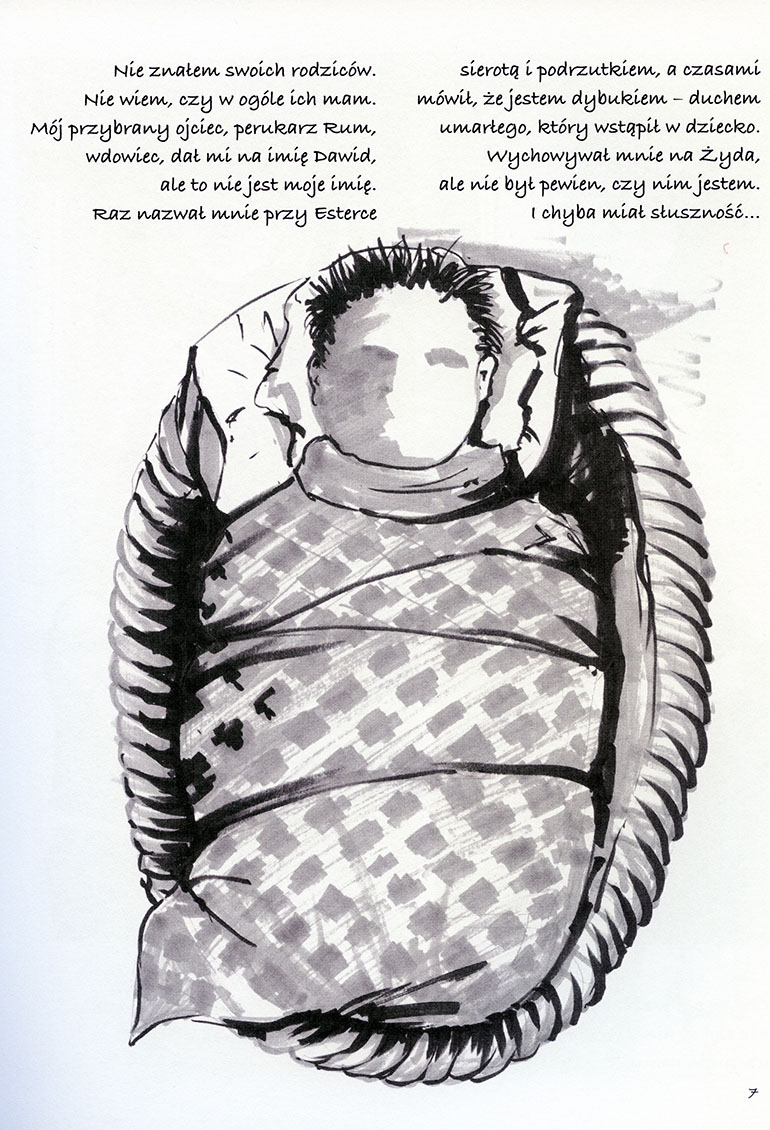
A panel from 'Nation of Perdition', photo:
promotional materials
It’s a story similar to that of Moses, but the Biblical prophet’s crib was looked after by his sister Miriam, who wanted to be sure that the baby is in the right hands. In the end the Decalogue’s recipient was fed by his own mother. Little Dawid had no such luck, as he said: 'he never tasted women’s milk'. He was educated to be a Jew by a solitary wigmaker Rum, and was given a little bit of family warmth by his foster sister. Those were difficult times for Jews (though the 1930s are now often turned into a myth). During an anti-Semitic demonstration the windows in the building where Dawid lived, were knocked down and a fire was lit – Dawid’s innocence was literally burnt, together with his ‘family’ house and his foster father. The young vagabond was separated from his sister and found himself in an orphanage. Since then, he was always lonely. Although he could read and write, he wasn’t able to say a single word. He had no friends and felt more and more alienated, even invisible; he was assured of his existence only by his own consciousness. And then the war started:
War! How exciting was the sound of this word, that I knew only from the Old Testament and schoolbooks.
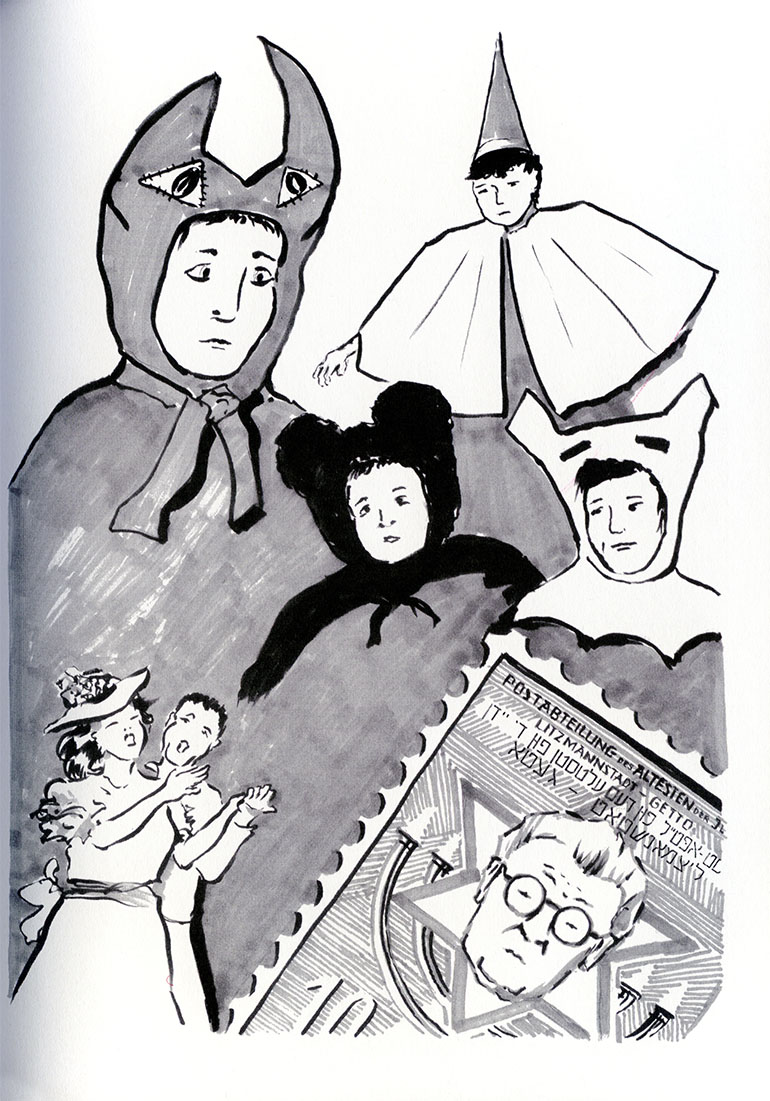
A panel from 'Nation of Perdition', photo:
promotional materials
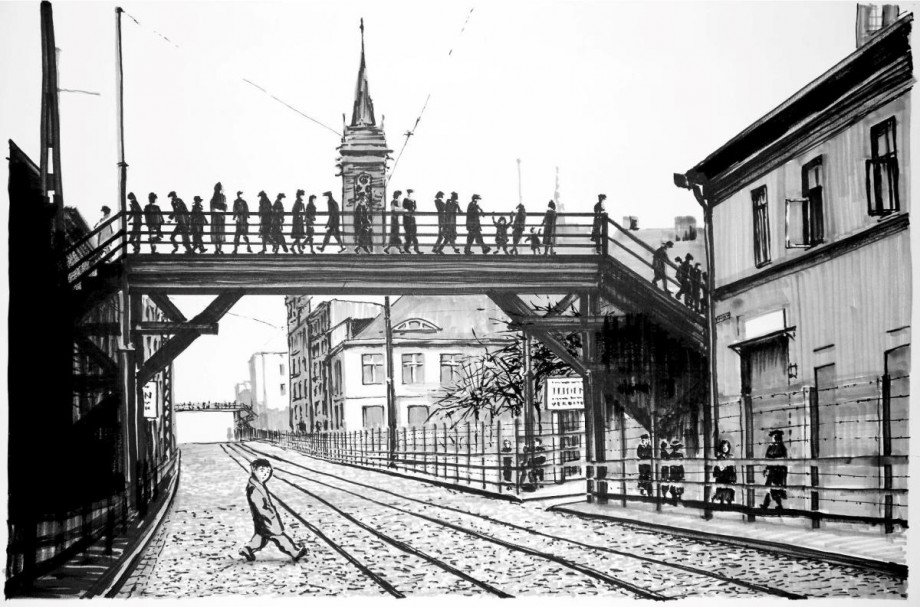
Germans killed people and destroyed synagogues, robbed shops and apartments, the Jews could not walk on Piotrowska street (which was now named Adolf Hitler Straße), they couldn’t even step into a park. One night Dawid was woken up by a total silence. It turns out there was no one in the orphanage apart from him. All children were closed in the ghetto (“a topsy-turvy exodus”). All but one invisible boy, who was wandering alone trough a destroyed city. He stole, unpunished, slept on the streets, and – what’s more surprising – he could go in and out of the fenced and guarded ghetto.
Shoah through a comic book
Not that long ago telling a Shoah story in a comic book was considered a taboo (at least in high culture, since pop culture has been dealing with this subject for a long time: it’s enough to mention Holocaust narratives in Marvel’s X-Men and an infinite mass of pulp impressions). It was Art Spiegelman who broke the silence, when he wrote Maus and courageously re-worked the moralizing convention of Aesop’s fables. In his story the Jews turned into mice, Germans into cats and Poles into pigs. La Fontaine, when writing about foxes, goats and frogs, instructed the reader, gave practical advice that can now be found in self-help books and newspapers – Spiegelman couldn’t give advice to anyone. Other stories about Shoah were more realistic. Holocaust’s children told stories of their families (Miriam Katin in We Are On Our Own: A Memoir, Martin Lemelman in Mendel’s Daughter, published in Polish by Polin Museum.
Maus is a word-driven comic book
– said Spiegelman in an interview, and this sentence could be applied to most comic books about Holocaust that I know, also to Naród zatracenia (some even speak of ‘non-fiction comic books’). Where can Świerkocki and Sołtysik’s novel be placed?
A panel from 'Nation of Perdition', photo: promotional materials
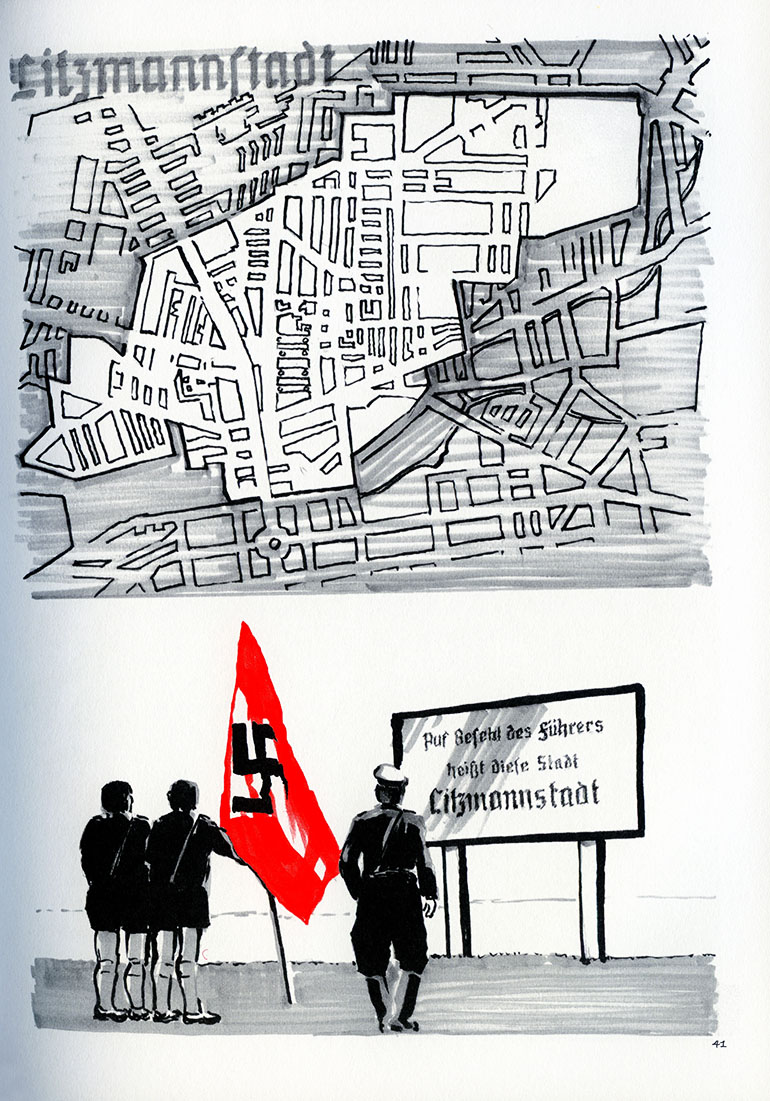
Sołtysik’s drawings are monochromatic, sometimes underlined with red, which only reinforces the message of the pictures, their dramatism; it also has a more important function, when from Litzmannstadt we move to the metaphorical space of History. Actually, it’s there where the whole book takes place. In Naród zatracenia we won’t find family memories or complicated human stories: what is presented here, are unexplained processes and pondering upon the nonsense of suffering. Already David father’s name can lead us to this: Rum is an omen of Chaim Rum(kowski), the president of Jewish Seniority of Litzmannstadt, who directed the organization of the Łódź ghetto (he was accused of collaboration with the Germans, but believed he fought to rescue the Jews and probably died in Auschwitz). Dawid’s sister is Esterka, and the president’s secretary’s name was Estera Daum. She survived the war and her memoirs were written down in the 1990s by Yad Vashem. In 2008 they were turned into a novel by Elżbieta Cherezińska.
A panel from 'Nation of Perdition', photo:
promotional materials
A few pages of the comic book are filled with German proclamations, city plans, archival photographs (like the famous picture of Rumkowski speaking on the so-called “fire-fighter square”), but we won’t find much of the ghetto area here, and it’s an absence I felt deeply. Our narrator is invisible and can freely walk out of a prison, where 200 thousands of people were held and where 40 thousands died.
I looked at it all as if it was a film in the cinema where Esterka once took me. I watched – oh yes, I watched! – cruelty, injustice, hunger, poverty, sacrifice, helplessness and death. People turned into beasts of burden. Dogs who had better lives than people, because at least they were fed by the German soldiers. It was better than cinema – said Dawid.
Apart from his own observations, he also references Tora, which he talks about as Old Testament. Is he so alienated that decided to call the book differently than wigmaker Rum, or did the authors decide on a term closer to the Polish reader? He reads the Book of Numbers, which – according to tradition – was written by Moses, a prophet whose childhood was similar to that of our Dawid.
And they warred against the Midianites, just as the Lord commanded Moses, and they killed all the males. They killed the kings of Midian [...] And the children of Israel took the women of Midian captive, with their little ones, and took as spoil all their cattle, all their flocks, and all their goods. They also burned with fire all the cities where they dwelt, and all their forts. And they took all the spoil and all the booty—of man and beast. Then they brought the captives, the booty, and the spoil to Moses […] keep alive for yourselves all the young girls who have not known a man intimately.
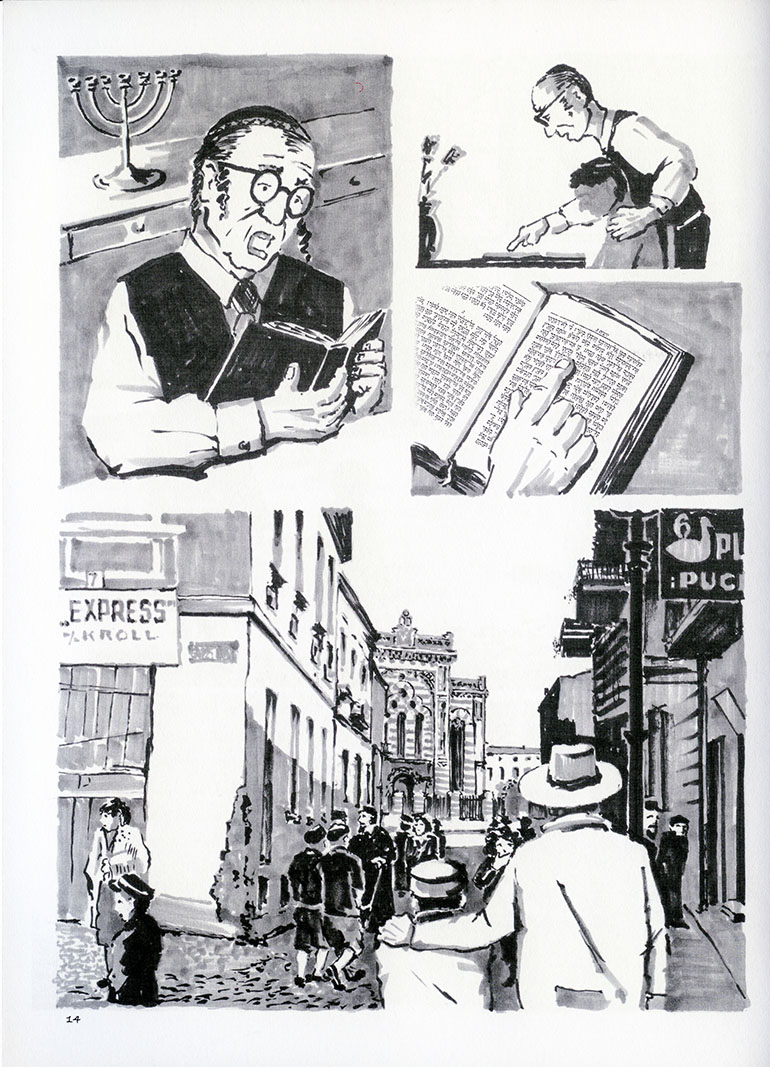
A panel from 'Nation of Perdition', photo:
promotional materials
Why does he read Bemibdar, the Book of Numbers? It’s unclear, maybe he searched for an explanation of his future deeds. The Book of Numbers says: ‘Do not accept a ransom for the life of a murderer, who deserves to die. They are to be put to death’. What would happen if Dawid read Tora instead of the Old Testament? In 1956 in Stimmer der Zeit, a shocking short story was published as an authentic account of Josel, a son of Josel Rakower from Tarnopol, an ardent emulator of Rabbi from Góra Kalwaria and a descendant of the great tzaddiks from the Rakower and Meisel families, who was allegedly writing, while looking at the burning ghetto of Warsaw.
The Sun cannot know how indifferent I am to the fact that I won’t see it rising tomorrow – wrote Rakower. – It’s not true Hitler has something animalistic in him, I truly believe he is a typical child of modern humanity. – It seems possible Dawid could repeat his words about Hitler, but for sure he couldn’t say: ‘I am glad to be a part of the unhappiest nation on Earth, of which the Tora presents the highest moral value and the most beautiful laws’.
The question is, whether Josel Rakower could call this nation the nation of perdition.
My ideas came from a number of photographs and a few films – said Spiegelman. – I am condemned to a lack of authenticity. Aside from that, I fear that if used people, it would be very old-fashioned. It would seem a weird plea for understanding or a call to ‘remember the 6 millions’ and that is not what I wanted.
One of Maus boards shows Artie sitting by his desk. Although he was born in the United States, on free land, he still shows himself as a mouse or rather as a man in a mouse-mask. III Reich doesn’t exist anymore, but he is still reduced to a racist stereotype and fights its trauma. On one of the last pages of Naród zatracenia we see Dawid who lays on a bad and changes the channels of his flat-screen TV. He’s not a child anymore, but he’s not old. He’s an unhappy teenager and half-naked neo-Nazis look at him from the screen. ‘Rember the 6 millions’? ‘History can repeat itself?’, ‘Is this a man?’
I feel as if Świerkocki and Sołtysik jumped on a trampoline: from the individual trauma to mechanisms of history, from cogitation on humanity to the world after Shoah. The only (?) result is death and violence.
Naród zatracenia / Nation of Perdition, text: Maciej Świerkocki, drawings: Mariusz Sołtysik. Published by the Marek Edelman Center for Dialogue, Łódź 2014.
06.11.2014, fl, translated by NMR, November 2015.
