There is something devious in the way the affair is depicted. On the one hand, she seems to take Curie’s side, showing the hypocrisy of Paris society, which viewed the scientist as a sinner and offender of social conventions. On the other hand, the director takes on the role of one of the gossipers, who, red-faced, watches the forbidden romance unfold. She does not even try to understand why the romance happened, what the romance means for the parties involved, and what it means for the couple. While watching the movie we cannot feel the bond between the lovers, we cannot understand their feelings and we cannot root for them. We are just passively passively waiting to see how the events unfold.
Parisian Grundyism
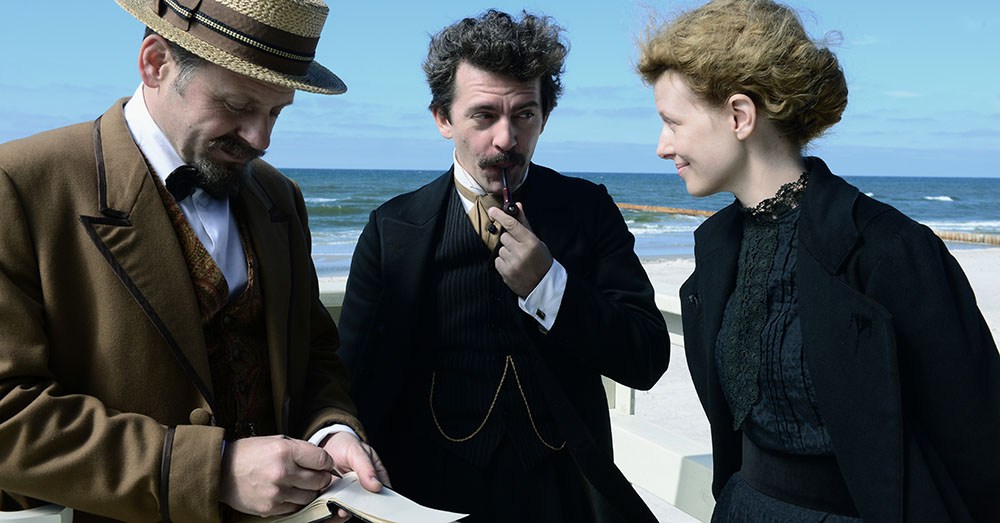
Still from the movie Marie Curie, directed by Marie Noelle, 2016. In the picture: Samuel Finzi, Piotr Głowacki, Karolina Gruszka, photo: Witold Baczyk/Kino Świat
Marie Curie is, finally, an emancipatory tale. It’s the story of an ingenious woman’s fight for recognition from the misogynistic world of academia. However, even that plot is not fully explored, because it cannot be. The movie is full of underdeveloped themes – romance, a family tale (the subplot about her father-in-law which got lost somehow), the story of a scientist, and a tale about freeing yourself from patriarchal society. However, with all these themes, it ends up being yet another predictable mass of pretty images.
If there is one thing worth watching the movie for, it’s Karolina Gruszka’s portrayal of the main character. The Polish actress, who is usually cast as an esoteric seductress, this time could prove herself playing a true, flesh-and-blood character, and she passed the test with flying colours. Gruszka’s Curie travels a long way, changing from a brittle wife and mother into a confident and empowered woman. The change is not explicitly stated in her words, but viewers can feel it in her gestures, face expressions and even the way she moves. The Polish actress indeed succeeded in creating a really convincing character despite all the faults of the screenplay. Her depiction of the chemist is shows a woman who picks a fight for her own sake.
However, even this brilliant and captivating performance cannot redeem the mediocrity of the movie. Marie Curie remains a film with unfulfilled potential, a very beautiful, but psychologically incomplete picture. Marie Curie, one of the most fascinating scholars in the history of science truly deserves a better, more thorough picture.
- Marie Curie, directed by Marie Noelle, cinematography: Michał Englert. Starring: Karolina Gruszka, Izabela Kuna, Arieh Worthalter, Charles Berling, Malik Zidi, Daniel Olbrychski. Release date: 3 March 2017.
Written by Bartosz Staszczyszyn, translated by AS, March 2017
