In March 2009 the contest for the design of the new facility of the Heritage Centre was launched. 52 architectural teams entered and eventually it was won by the Ad Artis Emerla, Jagiełłowicz, Wojda studio.
Despite the historical surroundings, the architects decided to place a cold minimalist cube in front of the cathedral. Although it formally stands out amongst the other buildings in the area, it seems to fit perfectly in context and integrates into the existing architecture.
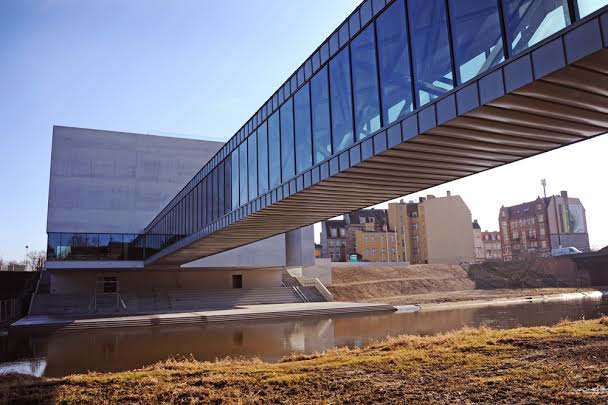
Porta Posnania, photo: Łukasz Gdak / courtesy of Porta Posnania
The designers linked the concrete paving stone and brick historic building of the cathedral with an illuminated bridge.
The Porta Posnania facility is cut through with a glazed aperture which points to the towers of the nearby cathedral; a few windows cut out in the concrete façades target the visitors’ sight at the most beautiful fragments of the area.
On the side by the river, the building was undercut so that it hangs above the water and leaves enough space on the ground for a promenade. The idea of the opening of the building towards the river is an essential idea of the project. Poznań, like many other cities in Poland, struggles to make use of the potential of its riverbanks. The designers’ hope was that Porta Posnania and its promenade will start the process of turning the city’s attention to the Warta river.
Poznań Porta Posnania is an extraordinary facility. It is the first institution which ‘interprets heritage’. It is a place where the history of Cathedral Island is told by multimedia and interactive devices. This unusual way of narration, without museum pieces, was designed by Tempora, a Belgian specialist in the field of exhibition design.
For this modern way of presenting history, the architects developed an appropriate setting. The interior of the building is as equally minimalist as its external shell; the hall and corridors are dominated by blackness - the floor is made of basalt plates and the walls are painted black as well. This bare space aims at stimulating visitors' focus on the exhibition. This exceptionally compact and coherently realised project is proof that a minimalist shape can be very attractive.
Website: www.trakt.poznan.pl
Source: press materials, ed.: NZ. March 2014, Translated by W.O., April 14th 2014
