In the second part of the 60s Kantor devoted a lot of attention to happenings. He organized and presented his first event of this type right after he returned from the USA, where he had been pursuing an artistic scholarship together with his wife Maria Stangret. In New York the artist had encountered the works of Allan Kaprow, a theorist and creator of performance art.
In December 1965 Kantor gave readings on American art at the Warsaw Zachęta and the Kraków Club of Plastic Artists. His first happening (some believe this was the first Polish happening ever) took place in December of the same year in Warsaw.
The title Cricotage stems from the name of Kantor’s theatre, Cricot 2, which was borrowed from the pre-war Cricot theatre of plastic artists. Some years later Kantor began to use the word cricotage to describe a certain theatrical form: a short play which was a kind of etude. The motifs which emerged in them were later often elaborated on by Kantor in his 'grand' performances.
Kantor’s first happening took place at the café of the Society of the Friends of Fine Arts in Chmielna street in Warsaw. He prepared Cricotage together with a group of artists and critics centered around the Foksal Gallery, which was being created at the time. Anka Ptaszkowska, Maria Stangret, Erna Rosenstein, Agnieszka Żółkiewska, Wiesław Borowski, Zbigniew Gostomski, Mariusz Tchorek, Alfred Lenica, Edward Krasiński, Krystyna Jarnuszkiewicz and Tadeusz Kantor himself were among those who participated in the happening.
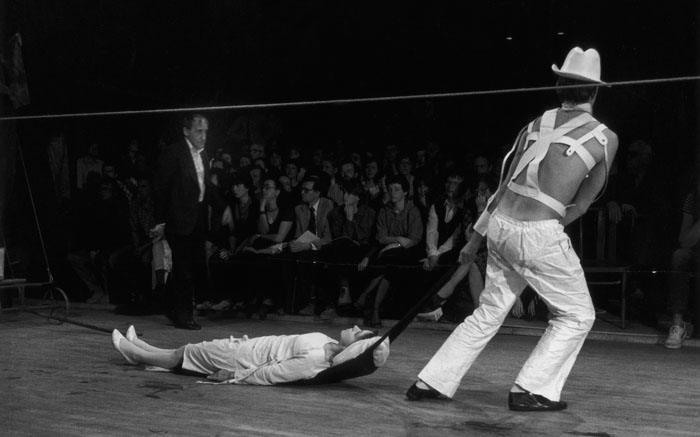
A photograph from the cricotage Where Are the Snows of Yesteryear / Gdzie są niegdysiejsze śniegi, the student club Stodoła, Warsaw, 2-4 May 1984. Sequence 8. An Ill-Timed Wedding / Niewczesne Wesele. Tadeusz Kantor, The Bride: Teresa Wełmińska, The Groom: Andrzej Wełmiński; photo: Jerzy Borowski; a photograph from the collection of the Centre for the Documentation of the Art of Tadeusz Kantor Cricoteka
The approximately one-hour-long happening Cricotage consisted of simple everyday actions such as eating, shaving and sitting. They were however deprived of their practical functions, they developed within themselves and through themselves.
To me the best material for creating a work of art is trivial, boring, everyday activities for which nobody has hopes – Kantor once said.
The particular activities weren’t logically linked to one another. They were given a new context – they were performed for an audience, for show, which caused them to become absurd.
During the happening Cricotage Mariusz Tchorek read one of his texts, making pauses and stopping from time to time. Kantor counted the time: 'Five minutes have past'. At the same time, he wrapped Maria Stangret in bands of paper. Anka Ptaszkowska was a 'contradictory person' (Tchorek’s expression), repeating the words “I’m sitting” over and over again, sitting on a chair then standing up.
In one of the corners of the room a woman was laying on a table. Coal was dumped on her. Next to the table sat three elegant men, who at a certain moment took off their jackets and ties, precisely soaped their faces and began to shave. Later the action of soaping began to affect the clothes and the objects surrounding the three men. Two other men ate pasta from a suitcase. Some woman constantly made phone calls. Somebody carried packages from one side of the room to the other…
The audience’s engagement in the happening surpassed Kantor’s expectations. Tchorek reminisced that:
At a certain moment Kantor left these activities in order to scold two intruders, who had seized the suitcase with the pasta and were throwing the suitcase’s contents around the room – this wasn’t part of the plan. Kantor didn’t accept the occurrence of this spontaneous activity. He reproached the two intruders.
This event and Kantor’s reaction are interesting in the context of how one may define a happening – the theoretical assumptions of various creators are slightly different. In Kantor’s happenings spontaneity was paired with meticulous preparation. The artist envisaged an improvisation, but one with a framework. It was possible that he considered unpredictable behaviours interfering with the structure of the happening as unacceptable.
Wiesław Borowski used the following words to explain the specificity and uniqueness of Kantor’s first Warsaw happening:
The happening Cricotage referred to the theatrical determinants of Cricot and at the same time presented a classic happening structure.
When Borowski was reminiscing about Kantor in a broadcast of Polish Radio he added:
His happenings were the only ones in Poland that mattered to me.
Author: Karolina Czerska, December 2014, Transl. M.K.
Literature
- W. Borowski, Tadeusz Kantor, pub. Wydawnictwa Artystyczne i Filmowe, Warsaw 1982
- T. Kantor, Metamorphoses. Texts about the Years 1934-1974 / Metamorfozy. Teksty o latach 1934-1974 selected and edited by K. Pleśniarowicz, pub. Ossolineum-Cricoteka, Wrocław-Kraków 2005
- T. Pawłowski, Happening, pub. Wydawnictwa Artystyczne i Filmowe, Warsaw 1988
- K. Pleśniarowicz, Tadeusz Kantor’s Theatre of Death / Teatr Śmierci Tadeusza Kantora, pub. Verba, Chotomów 1990
- Literary Finesses / Finezje literackie, a series of Polish Radio, 1997, http://ninateka.pl/audio/finezje-literackie-1997-tadeusz-kantor-odc-1
- Tadeusz Kantor: from the Archive of the Foksal Gallery / Tadeusz Kantor: z archiwum Galerii Foksal, edited by: M. Jurkiewicz, J. Mytkowska, A. Przywara, pub. Galeria Foksal SBWA, Warsaw 1998
