In Bound the player experiences two interrelated realities. One of them is completely ordinary, and the story consists of said woman walking to the nearby house. Whose house it is, and why it’s important to get there – these mysteries will be uncovered throughout the playthrough. What will also be discovered is her walk takes so long. The woman sits down on the beach every now and then and opens her notebook on another page. However, there is no text inside, nothing written down. There are only drawings there, child’s drawings. That makes this walk on the beach also a walk throughout childhood memories, not always cheerful, that the woman has to deal with before having a child of her own. Every picture awakens a memory from the past, and that is also a gateway into the second reality present in Bound. The story is completely different there: it’s a (seemingly) straightforward and archetypical. The protagonist – the Princess – is called for by the Mother to face the Monster who is terrorising her kingdom.
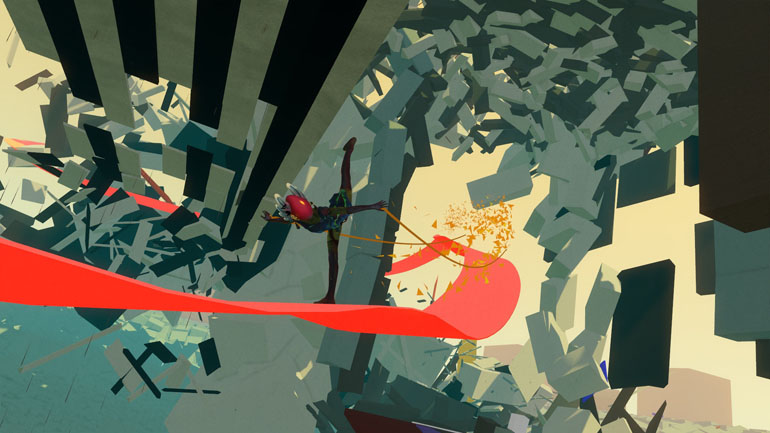
Bound, photo: promotional materials
These parts of the game, drawing from fairytale conventions, are its most important elements. The art style changes completely, abandoning any connections to reality. The world of the Princess is composed of simple, monochromatic, yet monumental blocks. These blocks are used to build even bigger structures, reaching as high as a few hundred metres above the ground. The creators of Bound in interviews before the official release often mentioned that they were inspired by the likes of Bauhaus, suprematists and De Stijl creators, and these inspiration are apparent in their game. The scenery, which takes after formal moderation of said inspirations, is not in any way incomplete or meager. On the contrary, Bound is a cornucopia of breathtaking visuals. It becomes even more stunning when played with Playstation VR. Getting cast into vast 3D plains of Bound feels much more impressive than many other VR apps that try too hard to feel realistic. One might think that a VR game focusing on grand, static forms may not be the best idea, but Bound’s enviroment seems surprisingly alive. Many design decisions point to Plastic’s past in Demoscene. Demoscene is a group of creators who aim to push the hardware they use to its limits with physics and effects that they employ in their creations. In Bound the player walks over an ocean made of thousands of cubes, and monumental walls vibrate, crumble and collapse as they are approached, just to immediately reassemble themselves a moment later. This constant movement is one of the reasons why you have to see this game not only in screenshots, but also in action.
The other reason to experience the movement in this game is the dance that the Princess performs. Bound, in its first drafts, was to be about a runner who utilises running as a way of coping with her turbulent past. This quick movement fits the game’s platforming conventions perfectly, as the hero has to traverse the terrain by jumping over haunting chasms, balancing on small ledges over endless pits and overcoming countless obstacles. When the whole runner idea was already far in development, the creators got interested in modern dance and noticed that although dance has accompanied humanity from the oldest of times there is not much of it in gaming. The runner became a dancer. The model for the Princess’s movement is a ballet dancer, Maria Udod, and the choreography is the creation of Michał Adam Góral. The only time when the game’s protagonist isn’t dancing is when she has to stand still. Every other thing, like walking, running, jumping, moving objects and even cowering in fear – all these are done with a dancing skip. The same mechanic is utilised to fight off potential threats. These are always, in some metaphorical way, connected with protagonist’s childhood memories, so we often take on flocks of paper planes, streams of fire and boiling water, or spiderwebs adorned with pearls from her mother’s necklaces, which broke during one of their parents’ arguments. The Princess’s movement is somehow liberating, enabling the player to change the surrounding world. It is also captivating for the player, because the fluent dance of the Princess pulls one into the game, makes it interesting to go off the beaten track and enjoy the movement itself. The soundtrack, obviously, plays an important role in the player’s immersion. It was composed by Oleg ‘Heinali’ Shpudeiko, an Ukrainian musician known for his blend of electronic samples with Philip Glass-like minimalism.
Each level of the game ends with submersion in yet another memory. These are represented by ash-like fragments, swirling in the air, eventually creating static images from protagonist’s life. We can see her playing chess with her father, her parents fighting in the garage, just before their family roadtrip, children playing with paper airplanes… The player becomes more and more aware of the connection between the two worlds. The Mother and the destructive Monster start to relate to real-life people, and the solution to the fictional conflict becomes clearer. A simple story about saving the kingdom loses its simplicity and gains depth, which is implemented by a kind of vagueness and understatement. These are probably the strongest points of Bound’s laconic plot – a journey through memories starts as a simple distinction between good and evil, but ends up much more complicated and vague, without a clear, black-and-white division. What has to be pointed out is that this ambitious tale falls a little short in the realistic sections of the game – the characters are a little too ambiguous to be related to. Luckily, the fairytale part, which takes up a much bigger part of the game, more than makes up for that shortcoming. Here, the plot is grounded in brilliant design of the characters and vivid animations, which tell the story that is not explicitly stated in the dialogue.
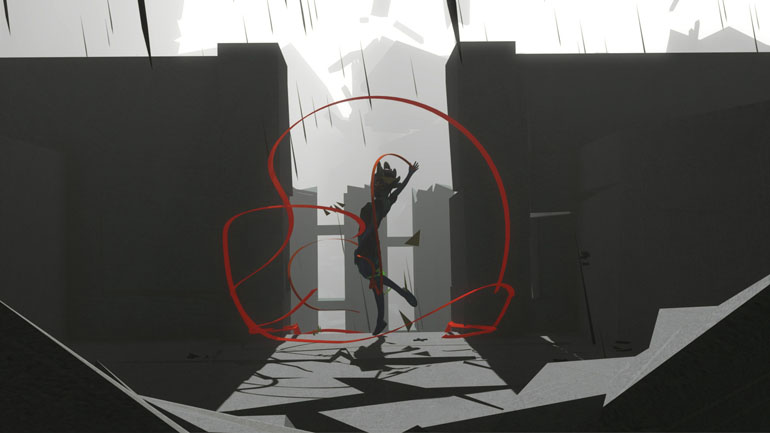
Bound, photo: promotional materials
Plastic is possibly the only big Polish game developer that focuses on ambitious artistic projects. For years they’ve been working with Sony, creating demos and games for PlayStation. One of their creations was a short, surrealist montage called Linger in Shadows, which was supposed to show off the PS3’s capabilities. The other, Datura, was a much more ambitious project, where a hero wanders through the forest straight through Dante’s Inferno, suspended between life and death, and contemplates his life choices. Both of these projects stood out in the console market, which is usually all about laid-back fun. Bound is the most mature and the most interesting of Plastic’s project to date. It was also well received critically by the jury of Polityka magazine‘s Passport awards – the main designer, Michał Staniszewski, was awarded in the Digital Culture category.
Originally written in Polish, translated by AS January 2017
