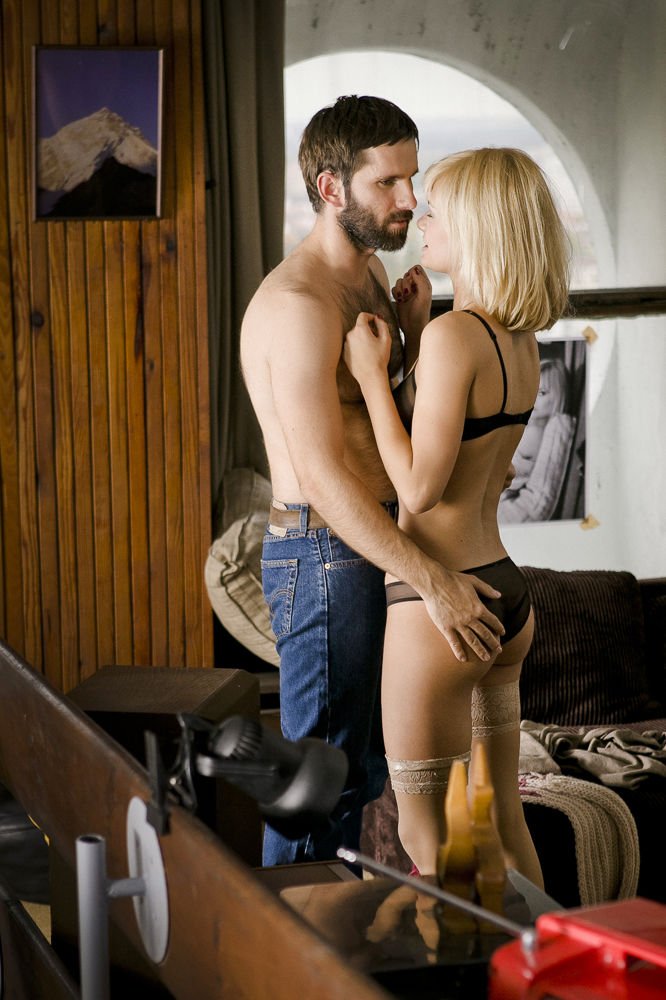
A scene from "80 million", dir. Waldemar Krzystek, photo courtesy of Kino Świat
The thirtieth anniversary since the introduction of martial law in Poland is one of reflection, although probably not the kind suggested in a new film by Waldemar Krzystek.
Martial law is usually associated with the Polish victims who died at a time when the communist government used the army against them: to choke the life out of the budding transformation process. But despite martial law, arrests of its activists and forfeiture of property, the Solidarity trade union survived, and after eight years, its members attended the famous Round Table talks and were on the ballots during the first semi-free Polish elections on the 4th of June 1989.
This would not be possible without the people who are the heroes of Krzystek's film: a brave group of activists from the Lower Silesia "Solidarity" group, who on the eve of martial law withdrew 80 million złoty from union accounts. The money helped organise the underground structures of the group.
The operation was only successful in Lower Silesia, a situation which begs the question: Why?
One of the many answers is that it happened in Wrocław. In Communist Poland, Wrocław was promoted as the "city of youth". The early life of a city was a kind of a curtain, behind which one could hide the cultural ties with Germany. But youth is marked by bravery, imagination and sense of humour. A willingness to take unconventional, even crazy action. It was in Wrocław that Major Waldemar Frydrych's Orange Alternative was conceived. Not to mention Wladyslaw Frasyniuk, Jósef Pinior, Stanisław Huskowski and Piotr Bednarz, who all found the courage, despite the strict supervision by the security police, to withdraw the large sum.
"This was not supposed to be a sad film about martyrdom, on the contrary, it is dominated by optimism and the belief that honesty, intelligence and truth in the end defeat lies, sheer power, and 'red' shenanigans", Waldemar Krzystek wrote in a press comment about the screenplay. "Our intention was to shoot the film in a fast-paced, addictive action-packed crime-caper style. At the same time, we wanted it to be a film about 'something'. A part of [Poland's] recent history, the people who created it – in different ways – and they are responsible for it. A film about people who had to change several times in order to alter the situations in which they found themselves. For example withdrawing that amount of cash from the bank and realising that the bag they brought with them was far too small! They planned everything down to the minutest detail, but they did not know – could not have known, since they had never seen so much money in one place – that in order to carry this amount of money one would not only need three suitcases, but also a large backpack."
"The great strength of the film Krzystek is its veracity, he presents [a real picture of] those times", noted Fr. Andrzej Luter, reviewer for the monthly magazine "Kino" (no. 11/2011). “His characters are ordinary lads, living the fullness of youth, not assuming in advance that they have to suffer for their country. Simply put, when you put to the test, they acted like decent people, no more and no less. And this, and not suffering, is the sign of true heroism."
- 80 Million, Poland 2011. Directed by: Waldemar Krzystek. Screenplay by: Waldemar Krzystek, Krzysztof Kopka. Cinematography by: Piotr Śliskowski. Music by: Zbigniew Karnecki. Production design: Marek Warszewski. Costumes by: Małgorzata Zacharska. Editing by: Marek Mulica. Sound by: Artur Kuczkowski, Kacper Habisiak, Marcin Kasiński. Starring: Filip Bobek (Władysław Frasyniuk), Marcin Bosak (Maks), Wojciech Solarz (Stanisław Huskowski), Piotr Głowacki (Captain SB Sobczak), Krzysztof Czeczot (Józef Pinior), Maciej Makowski (Piotr Bednarz), Agnieszka Grochowska (Anka), Adam Ferency (cardinal), Mariusz Benoit ("Stary"). Produced by: MediaBrigade – Studio Produkcyjne Orka – Odra Film, Dreamsound – Editingbrigade. Co-financed by: Wrocław City Hall, Marshal Office of Lower Silesia, Polish Film Institute. Distributed by: Kino Świat.
Duration: 105 min. Released in cinemas on the 25th of November 2011.