Młynarski was one of the most famous Polish singers-songwriters. Since 1963 he had repeatedly performed at the National Festival of Polish Song in Opole, where he would often receive awards. His lyrics are sought after by many Polish singers. The artist characterised his own style as 'suggestive'.
All my life I've been writing lyrics since 5 am. That's why in the afternoon I would often get nasty – he admitted in one of the interviews.
He wrote some of the lyrics at lightning speed – for instance, Wszystko Mi Mówi, Że Mnie Ktoś Pokochał (translator's note: Everything Tells Me Someone's Fallen in Love with Me) was created in 30 minutes. However, some other songs were being created for years.
Life in a song
Wojciech Młynarski graduated from Tomasz Zan Secondary School in Pruszków. He was a graduate of Polish philology at the University of Warsaw (1963). At the beginning of the 60s, when he was still a student, he debuted in the cabaret and the theatre of Hybrydy student club.
I stayed there until graduation and I wrote and performed many songs in two programmes: Radosna Gęba Stabilizacji (translator's note: The Happy Mug of Stabilisation) and Ludzie To Kupią (translator's note: People Will Buy It). The music was composed by my cousin Roman Orłow, who was already famous at the time. Some of the songs performed in Hybrydy, such as Po Prostu Wyjedź w Bieszczady (translator's note: Just Get Off to Bieszczady), are remembered even today. At that time, together with Orłow, I also wrote my first hit, the song Jesienny Pan (translator's note: An Autmn Man). Thanks to Hybrydy I became aware of the power of cabaret song. I was convinced that a song is a magic form which helps to establish a relation with the audience immediately and to play with them in an exciting way thanks to the use of metaphors, allusions and hints.
[in: Prawie Całość, a booklet accompanying a 5 CD box set, Warsaw 2001]
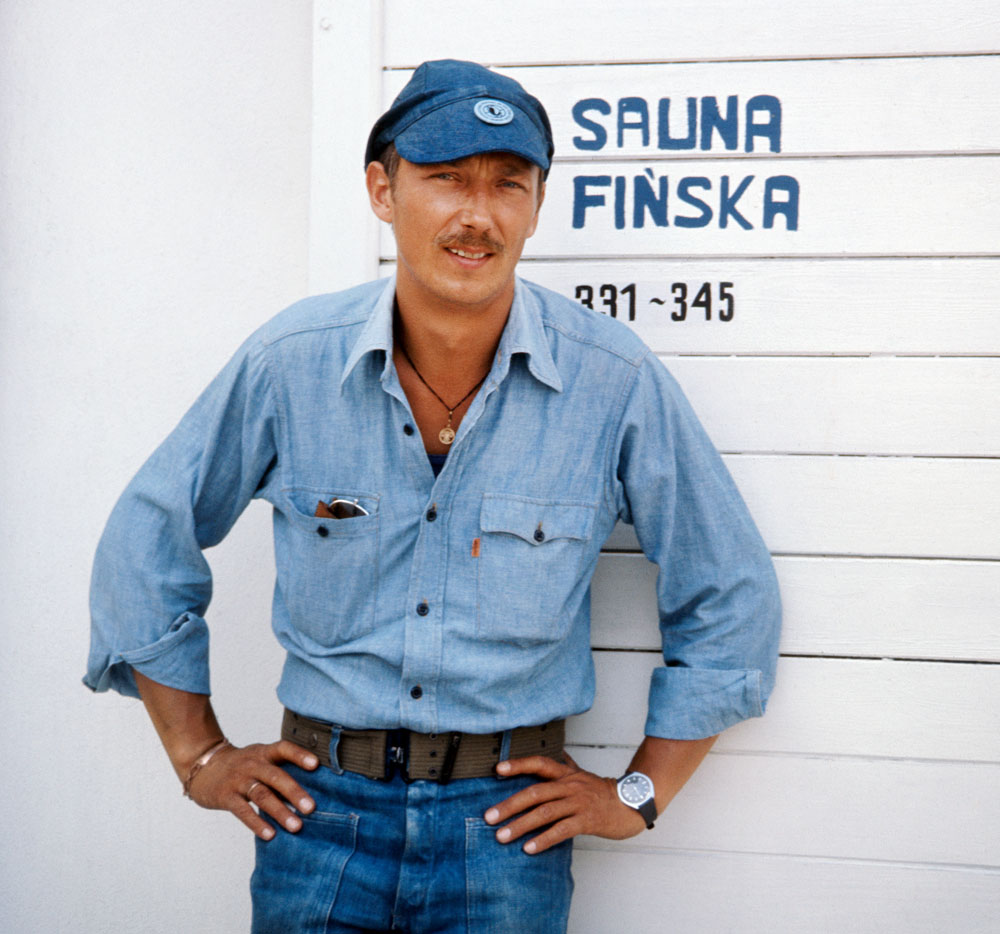
Wojciech Młynarski, photo: Jerzy Płoński / Forum
He was impressed by the songs of the Student Theatre of Satirists. Above all he admired the works of Andrzej Jarecki and Agnieszka Osiecka.
Such songs as Mnie Jest Wszystko Jedno (translator's note: It’s All The Same to Me), Kochankowie z Ulicy Kamiennej (translator's note: Lovers from the Kamienna Street) and Okularnicy (translator's note: Speckies) were a proof for me that in a song you can tell something extremely important about the country you live in.
Since 1963 Wojciech Młynarski's songs had been regularly appearing at the National Festival of Polish Song in Opole and they received many awards. In the second half of the 60s he started collaborating with the following cabarets: U Lopka, Dreszczowiec, Owca, and Dudek, the latter directed by Edward Dziewoński.
The collaboration with Dudek was a great lesson of both writing cabaret texts for a particular performer and evading censorship. While creating with Dudek I had the honour to write the firsts songs with Jerzy Wasowski, mainly for Wiesław Gołas. The culmination of this collaboration was the song W Polskę Idziemy (translator's note: Inside Poland We Go). When it comes to evading censorship, the most characteristic songs among my works for Dudek are Ballada o Dzikim Zachodzie (translator's note: Ballad about the Wild West) and Po Co Babcię Denerwować (translator's note: Why Annoy Grandma).
[in: Prawie Całość, a booklet accompanying a 5 CD box set, Warsaw 2001]
He also worked as the TV entertainment editor. He created the series Porady Sercowe (translator's note: Love Advice) for which he wrote such songs as Polska Miłość (translator's note: Polish Love) and Niedziela na Głównym (translator's note: Sunday at the Central Station) that became a hit in 1964. It was a Polish response for the song Dimanche à Orly by Gilbert Bécaud.
According to Jeremi Przybora (the creator of the iconic Kabaret Starszych Panów), Wojciech Młynarski, along with Agnieszka Osiecka and Jonasz Kofta, was one of the three 'bards of the Polish song'. They were the ones who presented their songs in the concert 'Nastroje – nas troje' at the Festival in Opole in 1977. Przybora believed that thanks to artists like Młynarski post-war Poland became an 'empire of the highest quality song'.
Since the end of the 60s Wojciech Młynarski performed with his recitals, such as W Co Się Bawić, Szajba, Wieczór Liryczny and Róbmy Swoje. He played concerts in Poland and abroad: in West Germany, France, United Kingdom and Italy, and for Polish communities in the USA and Canada.
On stage and on screen
In the 70s Wojciech Młynarski started writing bigger forms, such as opera librettos: Henry VI on Hunting and Kalmora (music by Karol Kurpiński) and musicals: The Shadow, Awantura w Recco (translator's note: A Row in Recco) with music by Maciej Małecki, Wesołego Powszedniego Dnia (translator's note: A Happy Weekday), Nędzy Uszczęśliwionej Epilog (translator's note: The Epilogue of a Delighted Misery) with music by Jerzy Derfel and Niedopasowani, czyli Goliath i Wieloryb (translator's note: Unadjusted, or Goliath and the Whale). The co-author of the latter was Krzysztof Dzikowski and the music was written by Marek Sart. Wojciech Młynarski also wrote the Polish librettos for the musicals La Vie Parisienne (music by Jacques Offenbach) and Jesus Christ Superstar. He is the translator of the songs from musicals Seesaw, Fantasics, Chicago and Cabaret.
On Scena na Dole of the Ateneum Theatre in Warsaw and on many other stages, also at festivals, he presented shows in tribute to remarkable artists. He translated lyrics of Charles Aznavour, Georges Brassens, Jacques Brel, Bulat Okudzhava and Vladimir Vysotsky.
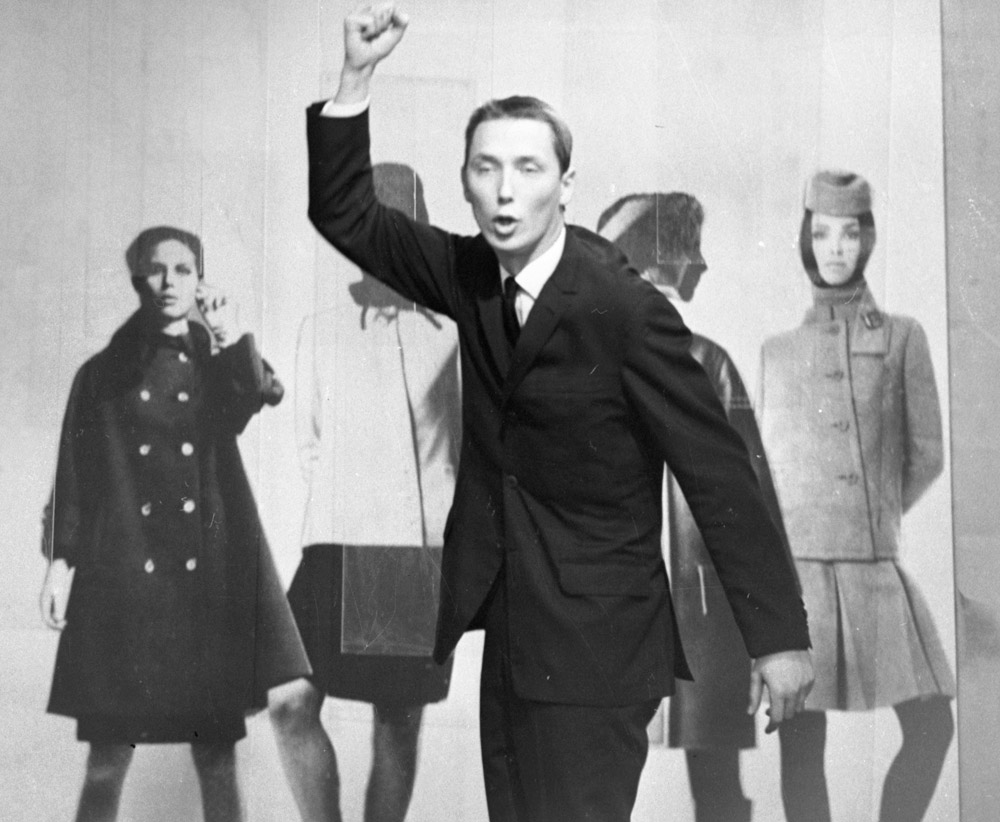
Wojciech Młynarski in Giełda Piosenki, a TV broadcast, 1966, photo: Jerzy Płoński / Forum
Let's do our things
Wojciech Młynarski inserted colloquial language into the elaborate form of his songs. He was a keen observer, which made his songs unusually communicative. They spoke to people from all social groups. The astoundingly constructed lyrics convey a genuine, clear meaning that the artist would reinforce with his public spirit.
Młynarski sometimes had to suffer consequences of his nonconformist attitude. He signed the so-called 'Memoriał 101', the Polish intellectuals' letter of opposition against the changes in the constitution of the Polish People's Republic. Because of that, at the beginning of 1976 he was put on the black list of artists who were banned from performing in public. He was allowed to perform publicly again over a year later.
Next restrictions were imposed on him a decade later after he resigned (together with two professors, Bohdan Korzeniewski and Zbigniew Raszewski) from the membership in the Artistic Council of the Association of Polish Stage Artists. That was their response to the top-down pressure regarding the breaking of the TV-boycott. 'The Mayor of Warsaw, Gen. Dębicki, issued a ban on giving permissions for Wojciech Młynarski's performances', Zbigniew Raszewski wrote on February 13th, 1986 in his diary 'Raptularz'.
On the 20th anniversary of the memorable elections of March 4th, 1989, Młynarski recalled in 'Rzeczpospolita':
I remember that day: March 4th, 1989. The atmosphere before the elections was unusual and unique. I was invited to meet the parliamentary candidates of Solidarność several times. I sometimes sang during those meetings. Many people related to my song Róbmy Swoje (translator's note: Let's Do Our Things) and its message and that's why it became a sort of an anthem at that time. Not long before the 4th of June there was a big concert in Powszechny Theatre in Warsaw and a dozen or so artists took part it in. I remember Joanna Szczepkowska and Jan Pietrzak. It was a hot time and the atmosphere was solemn. It was filled with expectations and hope. We performed for the people who would run for elections. Tadeusz Morawiecki was among them. Me and many others were convinced that something wonderful and extremely important was happening. We all had been waiting for a meaningful change. It could be noticed in people's chats and in the way we were looking to the future – in the same direction.

