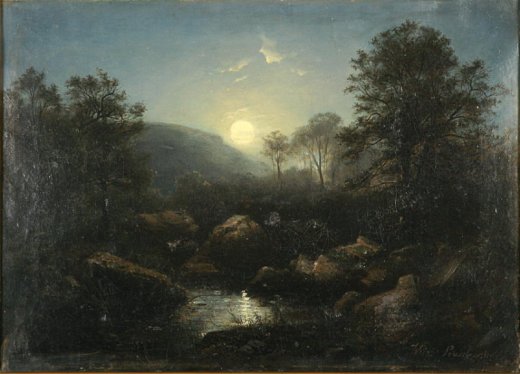
Moon Landscape, around 1870, oil on canvas, photo: Tomasz Szemalikowski, by courtesy of Upper Silesia Museum in Bytom
He spent his childhood in Odessa and Kiev. His youthful aesthetic ideals were shaped by classical culture. In 1860, after a short stay in Switzerland and Belgium, the Pruszkowski family moved to France, where they initially lived in Dieppe. At the turn of 1866 and 1867, they settled in Paris. It was here that Witold started learning to paint from a popular portraitist, Tadeusz Gorecki.
Between 1868 and 1872 he studied at the Academy of Fine Arts in Munich under Hermann Anschütz, Alexander Strähuber, and Alexander Wagner. It was during this period that he first came into contact with Polish Romantic literature, which had a significant impact on his later work, and assimilated certain features of Arnold Böcklin’s atmospheric symbolic painting.
In 1872 he went to Kraków to continue his studies under Jan Matejko, who was the director of the local School of Fine Arts at the time. Despite the respect he had for Matejko, he did not yield to his artistic influence. This is evidenced by a painting created under the master’s supervision, the only historical painting in the artist’s oeuvre, depicting the Offering of the Crown to Piast (1872-75). In spite of the arrangement of the multi-figure scene which was similar to Matejko’s composition, Pruszkowski’s work distinguishes itself by the very choice of the theme referring to the legendary history of Poland, as well as by the presence of supernatural beings and the poetic mood created by the extended part of the summer landscape and the light modelling the phenomenal angel figures.
From 1872 Pruszkowski regularly participated in exhibitions of the Society of the Friends of Fine Arts in Kraków. He also frequently exhibited in the Lviv Society of the Friends of Fine Arts (since 1875) and the Warsaw Society for the Encouragement of Fine Arts (since 1876), and since 1880 in Aleksander Krywult’s Salon. He took part in many international exhibitions, among others in Paris (1881), Munich (1879), Berlin (1891, 1895, 1896 – a gold medal for the pastel March to Siberia), Chicago and San Francisco (1893 – a silver medal for the pastel Courtship). After graduation in 1876, he lived in Kraków for several years. During this period, he established close contacts with Jacek Malczewski, which in time turned into a cordial friendship. He was one of the initiators and co-organisers of the Literary-Artistic Circle founded in 1881. A year later, he settled with his family in Mników near Kraków. In 1890 he spent a longer period with his family in Lviv, and in 1891 he accompanied his brother on a trip to Africa (Algiers, Tunis). On the way back, he also visited Italy. From 1894 onwards he struggled with an incurable disease that led to disability and death. Nevertheless, he did not part with his brushes and palette almost until the very end. In September 1896 he went with his family to relatives in Kołomyia, from where he left in an unknown direction without saying goodbye. Found in a state of extreme exhaustion at the Budapest station, he was taken to the local hospital, where he died after a few days.
Pruszkowski was a versatile artist in the choice of themes and stylistic conventions. He used oil and pastel techniques with equal mastery. He was a loner, working in seclusion and concentration and never showing his unfinished works. His paintings were very much influenced by his personal experiences, emotions and moods. During his stay in France, he became acquainted with the latest achievements of European art, which largely influenced the formation of his complex creative personality, in which painterly sensitivity to light and colour was combined with a love of fantasy, while his tendency towards Romantic mysticism and increased expression in patriotic-martyrologic scenes went hand in hand with the ability to observe the world realistically. The artist’s mature work, developed between 1875 and 1894, created a kind of bridge between the legacy of great Romantic poetry and the symbolic art of Young Poland.
In 1876 Pruszkowski left for Mogiła, having been commissioned to create a polychrome for the chapel of Mother Mary in the Cistercian monastery there. Following his first longer stay in the countryside, his paintings were influenced by genre motifs from the life of the local people, as well as paintings inspired by folk tales and beliefs. The first of these thematic trends opens with a composition entitled When Dawn is Breaking (1876). In Pruszkowski’s interpretation, little shepherds singing a morning song to God become a link between the earthly and the supernatural. Their fervent prayer directs thoughts towards the Creator’s unchanging but sensually elusive presence in nature. The painterly impression of light gently dispersing the darkness of the night is the main means of expression here, creating an elegiac, reverie-oriented mood, in which the artist’s contemplative attitude towards nature and people’s lives shown against its background is revealed. Idyll (1880) maintains a similar poetic aura, showing a couple of children sunk in the silence of the night, which seems to be enlivened only by the delicate sound of a melody played on a pipe. The intuitive, almost biological link between the children and the world of nature was also emphasised in Midsummer’s Eve (1875), referring to the fascination with the mysterious world of folk tales and legends which has its roots in Romanticism. Here, the artist used the fairy-tale motif of searching for the miraculous fern flower (providing power, wealth and happiness) in the gloomy forest.
Pruszkowski’s imagination, freely crossing the borders between the real world and fantasy, was strongly inspired by the ‘commune song’ passed down through the generations, in which ancient beliefs built around archetypes of good and evil, truth and lies, virtue and misdemeanour were stored. This is reflected in a series of works which are permeated by an atmosphere of poetic mystery, emphasised by a fairy-tale type of landscape – a dark thicket of reeds (Rusalskas, 1877), a forest thicket of exuberant plants and expressively twisted tree branches (Madej’s Confession, c. 1879), the night-time moonlight reflected from the mirror of the lake (Nymphs, c. 1877) or a dark cavern decorated with garlands of flowers (Wawel Dragon, 1884). The supernatural beings – rusalkas, nymphs, the winged dragon – who populate these fairy-tale landscapes usually take on an astonishingly corporeal, sometimes tempting sensual form and are reproduced following the rules of realistic imaging. It is only in the artist’s later works that fantastic figures are shown more phenomenally, not so literally and materially (Falling Star, 1884; Spring, 1887; Świtezianka, c. 1887).
Pruszkowski, this late Romanticist of Polish painting, was the first to enrich the movement with the half-real, half-imaginary creatures marked by the stigma of death (All Souls’ Day triptych, c. 1894-96). The female protagonist of All Souls’ Day’s triptych crosses the border of the temporal and the ‘other’ world freely to visit her mother, who is in grief after her death. Her seemingly scared figure seems to melt into the fog and pale moonlight, she appears to us – like the heroine of Juliusz Słowacki’s piece Do Pastereczki, Siedzącej na Druidów Kamieniach w Pornic nad Oceanem (To the Shepherdess Sitting on Druid Stones in Pornic by the Ocean) – as ‘the guardian and the spirit of the grave.’ And just like in the poem, the unreal transparency and lightness of this phantom ‘without blood and body’ in some strange way illuminates and fills the gloomy scenery of the cemetery with warmth. The triptych Enchanted Violin, painted by the terminally ill artist, is not only an illustration of Henryk Sienkiewicz’s novel about a talented, rural boy who paid with his life for his love of music. Pruszkowski showed his tragic fate in a broader symbolic context referring to the artist’s social and spiritual condition. In presenting the figure of a shepherdess listening to the music of nature, which he tries to recreate in the melody played on the violin, he also metaphorically referred to the essence and sources of creative inspiration (Shepherd I, part of the Enchanted Violin triptych, c. 1894-96).
After settling down in the countryside, Pruszkowski quickly established close ties with the local inhabitants, frequented the fields, pubs and fairs, often supported them with advice and financial assistance in difficult situations; he wore a Cossack peasant costume, in which he also presented himself in the 1893 Self-Portrait. His deep insight into the village life, both the greyness of its everyday existence and the festivity of its rites, is evidenced by paintings such as By the Well (1882), Assumption Sunday (1889, now missing) or Courtship (c. 1893), showing the local folklore, costumes and customs with great sensitivity. In this part of the artist’s work, his attachment to technique characteristic of realistic painting was most strongly revealed.
In Pruszkowski’s landscape painting we can observe a specific combination of realistic forms of expression with a tendency towards symbolism which is essentially Romanticist. Another tendency is to give pictorial visions a metaphorical dimension, in which there is a deep sense of the whole universe present – that of man, nature, temporal and definitive matters. During his studies in Munich, the artist succumbed to the influence of the elegiac-mood movement of Stimmung painting. When painting landscapes, he eagerly chose the time of the breakthrough between day and night, when the misty light evokes a mood of indeterminate sadness and longing (Dawn, 1881; Twilight, c. 1881; Kurgans at Night, c. 1886; Willows on the Moor, 1887; Willows, c. 1890; Garlands, c. 1891). The extremely suggestive mood of these pictures comes from a delicate haze, understatement of forms, built up with soft spots of subdued colours with subtle transitions, thanks to which they evoke an aura of contemplative reverie, inducing the viewer to ponder and dream. Another effect, dramatic in expression, is produced by a pastel study of a willow, expressively bent over a vast body of water, bathed in the red glow of the setting sun (Willow, c. 1890). An interesting experiment with impressionistic origins was a series of three landscapes in Pruszkowski’s oeuvre, showing the same fragment of nature in different lighting, determined by the time of day and the type of weather (Orchard, c. 1890, in three versions).
An important place in Pruszkowski’s body of work was occupied by paintings with patriotic and martyrological themes, largely inspired by Polish Romanticist poetry. The artist’s imagination was most strongly influenced by Słowacki’s poem Anhelli (1837), which was extremely pictorial in regards to its poetic vision, referring to the idea of sacrifice and resurrection of the nation through a metaphor of the fate of Siberian exiles (Death of Anhelli, 1879; Anhelli, 1889; Death of Ellenai, c. 1892; Eloe, 1892). Most of these scenes are set in the endless, snowy wilderness of Siberia, and their visionary aura is emphasised by the presence of the airy figure of Eloe, as if made of fog and snowy dust, leaning over Anhelli’s dead body in the bloody glow of a polar aurora, or shown as the guardian of graves in the blue glow of a winter night. In view of the simplicity of compositional shots and sketchiness of the freely-shaped, blurring details of the painted matter, the main means of expression in these paintings becomes colour, reduced to the basic triad of white, red and blue, to which Pruszkowski gives symbolic meaning. The scene of Ellenai’s death is more concrete, closer to a realistic depiction. Here, too, with discreetly differentiated browns and greys, the red-tinted ray of light falling on the dead body of an exile determines the expression of the image, giving the scene an elegiac, almost mystical dimension. The patriotic and martyrological trend in Pruszkowski’s paintings includes such paintings as Unitka (1888) or March to Siberia (1892-93), repeated in three versions (oil and two pastels), probably inspired by Grottger’s work of the same title, but less literal in the way it shows the exiles’ journey through the snowy abyss of this ‘inhuman land’, over which the border post with the emblem of Tsarist Russia towers. Vision, inspired by Zygmunt Krasiński’s Przedświt (Daybreak) – a colourful procession of rulers, knights, peasants following the luminous figure of Our Lady Queen of Poland – gained the dimension of a symbolic metaphor generalising the fate of the nation in the context of the messianic idea.
Portraits depicting family and friends, as well as the inhabitants of the villages he lived among (the artist never took orders for paintings from strangers) were a separate, extremely rich part of Pruszkowski’s body of work. Beginning in the 1870s, his portraits revealed the influence of Edouard Manet’s work, as well as the colourful achievements of early impressionism (Portrait of the Painter’s Wife With a Veil, 1877; Portrait of a Girl, 1888). Thanks to these inspirations, the artist definitely broke with the conventional type of image showing characters carefully posing indoors or against a neutral background. He was one of the first Polish painters to introduce portraits in the open air in the form of everyday situations, rather than the dramatised, imaginary landscape of the Romantics. An example is the artist’s Portrait of the Sister (1875), depicting the model against a background of the lush vegetation of the garden, drawing attention with an unconventional way of depicting the figure – a young woman, visible from behind, turns her head towards the viewer, as if under the influence of a sudden impulse. One of Pruszkowski’s masterful achievements in the field of portrait is a modest (in terms of technique) effigy of Kazimierz Bartoszewicz (1876), which presents a figure as if captured by accident during a walk in the winter open air. The freedom of painterly texture of dense paints, applied with wide, elaborate brushstrokes, emphasises the fresh, spontaneous character of the Portrait of Stefania Fedorowiczowa (1878). The Portrait of Stefania Fedorowiczowa on an Ottoman (1879), which came closest to Manet’s works, also painted widely and freely, broke with the traditional convention of defining the social position of the portrayed person through elements of the interior. Contrasted with the deep, ‘Manetesque’ black of the model’s dress, the background elements – the patterned wallpaper, the ottoman’s upholstery, the red fabric imposed on its backrest – are only a set of colour patches defining the painting’s colour structure, delicate reflections enriching the luminous complexion of the face and the white of the lace collar. With a clear focus on resolving the problems of colour and light, the artist does not, however, give up on insightful characterisation. The innovative features of portrait representations, visible in Pruszkowski’s work as early as in the 1870s – an unconventional way of depicting a model, the free sketchiness of the painting technique emphasising the fleeting, impressionable character of the painting – marked one of the directions of further evolution of this genre in Polish art, although the artist did not find direct followers.
Originally written in Polish by Ewa Micke-Broniarek, National Museum in Warsaw, February 2005

