Control Units
One of his most recognised series is Control Units – machines designed to manage selected parameters of reality. The inaugural one, Earth Rotation Speed Control Unit from 2003, provides viewers with the potential ability to interfere with the Earth's speed of rotation. The use of the object allows one to decelerate the rotation of the planet by a split second or to extend a day by the same amount of time. A physical theory describing the phenomenon of reducing the Earth's rotation speed through the civilisational activity of humans on the planet is an integral element of the piece.
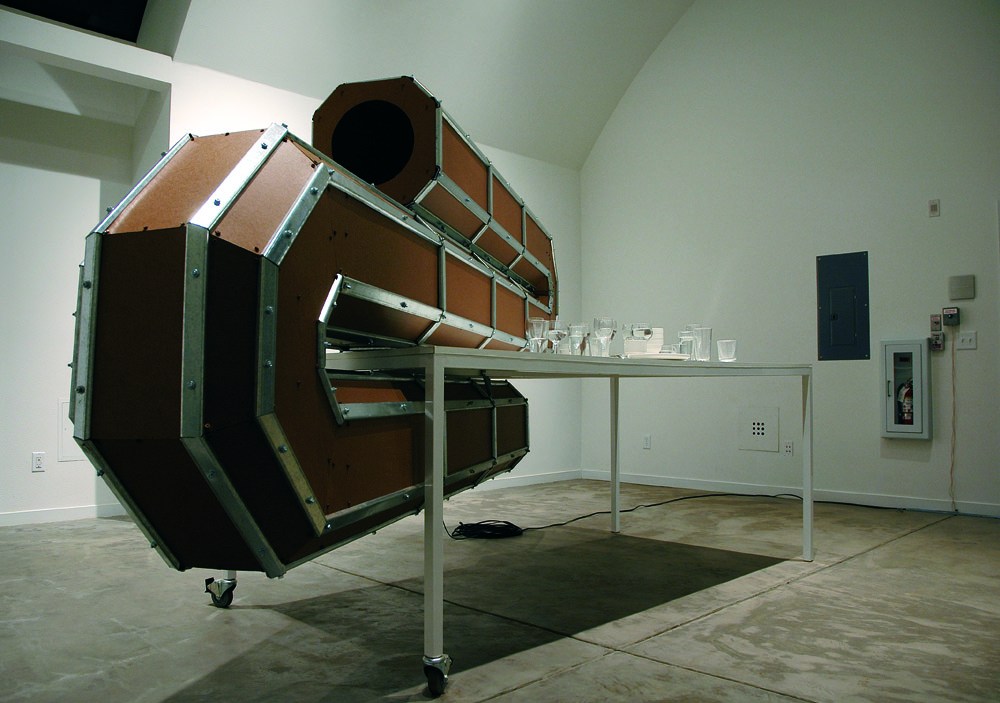
Przemysław Jasielski, Earthquake Control Unit, 2004, a machine generating low-level seismic activity, photo courtesy of the designer
Earthquake Control Unit from 2004 is a machine that can generate low-level seismic activity. After it is launched, a recording of a very low frequency seismic wave is played, causing the surrounding objects to vibrate. The piece was realised in one of the most seismically active areas on Earth – in San Jose in California.
Yet another machine, Global Warming Control Unit from 2010 is an interactive device for diminishing the negative effects of global warming. Basing his work on scientific research, Jasielski created a hypothetical apparatus that enabled a regulation of the natural state of global atmosphere.
In 2015, the artist created another work from the series – Emotions Control Unit. First displayed at the Frieze Art Fair in New York, the object possesses features of both an automatic and behavioural intelligence. The machine reacts to the presence of people in its surrounding and displays parameters describing its own emotional state. The viewers are partly able to affect the object's state by manipulating it, however, some of the reactions are self-generated, in a reference to scientific discourse relating to the autonomy and emancipation of artificial life.
Artificial life
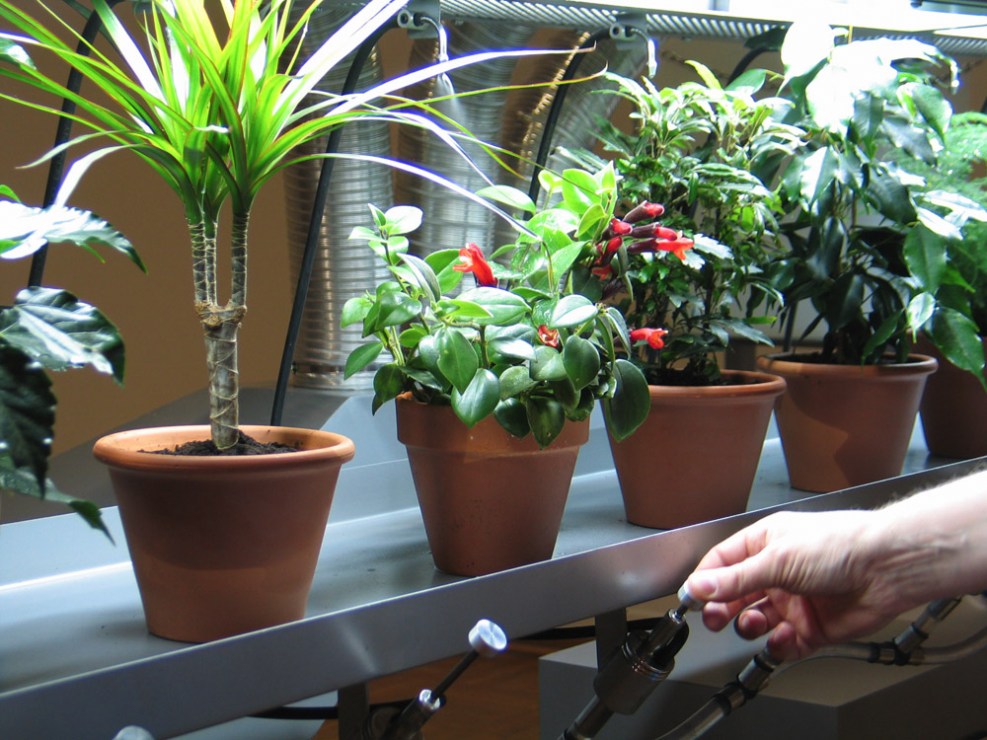
Przemysław Jasielski, Sounds Of My Room – Plantation, 2004, photo courtesy of the designer
One could also try to organise some of Jasielski's other works, such as Sounds Of My Room – Plantation, Opportunity, and Leviathan, into a coherent series, bound by a reference to scientific concepts of artificial life, environmental intelligence, and post-humanist cognitive strategies.
In 2004, the artist designed the installation Sounds Of My Room – Plantation, a kind of ‘incubator’ which allows the regulation of environmental conditions to sustain the life of plants in artificial conditions. While the robot in the work Opportunity, whose title makes a direct reference to the NASA mission to Mars which investigated the planet's geological make-up, gained cognitive autonomy by generating a picture-based panorama of the interior of the Warsaw-based Skolska28 gallery without any assistance. The exhibition's visitors had the opportunity to juxtapose their perception with the vision produced by an autonomously perceiving and documenting robot. Yet another object by Jasielski – Leviathan – which premiered in Poland at the exhibition Transnature Is Here (2013), was a certain critique of the concept of carbon chauvinism – a theory according to which life can only emerge within organic chemistry. Leviathan reacts to the presence of spectators and emits sounds of very different frequencies. The alternating oscillations not only fill the space around the object, but also make it tremble and vibrate, thus modifying the viewers' tactile perception.
Jasielski addresses the place and role of technology in the modern world, while showing empathy for robots and artificial intelligence. A manifestation of this can be seen in the installation Photo Robotoid (2019), a robot that takes photos of visitors. What sets it apart is its own decision-making about when to take a photo – and it's not necessarily the robot's vision that coincides with human preferences. This contradicts our habit of having technology help us retouch, beautify, catch the right moment. Rather, the works of Photo Robotoid bring frustration or anger – in a gallery context, however, masked by laughter.
Another of the roles Jasielski has chosen to assign to robots is that of curator. His Robotic Curator (2022) has an artificially developed aesthetic sense that allows it to evaluate artworks without ideological bias, political correctness or other factors not directly related to art. The observation of Robotic Curator raises the question of how we transform images into discourse and how much of a role cultural contexts and subjectivity play in this.
Isolated spaces
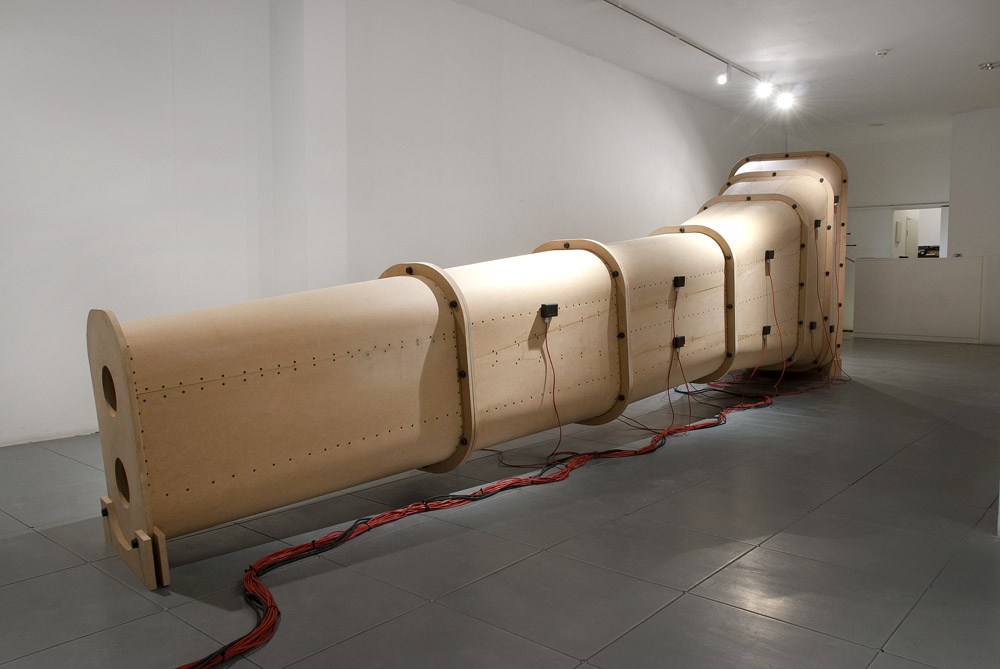
Przemysław Jasielski, Leviathan, photo courtesy of the designer
Jasielski's installations in which he examines a laboratory position of isolation, are equally interesting. In White Noise from 2011, we are faced with a phone booth, whose tight space, upon one's entrance, fills up with ambient recordings of a technology-infused city, completely separating the viewer from the external world.
Analog Immigration, presented in 2013 in the United States, sends us back to the pre-digital era and the world of analogue experience. Upon entering the installation, the spectators are asked to hand in their phones and electronic devices, while a brass cage surrounding the installation's structure filters all electrical signals, shutting out any radio, cell, or internet connection. In this way, the viewers are cut off from the contemporary fabric of technoculture and motivated to interact with their own pre-technological experience of the world.
Jasielski also raises the question of a broader dimension of isolation – that of man from the cosmos. Small Apocalypse, created in collaboration with Paulina Nadobna (ZAMEK Cultural Center, Poznań, 2023), is an installation featuring a badly damaged, though still functioning, laptop computer displaying a video of a meteorite in a loop. The video, recorded with an electron microscope, shows microscopic images of a small fragment of a real iron meteorite. This meteorite is also part of the installation and can be viewed with a set of powerful magnifying glasses. The work asks whether the development of civilization and the state of modern technology and science have changed humanity's approach to cosmic phenomena – once sabotaging the narcissistic nature of reason.
Selected solo exhibitions:
1994 – To hear the sound of an angel wings and to measure it (Academy of Fine Arts, Poznań)
1997 – Sounds of my room – installation (Potocka Gallery, Cracow)
1998 – To see the sound of an angel wings (Laboratory Gallery, Warsaw)
1999 – To see the sound of an angel wings – Hollywood version (Potocka Gallery, Cracow)
2003 – Earth Rotation Speed Control Unit (OPTICA Centre for Contemporary Art, Montreal, Canada)
2003 – To see the sound of an angel wings – anatomical version (The Gallery, International Artist in Residency Centre, Guernsey, Great Britain)
2004 – Earthquake Control Unit (Lucas Artists Residency in Montalvo, California, USA)
2006 – Hi-Fi (Oko/Ucho Gallery, Poznań)
2006 – White Noise (AT Gallery, Poznań)
2008 – Ukukula (Munandi Art Center, Lusaka, Zambia)
2009 – Drawings Of Something Completely Else (Le Guern Gallery, Warsaw)
2010 – Global Warming Control Unit (Gyeonggi Creation Center, Seongamdo, South Korea)
2011 – Opportunity (Skolska28 Gallery, Prague, Czech Republic)
2012 – Paper Bridge Over Stone Water (Tokyo Wonder Site, Tokyo, Japan)
2013 – Analog Immigration (CSU Galleries Cleveland Ohio, USA)
2014 – Leviathan (Le Guern Gallery, Warsaw)
2019 – Photo Robotoid (Le Guern Gallery, Warsaw)
2020 – Oracle (AT Gallery, Poznań)
2023 – Non-Human Portraits (PF Gallery, Poznań)
Michał Krawczak, October 2015, transl. AM, January 2016, updated by AB, July 2024

