In his interdisciplinary art he uses various means of expression: photography, film, video, graphics, word, sound. His most crucial area of work is, nevertheless, performance. He represents one of the most consequent and, at the same time, radical approaches in Polish art – for him, art is tantamount to life. The complex approach of Dudek-Dürer is characterized by religious and spiritual syncretism. His works allude to religious and philosophical systems of the East and the West, and to shamanic practices. He’s one of the most prominent representatives of performance and mail art in the world. Dudek-Dürer lives and works in Wrocław.
Life subordinate to art
Andrzej Dudek-Dürer debuted in the end of the 60s. The foundations of his artistic development were on the one hand fascination with the culture of the East, meditation and belief in reincarnation, and on the other experiments with photography and graphic processes, and exploring the possibilities of representing three-dimensional reality by means of two-dimensional images. At that time, Durek-Dürer made his first attempts at manufacturing his own paper and did his first experiments with authorial print. It was also in the 60s that the artist has started his life-performance which is still going on today – Art of shoes – Art of Trousers – Art of Andrzej Durek-Dürer (Living sculpture). From this moment on, his life became completely subordinate to art.
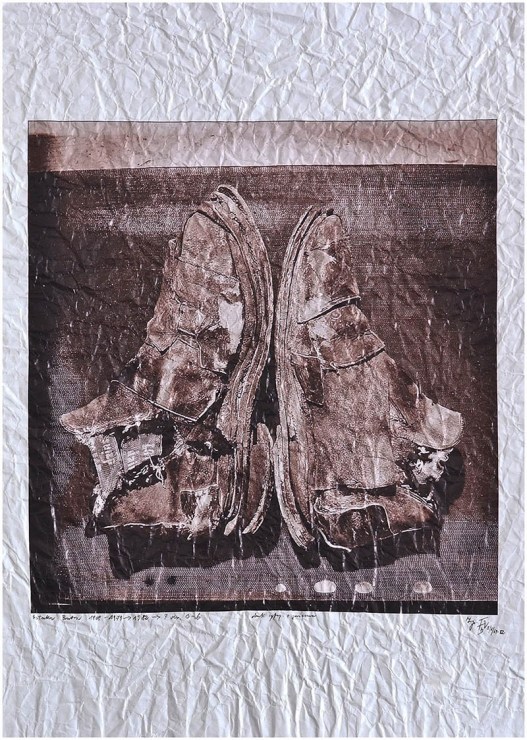
Andrzej Dudek-Dürer, Sztuka butów / The Art of Shoes, 1969- 1979 1982 ver. s, living sculpture, authorial mixed technique, photography, creasing, 50 cm x 70 cm, photo: courtesy of the artist
In 1969 the creator discovered that he was an incarnation of Albrecht Dürer. He started to identify with the Renaissance artist and became to realize works alluding to Dürer on many levels – through the themes explored by the German woodcut creator, iconographic references to his works, and autobiographical strands. Except for spiritual and artistic affinity, there are other connections between the two artists – including an uncanny physical resemblance. The most easily recognizable motifs corresponding with the works of the German master are the idea of self-portrait explored in many ways, depictions of death, and formal mastery in using graphic techniques.
Andrzej Kostołowski, an eminent Polish art critic, characterizes Dudek-Dürer’s approach as looking for ‘the most mysterious from the mysterious anastomosis of the spiritual and material elements’ in himself. He writes, that the spiritual elements are
the subsequent mental states of the artist, and the material ones – his clothing, surroundings, communication, documents, actions. His aim is to create some sort of a suitableness system between what is spiritually lived and what is materially communicated.
Photographs
According to Dudek-Dürer, performance is central to his work. However, Adam Sobota, the curator of photography in the National Museum in Wrocław, has noticed that ‘everything that can be called performance in the works of Dudek-Dürer, is strictly related to the usage of photography’. The crucial importance of photography (and video recording) in Dudek-Dürer’s work is, according to Sobota, connected with the documentary and creative possibilities offered by this medium, capable of seizing the core of artistic work. It is photography, which has a lot in common with graphic works on paper, that registered many of the artist’s works.
Since 1973, Dudek-Dürer creates crucial works comprising the cycle Ukrzyżowanie (editor’s translation: Crucifixion). The photographs taken after the death of the artist’s brother and father, in which he depicted himself as crucified Jesus, became a personal utterance about suffering and the sense of life. Another cycle, created between 1973 and 1974, is Autoukrzyżowania (editor’s translation: Self-crucifixion), depicting the artist’s naked body posing as the crucified Christ. Unlike in the earlier works, in this cycle Dudek-Dürer made use of everyday objects, appearing as if accidentally. In 1977, a series of photomontages with the artist’s multiplied head with crucified figures was created.
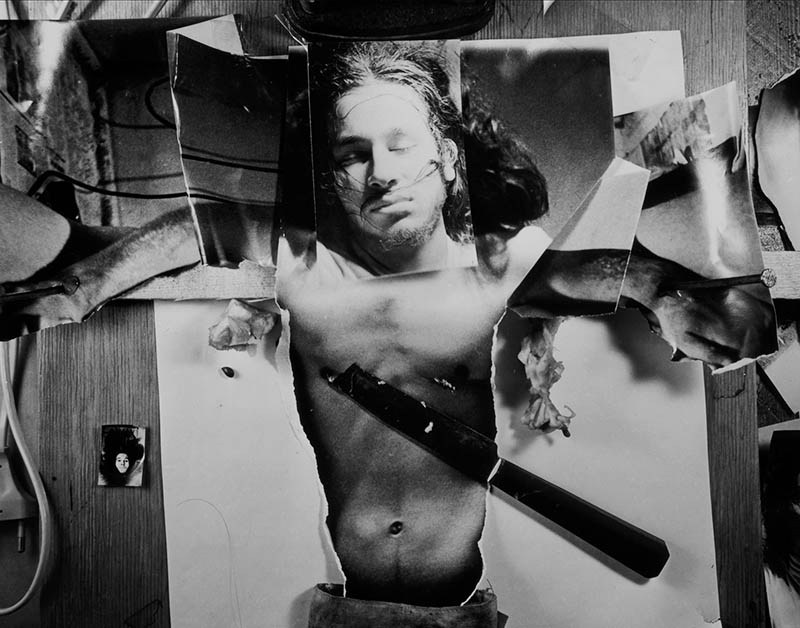
Andrzej Dudek-Dürer, Autoukrzyżowanie / Self-crucifixion, 1973, performance in Galeria Jednej Osoby, Wrocław, photograph, 100 cm x 70 cm, photo: courtesy of the artist
Photography, with its immanent element of processing reality and possibility of multiplying images, became the artist’s tool to question realness. More and more often Andrzej Dudek-Dürer would connect various spacetime contexts. Adam Sobota has noticed that the artist is occupied with the notion of ‘manipulating’ images. It is most clearly visible in the series exploiting multiplication, for instance self-portraits. As Sobota wrote:
Exposing serial, slightly modified images, would indicate that the main objective of the artist is not achievement of a richer aesthetic effect, but drawing attention to the fact of manipulating a medium as such.
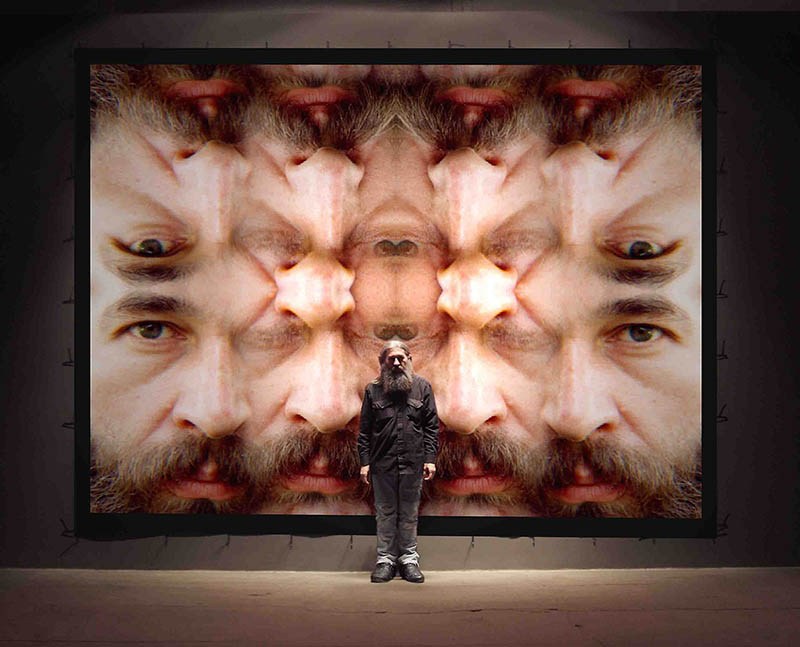
Andrzej Dudek-Dürer, Autoportret zmultiplikowany metafizyczno-telepatyczny III / Multiplied Metaphysical-Telepathic Self-Portrait III, 1994, photograph, solvent based print on canvas, 525 cm x 400 cm, photo: courtesy of the artist
Living sculpture
A crucial element of the artist’s identity are his shoes, worn since 1969, repaired and resewn numerous times. He also has one and the same pair of trousers for decades now. The elements of the ‘costume’ consequently used by Dudek-Dürer are organically connected to the idea of ‘the living sculpture’. The artist creates a live-performance wherever he appears. He simply exists. His presence is an opportunity to meet with a transcendental mystery, which one may encounter in obvious places, such as art galleries or museum, but also in public space. Krzysztof Dobrowolski compared the aforementioned shoes to a living organism, symbolically unveiling reincarnation, and subsequently analogized them to the artist’s body. As Dobrowolski wrote:
The old jeans are a similar object, as well as the artist himself – his body, beard, hair, meticulously collected and amassed throughout the years as traces of presence and passage of time, and later turned into artifacts by the creator’s gesture.
Performance
Some performances of Dudek-Dürer are recorded by means of photography or film, in sequences showing successive stages of the act. The works Życie (editor’s translation: Life) from 1974 and Tworzenie-Niszczenie (editor’s translation: Creation-Destruction) from 1979, realized in Katakumby gallery in Wroclaw, may serve as examples. The record of this performance is made up of twelve photographs. The action was connected to the ritual of meditation, playing music on a self-constructed sitar, and creating drawings and photographs to destroy them afterwards.
Archive
The notion of ‘archive’ is important in Dudek-Dürer’s work. It is present in his 1974 action – ‘potting’ his self-portraits in jars, ‘preserving’ the moment happening in a concrete ‘here and now’. A similar, but created in completely different political reality, work is Apokalipsa w konserwie (editor’s translation: Apocalypse in a can) from 1981, realized during the time of martial law in Communist Poland. The reproductions of Albrecht Dürer’s famous woodcut Four Horsemen of the Apocalypse were canned in jars. Another example of such ‘archiving’ is the work Worki metafizyczne (editor’s translation: Metaphysical bags) realized since 1974. The artist put material scrapes of reality (fragments of photographic film, letters, texts and his own images) in transparent foil bags.
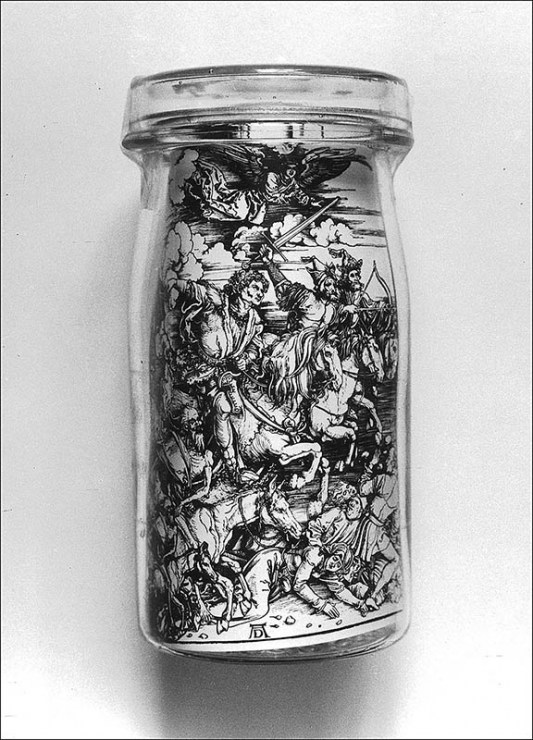
Andrzej Dudek-Dürer, Apokalipsa w konserwie / Apocalypse in a can, 1981-1982, object, glass, screen printing, 19. 5 cm x 9.5 cm x 9.5 cm, photo: courtesy of the artist
Mail art
In 1976 Dudek-Dürer initiated his participation in an international network of mail art through the action Informacja – Dezinformacja – Działanie Metafizyczno-Telepatyczne (editor’s translation: Information – Disinformation – Metaphysical-Telepathic Action). From that moment on, the artist participates not only in private artistic exchange with other creators from all over the world, but also in exhibitions of mail art.
Mail art allowed the artist to make and maintain artistic contacts, which would later become occasions to travel and work abroad. Similarly to many creators of mail art, Andrzej Dudek-Dürer signals his existence ‘from a distance’, and in modest form and means (mostly works on paper) communicates his current artistic problems, emotions, or spiritual condition. During the realization of the first works of mail art, one of the most extraordinary projects, crossing all borders, crystallized. Communication became the most important aspect of the metaphysical and telepathic actions. The objects of creation were set aside.
The journey
The motif of journey is constantly present in the life and work of the artist. It may be seen as ‘inner immigration’, ‘the wanderer’s tramp through the world’, or a ‘sequence of endurance in time and space’. In 1979 the artist started traveling through Poland and participating in plein air painting workshops in Miastko and Osieki. Since 1983, which marked the end of the martial law in Communist Poland, Dudek-Dürer has been traveling all over the world. His journeys are registered by means of photography, film, drawings, and graphics. They depict Dudek-Dürer, or a fragment of the artist namely, his characteristic shoes. The elements of the cultural landscape, or a sign with the name of the town serve as indicators of the particular place Dudek-Dürer went to. An examples of this is a series of photographs, realized throughout several decades, which show the artist’s shoes against the cast iron elements of inspection chambers (in, for instance, New York, Seoul, Calgary). Shoes as the ‘vehicle’ leading Dudek-Dürer through art have often been a motif and theme of photographic works using the technique of montage, multiplication, fragmentation or creasing – Analogie (editor’s translation: Analogies) in 2002, Sztuka Butów 1969-1995 IIIb (editor’s translation: The Art of Shoes 1969-1995 IIIb), Sztuka Butów w Wenecji podczas 51 Biennale Weneckiego - Meta… Konfrontacja (editor’s translation: The Art of Shoes in Venice during the 51st Venice Biennale - Meta… Confrontation) in 2005, and Autoobserwator I wersja III (editor’s translation: Self-observer I version III) in 1999.
Music
Music is an important aspect of Dudek-Dürer’s work. The beginnings of his interest in composing and performing are connected with the Hindu tradition and the sitar, an instrument used in Indian classical music. Dudek-Dürer was fascinated with its sound and meditative aura. The artist manufactured his own sitar for the first time in 1974, and has since used it many times in his performances. His instrumentation consists also of a piano, guitar, Japanese koto, and electronic instruments. The compositions of the artist have been released as albums: Metaphysical Sitar Music (1983), Gregorian Chance with Mark Bloch (1988), Equivalent (1996), Transmutation (1999), Infiltration of the Timespaces (2000), Trans Trip (2001), Transmutation II (2003), Trans Power Music Project A. Dudek-Dürer (2012), Projection z Lucyanem (2014).
Inscription
A recurring motif during the long decades of the artist’s work is the inscription Copyright by ADD, using the signature of Albrecht Dürer. It appeared in various forms and contexts: on the Berlin Wall (1984) during the partition of Germany, on plaques ‘informing’ about the end of the artist’s concert or performance, or as a huge land art sculpture, such as the one in New Zealand (1989). This sign can be interpreted as both flirting with intellectual property rights and the politics of ‘not sharing’, an expression of strong identity of the artist putting emphasis on the fact that he is Albrecht Dürer’s incarnation, as well as leaving trace of himself in various places and spaces.
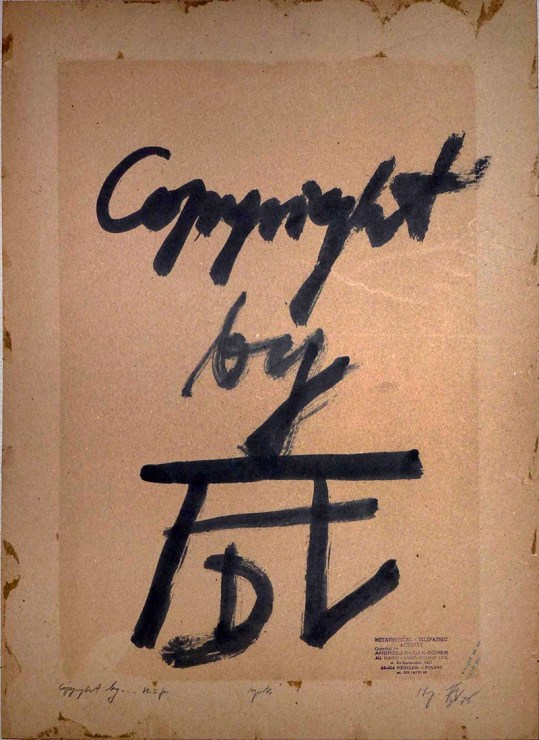
Andrzej Dudek-Dürer, Copyright by…n.s.p , 1975, ink on cardboard, 50 x 70 cm, photo: courtesy of the artist
Andrzej Dudek-Dürer is constantly searching and experimenting. His multidimensional work is impossible to place in the framework of artistic schools, movements, or forms of art. Krzysztof Jurecki, who has been doing research in Dudek-Dürer’s art, writes:
It is difficult to tell what the core of his work is – performance, photography, graphics, video? Maybe he himself as the idea of a ‘living sculpture’ which comprises all forms of multimedia activity. His moral approach and focus on transcendence are worthy of appreciation. He has for sure found new aspects, also formal ones, in many forms of art, such as performance, graphics, photography or video. He successfully expands the eternal problem of discourse on the obligations of the artist and art as such.
The works and documentary materials of Dudek-Dürer’s work are located in many private and public collections, including the National Museum in Warsaw, the National Museum in Wrocław, the City Museum of Wrocław, Muzeum Sztuki in Łódź, Zachęta - National Gallery of Art in Wrocław, Centro de Arte Actual in Barcelona, Stedelijk Museum in Amsterdam, Museum of Modern Art in New York, Tate Gallery in London, City Art Institute Library in Sydney, the School of Art Institute of Chicago.
Author: Michał Jachuła, translation: NS, June 2016
Awards
- 2014 - Special Award of the Minister of Culture and National Heritage
- 2014 - Special Award of the Marshal of Lower Silesia
- 2011 - Scholarship of the Ministry of Culture and National Heritage
- 2002 - Scholarship of the Ministry of Culture
Selected individual exhibitions/performances:
- 2016 - Plejada Artystów Współczesnych / Array of Contemporary Artists - Andrzej Dudek-Dürer, the National Museum in Wrocław
- 2014 - Meta… Korelacje Czasoprzestrzeni / Meta… Correlations of Spacetime - Andrzej Dudek-Dürer, Galeria wspólna in Bydgoszcz
- 2013 - Andrzej Dudek-Dürer installations, video, graphics, photography, objects - Arts Centre Gallery EL in Elbląg
- 2012 - Meta Przemiana II, Andrzej DUDEK-DÜRER Żywa Rzeźba / Meta Transformation II, ANDRZEJ DUDEK-DÜRER Living Sculpture, Galeria Stara ZPAF in Warsaw
- 2011 - Meta Przemiana I, Andrzej DUDEK-DÜRER, Żywa Rzeźba / Meta Transformation I, ANDRZEJ DUDEK-DÜRER, Living Sculpture, The City Museum of Wrocław in the Old Town Hall, PATIO Gallery
- 2010 - A. DUDEK – DÜRER, CROSSING - IN TIME AND SPACE. LIVING SCULPTURE, Art Space Leguit Antwerpen
- 2009 – 2010 - The Mental Steps - LIVING SCULPTURE of A. Dudek-Dürer, WRO Art Centre in Wrocław
- 2006 – 2007 - A. DUDEK-DÜRER, REKONSTRUKCJA TOŻSAMOŚCI, Fotografia i wideo, prace z lat 1965 – 2005 / A. DUDEK-DÜRER, RECONSTRUCTION OF IDENTITY, Photography and video, chosen works 1965 – 2005 - a retrospect presentation shown in BWA in Jelenia Góra, the National Museum in Wilanów, the National Museum in Bratislava, BWA Wozownia in Toruń, Galeria Fotografii in Wrocław, BWA Galeria Bielska in Bielsko Biała
- 2000 – Przenikanie Czasoprzestrzeni I; Performance, Wystawa / Permeating Spacetime I; Performance and exhibtion, BWA Awangarda in Wrocław
- 1997 – Działanie Metafizyczno Telepatyczne W 526 Rocznicę Urodzin Albrechta Dürera / Metaphysical-Telepathic Action on the 526th Anniversay of Albrecht Dürer’s brith, Black Black Gallery in Budapest, alongside with an individual exhibiton
- 1990 – Life, Travel, Meeting As Art…,The School Of The Art Institute of Chicago in Chicago
- 1987 – Metaphysical-Telepathic Space 15., performance, Demarco Gallery in Edinburgh
- 1983-1994– Sztuka Podróży I-XVII / The Art of Travelling I-XVII, Germany, the Netherlands, Denmark, Belgium, France, England, Czechoslovakia, Cuba, Spain, Portugal, Italy, Canda, Mexico, USA, New Zealand, Australia, Singapour, Thailand…
- 1979 – Tworzenie – Niszczenie / Creation – Destruction, Galeria Katakumby in Wrocław
- 1976 – Informacja – Dezinformacja - Działanie Metafizyczno Telepatyczne / Information – Disinformation – Metaphysical-Telepathic Action, Wrocław and the World
- 1974 – Sztuka Sitar – Działanie Jednomiesięczne / The Art of Sitar - One-month action, Wrocław
- 1973 – Autoukrzyżowanie, performance / Self-crucifixion, performance, Galeria Jednoosobowa in Wrocław
- 1971 – Sztuka Chleba – Sztuka Pizzy – Sztuka Jedzenia / The Art of Bread – The Art of Pizza – The Art of Food, Wrocław, Berlin, Amsterdam, Edinburgh, Phoenix...
- 1969 –2016 – life performance Art of shoes — Art of Trousers — Art of Andrzej Durek-Dürer (Living sculpture) in Places Where He Appears…, Wrocław, Berlin, New York, Tokyo, London, Seoul…
Selected group exhibitions:
- 2014 - Army of Telegraphists, Galeria Jaqueline Martins in São Paulo
- 2013 - MOVING ART BOX, Neuer Kunstverein in Wuppertal
- 2011/2012, 2. - VISEGRAD SYMPOSIUM + AUSTRIA, Egon Schiele Art Centrum- Museum in Český Krumlov
- 2011/2012 - WroConcret. WROCŁAWSKI TEKST WIZUALNY 1967+ / WroConcret. WROCŁAW VISUAL TEXT 1967+ , Muzeum Współczesne in Wrocław
- 2010 - Konceptualizm. Medium fotograficzne / Conceptualism. Photographic medium, Muzeum Historii Miasta Łodzi in Łódź
- 2009 - WRO 13 Biennale Sztuki Mediów 09 / WRO 13 Biennale of Media Art 09, Wrocław
- 2009 - Zwiadowca / The scout, CSW Łaźnia in Gdańsk, BWA in Bielsko Biała
- 2008 - Between Changing..., performance, Panipanama and Polish Institute in Leipzig
- 2007- 2008 - Bliźniemu Swemu... X aukcja na rzecz Towarzystwa Pomocy im. św. Brata Alberta / For Your Fellow… an auction to aid the St. Albert Beneficial Society, exhibition in Warsaw, Wrocław, Katowice, Kraków, Rzeszów
- 2007 - Polska Fotografia w XX wieku / Polish 20th century Photography, Palace of Culture and Science in Warsaw
- 2006 - Urban Potentials, Dresden
- 2006 - XX Wiek w Fotografii Polskiej z Kolekcji Muzeum Sztuki w Łodzi / The 20th Century in Polish Photography from the collection of Muzeum Sztuki in Łódź, presentation in Shoto Museum of Art in Tokyo i Nigata City Art Museum in Nigata, Japan
- 2005 -2008 - 26, 27, 28, 29 International IMPACT Art Festival, International Art Center of Kyoto
- 2005 - Variable State Of Concentration, Polnischer Kulturladen in Lindenau, Leipzig
- 2004 - Tollwood Festival Parallelwelten, performance and video, Munich,
- 2003 - 2013 - La Biennale di Venezia/ Extra 50/ Brain Academy Apartment – Venice 2003; a participant of Venice Biennale 2003-2015,
- 2001 – Hommage A Paul Klee, National Museum, Warsaw, Poznań
- 2000 - Nine Dragon Heads International Enviromental Art Festival & Symposium, Taechong-Lake, Chong Ju (South Korea)
- 1998 – In Orbit Round The Drifting Book, Polish Institute in Budapest
- 1997 – Perfomedia 8 Intermedia Project Venezia
- 1993 – IV Bienal Poesia Visual Experimental, Mexico City’s Subway, Mexico City
- 1985 – Künstler Bücher – Buch Objekte, Oldenburg
- 1983 – Audio, Moderna Museet in Stockholm
- 1981 - Labirynt Samoświadomości / The Labirynth of Self-consciousness, the City Museum of Wrocław
- 1981 - Spotkania Krakowskie / The Kraków Meetings, BWA in Kraków
Selected publications:
- 2014 - Paweł Modzelewski, Andrzej Dudek-Dürer. Uczynić życie sztuką, Format nr 67, pages 110-115, Wrocław.
- 2011 - Paweł Możdżyński. Inicjacje I Transgresje. Antystrukturalność sztuki XX i XXI wieku w oczach socjologa , pages 93, 128, 171,172, 174, 176, 204, 205, Wydawnictwo Uniwersytetu Warszawskiego, Warsaw.
- 2005 - D. Jarosz-Franczak, Transcendencja w performance Andrzeja Dudka-Dürera, MA Thesis, tutor: B. Ostrowska, Uniwersytet Śląski, Wydział Artystyczny, Instytut Sztuki, Cieszyn.
- 2002 - Marcin Czerwiński, Trans- Meeting, Rozmowa z A. Dudkiem-Dürerem; Rita Baum pages 33-41, Nr 5, Wrocław.
- 2002 - C.C. Malzahn, Ein Stadt sucht ihre Seele, Der Spiegel, nr 16, Hamburg.
- 2000 - L. Wiśniewska, Andrzeja Dudka-Dürera wędrówki w czasie i przestrzeni, [in:] Czasoprzestrzenie 1471-2000 [kat. aut.], Studio im Hochnaus
- 2000 - A. Sobota, Trans... Komunikacja, Format, nr 35/36, Wrocław
- 1999 - A. Tiśma, Art as Telepathy, Meeting and (Spi)rituality, ND 14 [Austin, Texas]
- 1997 - KIM, Jae-Young, Nine Dragon Heads – Heritage for the Future, exhibtion catalogue, Chong Ju.
- 1992 - A. Sobota, Andrzej Dudek-Dürer, ND, [Austin, Texas] nr 16.
- 1991 - A. Sobota, Życie jako sztuka, Format, nr 4-5, Wrocław
- 1989 - L. Harris, Life as an Art Form, "Otago Daily Times" [Dunedin], 26 VI 89.
- 1989 - C. Rauber, Bienal lnternacional De Arte Reune 4 Mil Obras Em Brusque, Jornal de Santa Catarina, 5.404-7 de Junho de 89, Brasil.
- 1988 - K. Eliot, "A Polish Story", "Variant" No 4/1988, Glasgow.
- 1986 - K. Groh, Artists’ Books, [exhibition catalogue], University of Oldenburg, Oldenburg
- 1985 - Eulalia Domanowska, Andrzej Dudek-Dürer SCENA Nr 5/84, Warsaw, Poland
- 1984/85 - DOCK/S nr 6/84, 71/85 Ventabren, France
- 1984 - TO GET CLOSE HUMAN CONTACT - Stichting Makkom, Amsterdam, the Netherlands
- 1984 - Voices Through, exhibition catalogue, Stichting Makkom, Amsterdam
- 1983-84 - W. Sztukowski, Bez konwencji, Sigma, nr 1 (123), [Wrocław]
- 1983 - Audio - Moderna Museet, exhibiton catalogue, Moderna Museet, Stockholm.

