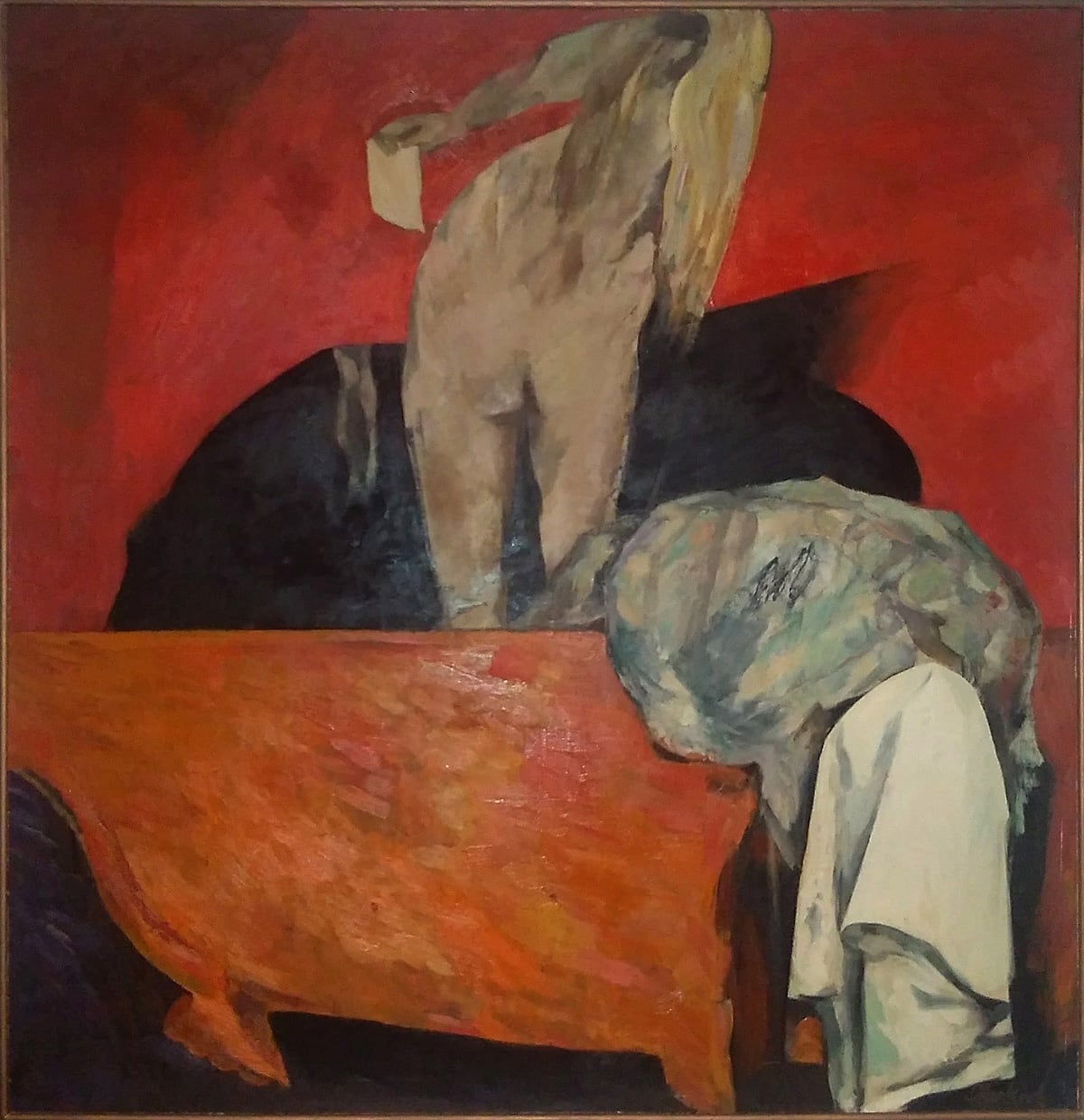
The Death of Marat by Stanisław Frenkiel, 1960s, photo: Antoni Bohdanowicz
Charlotte Corday has just murdered Marat. She is holding the list of names that the French revolutionary wrote down from her oral account. Those were the traitors she denounced in order to get close to one of the bloodiest men the French Revolution had seen.
This is a classical theme, made most famous by Jacque-Louis David, a friend of the deceased Jacobine, but has found its interpretations by Paul Jacque Aime Baudry, and later even by Edvard Munch and Pablo Picasso. But it is neither of these four, who are amazing painters who have caught my imagination more than once, than the work of art I look at and stop to think about every time I have breakfast.
No matter how well I know The Death of Marat by Stanisław Frenkiel, I keep noticing something else, my thoughts move on. Even now as I look at the painting I know so well I keep thinking of new things.
Blood. Where is the blood? Is the blood red orange that surrounds the two heroes supposed to symbolise it?
Where is the dagger? The dagger has often been a hero of this scene, yet it is nowhere to be found, unless hidden in some mysterious shape.
It is a strange thing, bearing in mind it is probably one of the most simple works of the Krakow-born painter. Most of his paintings have a mysteriously disfigured face.
Here we see no faces. Charlotte is a smudge, Marat is covered by a towel. Only the red-orangey background is something you get to notice in many of the authors works.
Nevertheless, welcome to the world of Stanisław Frenkiel.
Forced into exile
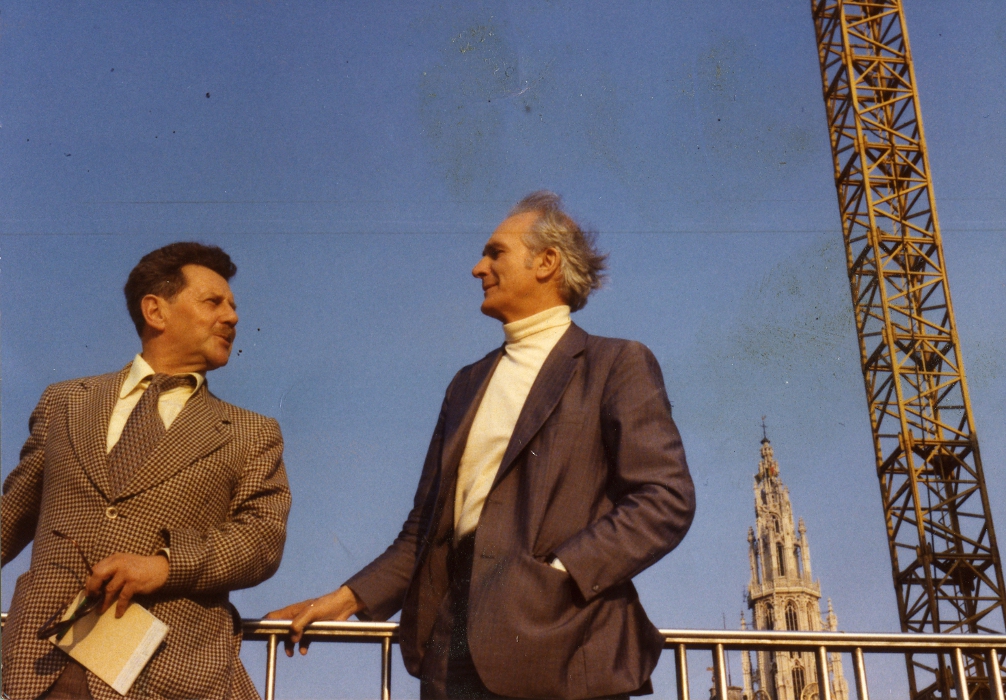
Stanisław Frenkiel with Marian Pańkowski, Antwerp, 1978, photo: www.umk.pl
World War II claimed the lives of many young and talented Polish artists, and plenty of those who survived were forced to spend the rest of their lives exile. These artists had to promote their trade in a hostile environment, where they competed against local talent. Many ended up having to give up on an artistic career, others persevered and managed to make a living from sculpting or painting.
Among them was the 29-year-old Stanisław Frenkiel, who arrived in England in 1947. He had just graduated from the Academy of Fine Art in Beirut, and was to be shortly joined by his wife Anna, and their recently-born son. It was the love for that particular woman that was the cause of many tragic adventures in the life of one of the most prominent painters of the 'London Emigracja'.
It was only 8 years earlier that the artist was in Paris, the city to which he travelled to meet many interesting and influential French artists. Among them Georges Rouault, the magnificent expressionist and Fauvist. The outcome of the war, and the need to be with his fiancée caused Frenkiel to want to return to his home country and survive the war along her side. But in a certain way, this unfortunate adventure had a certain impact on the Kraków-born painter
Grotesque figures
Frenkiel was most known for his colourful and adventurous forms, with lots of burlesque dancers, criminals, and card players. He painted a perverse world full of sex, nudity, violence and death. You also got a taste of classic scenes, like the aforementioned The Death of Marat. But among his colourful paintings full of sex you he also presented gloomy pictures of the atrocities he saw during his years as a Soviet prisoner of war, and later as a soldier in the Polish Armed Forces in exile.
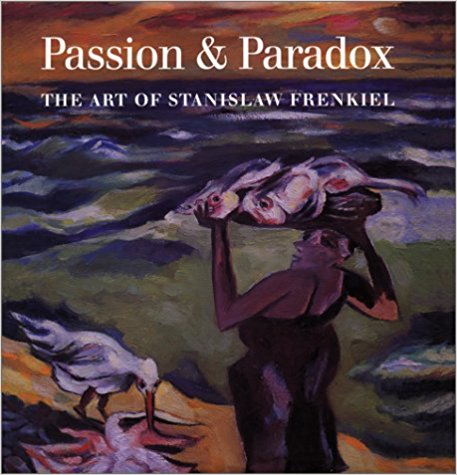
Passion & Paradox, photo: promo materials
In many ways, his sketches reminds us of Goya and the experiences the Spaniard had during the years of Napoleonic occupation. Both artists overwhelm us with the tragedy of war and death. We get to read about this specific style in Anthony Dyson’s book about the artist, Passion and Paradox:
The whole spectrum of Frenkiel’s work, ranging from the mundane to the fantastic, the comic to the tragic, is characterised by his capacity for transformation. His labyrinthine imagination in league with relentless powers of observation and acute psychological insight, can imbue the mundane with majesty or mystery, the fantastic with layers of meaning far beyond the superficial impression of revelry or ritual, and can spice the comic with strange bitterness…
When you look at Frenkiel’s biography, you get to notice what episodes and themes influenced him as a painter and defined his art. Of course we have the war, and portraits of death. But there are also episodes full of life, colour and disfigured degeneration. The first being his childhood in Kraków. As the artist himself wrote in 1975:
Kraków was a town much addicted to celebrations of anniversaries, processions, masquerades and funerals, all of which stayed in my mind from childhood as an unending pantomime or mardi gras with faint intimations of flesh behind the scenes.
French & German influences
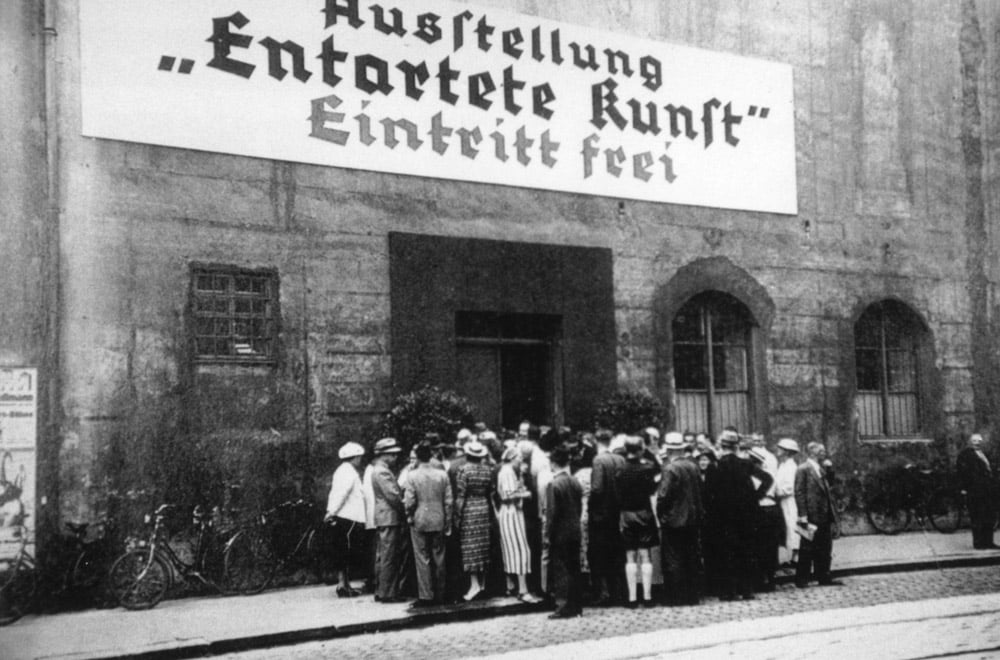
Queues outside the exhibition Degenerate Art, Munich, 1937, photo: Süddeutsche Zeitung/Forum
The next episode in Frenkiel's journey was Paris. He was advised to travel there by Eugeniusz Eibisch, his professor from the Academy of Fine Art in Kraków. He spent a good few months in the capital of France where thanks to certain recommendations he made connections with many leading artists of Polish descent including Moise Kissling. But probably the biggest influence on the up-and-coming Polish painter was that of Roualt. Though Frenkiel’s style is mainly compared to that of George Grosz and Stanley Spencer, you can see that the French painter had deeply touched him and had a large impact on the way he would paint.
On his way back to Paris, Frenkiel stopped by in Berlin, where he visited the exhibition Degenerate Art. This was a presentation of German artwork in its top modernistic form. You had expressionists, Dadaists and cubists. Almost every household in modern art name you could imagine was there. According to historic records, most of this artwork was either sold off by the kilo, and a further 5,000 burnt later on in 1939. Looking at the art that survived the vicious purge of the Nazis, you can see how it helped form the specific style Frenkiel would later develop.
His making in the Middle East
Stanisław Frenkiel, late 1950s, photo: www.umk.pl
But it would take the tragedies of World War II, and later his two years spent in Beirut at the Academy of Fine Art that defined him as an artist. It was the capitol of Lebanon that provided the world with the complete Frenkiel. The artist mentions all of these episodes in his writings titled Beirut Sketches:
I went to Beirut in 1944 on leave from the army in Egypt to visit my wife who was studying medicine at the American University. I was 25, a soldier of the Polish forces in the Middle East under British command. Before the war I had spent two years studying art at the Cracow Academy of Fine Art and had enjoyed a brief stay in Paris where I met other artists of that epoch on the eve of World War II. Early in the war I had been imprisoned in Russia and after an amnesty worked as a free-lance painter: called into the Polish army I was shipped from Russia across the Caspian Sea to Iran. After a year in Teheran I stayed in Baghdad, Jerusalem, Cairo and Alexandria, and towards the end of the war went to Beirut a number of times. When the war ended I was granted study leave to complete my art training at the Academie Libanaise des Beaux-Arts. Thus at 25, I had some experience as a painter and my arrival in Beirut in November 1944 marked the beginning of two happy years with my wife in a civilised atmosphere allowing for work, study and unreserved commitment to art. Apart from studio work at the Academy I was free to... roam the town with my sketch book and to record scenes and events of the community's life in cafes, markets and bazaars, as well as the more distressing sights of the city in the poor quarters where beggars, cripples, drug pushers and houses of prostitution provided rich material for drawing and painting.
Many of those who studied Frenkiel’s art mentioned that it was Beirut that defined Frenkiel as an artist. Simon Wilson, the former curator for interpretation at Tate, wrote ahead of an exhibition of Frenkiel’s paintings at the Royal West of England Academy in 2003:
He continued to develop his vision in the marvelous graphic works he made in Beirut in the immediate post-war period. These are among the best things he ever did – his drawing style had matured and he had access to finer materials – the results are pen, ink and wash drawings, some beautifully heightened with monochrome colour wash, that are miracles of observation.

