Some of the factory owners made enormous fortunes in Łódź. It wasn’t uncommon for them to build entire palaces, which still stand in today’s Łódź. For example, among the richest was the German Karol Scheibler, who was so influential that at a certain point he owned almost 15% of the city’s land. He was known for his uncompromising work ethic involving coming to work at the same time as the labourers (5 in the morning) and staying until late in the evening. His great rival was the aforementioned Jewish manufacturer Izrael Poznański. A number of the representative structures this extremely wealthy businessman had built house important institutions in today’s Łódź. His monumental, neo-baroque palace is where the Musuem of the City of Łódź operates, the neo-renaissance residence he gave his daughter as a wedding gift accommodates the rectorate of the Medical University. The two gentlemen, along with Ludwik Geyer, made up the so-called ‘big three’ of Łódź’s textile industry.
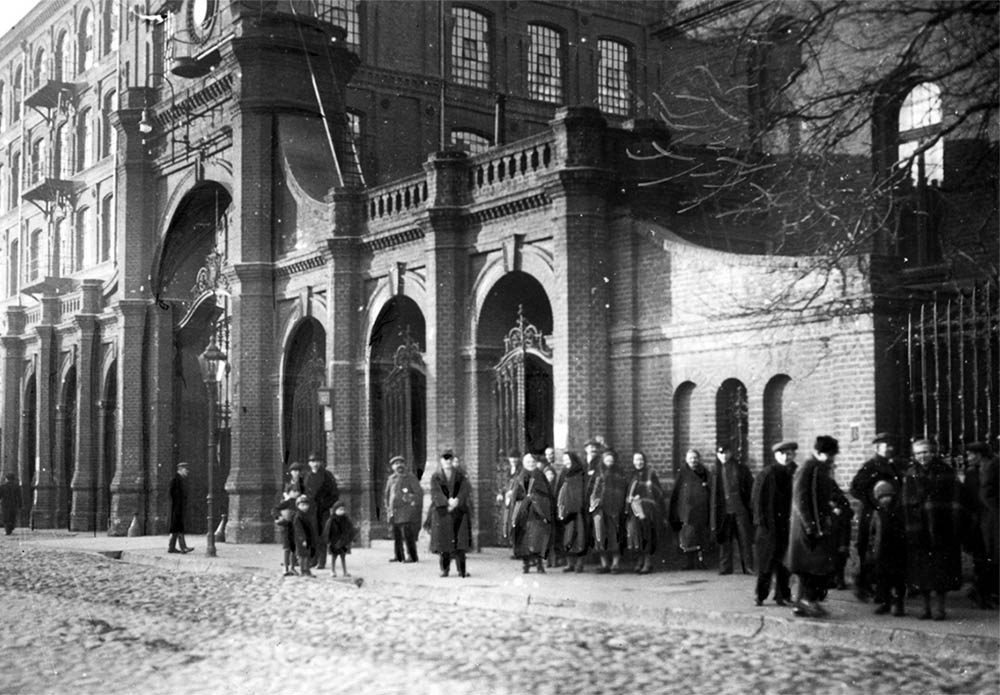
The I.K. Poznański Cotton Products Company in 178 Ogrodowa Street, Łódź, photo: www.audiovis.nac.gov.pl (NAC)
The tycoons of Łódź would even build entire private neighbourhoods consisting of worker’s houses, industrial facilities and impressive residences. Księży Młyn, the area created by Scheibler, boasted a massive spinning mill, a hospital, a school, shops and even a fire station. The numerous industrial complexes spread throughout the city included bleaching and weaving plants, dyeworks, textile printing shops and subsidiary facilities like gasworks and brickyards. The many streams provided water power and fed the steam machines.
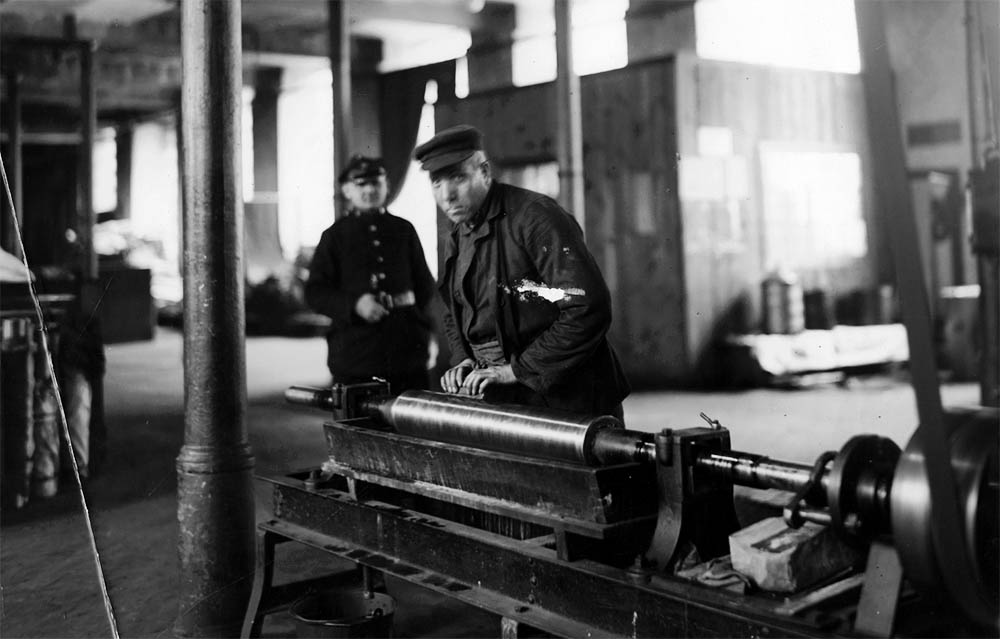
An unidentified weaving plant in Łódź, 1930-1938, in the image a worker by the surname Matuszewski at a printing machine, photo: www.audiovis.nac.gov.pl (NAC)
The persistent flow of great numbers of people to the city resulted in chaotic urban development, which was visible especially in the suburbs – the authorities didn’t cope with planning well enough. But despite that, the golden age left behind plenty of extraordinary architecture. Apart from the residences of the manufactureres, some of which were designed very tastefully, and the industrial buildings that from today’s perspective are valuable historical monuments, Łódź also gained a number of beautiful tenement houses. The Art Nouveau ones along the city’s most famous street Piotrkowska are surely noteworthy.