Rubanova is the author of several significant research papers, many of which fell victim to censorship in their time. Exclusively for Culture.pl, Irina Ivanova discusses how Poland became her second homeland, her opportunity to interview Zbigniew Cybulski, what Soviet cinematographers learned from the Poles, and why culture must be separated from politics.
Denis Viren: Irina Rubanova, how did you first become interested in Polish cinema? Specifically, why Poland?
Irina Rubanova: It all began, as you might say, because of fate, but actually it was a complete accident. I had graduated from the philology faculty at Moscow State University and did freelance work for the journal Voprosy Literatury (Вопросы литературы/Literature Questions), but I earned money in ‘the publishing house of light industry.’ My focus was perfumery and confectionery. Our department wrote brochures about inventions in these areas. For example, I got to visit the Red October factory in connection with a brochure I was writing called Design and Function of the Polurepka Packaging Machine (which wrapped truffles). My husband Ilya Kabakov was always telling me: ‘How long will you keep doing this? You should leave. Somehow we will survive.’
On the other hand – and this hand was more active – Leonid Kozlov, my friend, and classmate, as well as a film expert, kept telling me ‘Shame on you. Why don’t you want to go to graduate school?’ And I answered: ‘For what?' ‘For film.’ To that, I answered ‘Lenya, you are the one who likes film. I don’t.’ I was a theatre-lover, and if I could choose what to study, I would have chosen theatre. Yes, I did write film reviews for the faculty newspaper, but through coercion by that same Lenya, not because it interested me. I was absolutely indifferent to film. It didn’t grip me. But then… It happened during the International Festival of Youth and Students in Moscow in 1957. It was the most wonderful moment of our lives. For the first time, I saw abstract portraits in the original, not reproductions. I remember a fantastic Japanese exhibit. I remember the student theatre Bim-Bom from Gdańsk with Zbigniew Cybulski and Bogumił Kobiela... and then I saw Andrzej Wajda’s film Kanal.

Scene from the film Kanal by Andrzej Wajda 1956, photo: Polfilm / East News
What about that film struck you?
The main thing was that I suddenly felt that film was a serious thing, that it could think and speak like the high arts of theatre and literature. Secondly, I was surprised by its historical plot, it was a story I had never known. And when Kozlov once again started going on and on about a graduate programme and said that with all ignorance on the subject, I could easily apply with a topic on the cinema of some communist country, for example, Czechoslovakia, I replied, ‘No, I want Poland.’ He was very happy, ‘Poland is very good! Write an abstract to avoid any ideological pitfalls. Pick a subject on a genre like Polish comedy, without getting into the historical jungle.’ Lenya arranged a preliminary meeting for me at the Institute of Art History with Rostislav Yurenev. Yurenev's verdict was this: ‘Intelligent woman, but very innocent.’ To that Kozlov said: ‘Rostislav Nikolaevich, it is innocence that is easiest lost.’ Such was their academic discussion.
I submitted the documents and began to go to Gosfilmofond (National Film Foundation) to watch Soviet and world cinema, which Kozlov had said was essential. I read. But the fact was that I didn't know a thing about film. Luckily the admissions committee didn't know anything about Polish cinema and could not torment me with questions about it – that was a happy coincidence. The second language I had studied at university was Bulgarian (the first, German), but I quickly began to read the Polish journals Film and Ekran. Therefore, I already knew some things about Polish cinematography that the examiners did not know and therefore couldn’t ask about. Yurenev had seen a few Polish films and considered them very revisionist. It just so happened that there was a campaign against revisionism later on, and he wrote a disgusting article On the Impact of Revisionism on Polish Cinema Arts (this was actually after I had enrolled, but more on that later). I babbled something here and there and the committee wanted to accept me, I could feel it. Yurenev immediately said that he would be my academic advisor. Probably, in order to drag me along somewhat, they asked me about the film We are from Kronstadt (Мы из Кронштадта) directed by Efim Dzigan. I’d seen it, but I barely remembered it. ‘Well, then what do you remember?’ I say: ‘I remember smoke, smoke…’ From that Yurenev made the conclusion that I had a cinematographer’s eye. ‘Others would remember the plot twists.’ Thanks to the smoke I was accepted.
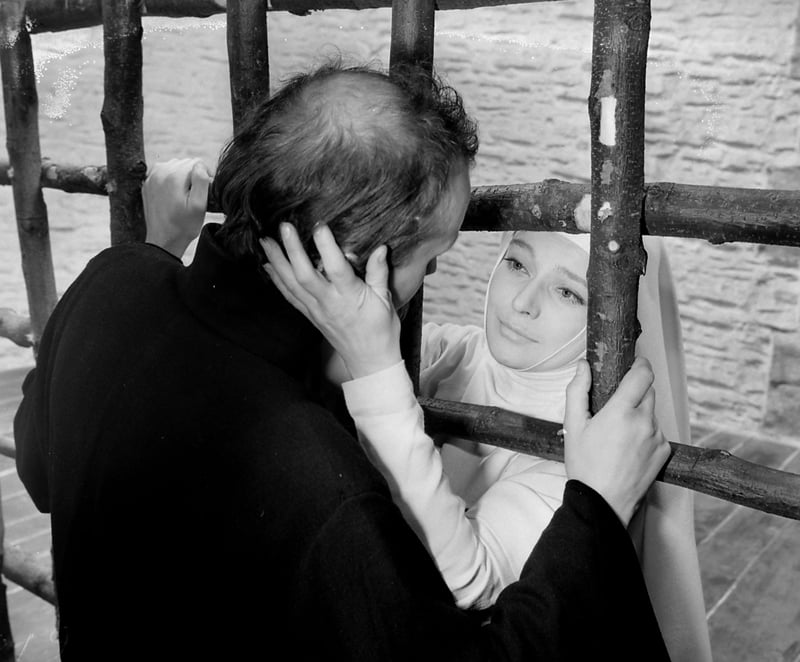
Scene from the film Mother Joan of the Angels. In the photo: Lucyna Winnicka and Mieczyslaw Viot, photo: ZRF Kadr / Album / East News
So you were accepted to thoroughly study Polish cinema…
It helped that soon after my acceptance to the Institute the Art of Socialist Countries Sector was opened. It was headed by Igor Fyodorovich Boelza. He had a tough time recruiting personnel – at that time there simply weren’t any specialists – and was so desperate that he even brought in two people from China, who quickly disappeared. Boelza was a specialist in Polish studies and a Pole himself. His focus was Polish music. He supported me in my growth as a Polish film expert. I didn’t leave Gosfilmofond until I had watched every Polish movie they had. Igor Boelza introduced me to the Cultural Attachéat the Polish Embassy where they put on exhibitions (it was then located on Mickiewicz Street, now its Great Patriarch’s Lane). It was there that I saw Mother Joan of the Angels by Jerzy Kawalerowicz. In my graduate programme, I had begun to study Polish. The Culture Department at the Embassy helped me and provided me with educational materials. Incidentally, my colleagues thought that my first notable article was about Mother Joan. They fawned: ’Where did you get all that knowledge from?’ I didn’t know, I just had truly liked the film. It became one of my favourite Polish films. That and all of Wajda’s work.
When did you first visit Poland?
In 1962, with a tourist group from the Union of Soviet Friendship Societies. They arranged the trip for people of culture. It was, first of all, an introduction to the country: Warsaw, Gdańsk, Kraków… In Kraków, we were fortunate enough to meet with Tadeusz Kantor. The playwright Alexander Stein was in our group, therefore the organizers figured that we needed to be taken to the theatre. We went to the Krzysztofory Palace, where Witkacy was playing. Kantor was there. He talked with Stein. I didn’t interfere in the conversation, but I got to see Kantor’s style of theatre. Honestly, I was shaking from excitement. I still did not realise how great a man he was: sitting in the basement of Krzysztofory Palace, putting on a semi-amateur play.
How did your first come in contact with Polish filmmakers?
I was lucky because my article about Kawalerowicz seemed to make an impression on Sergei Iosifovich Yutkevich, who was my colleague from the Institute and read a lot of our work. He loved to walk down the halls and chat about reading and films. Yutkevich treated me seriously, which surprised me a little, and took care of me, as he was the chairman of the Foreign Commission of the Union of Cinematographers.
And then, in December 1963, a delegation of Polish filmmakers headed by Stanisław Różewicz came to Moscow. The journalist Krystyna Garber from Film magazine and the film expert Zbigniew Czeczot-Gawrak from the Institute of Art of the Polish Academy of Science were also there. Yutkevich insisted that I join them. But I had a small child so I declined. A translator was found for them in Moscow, but I agreed to go with them to Leningrad. I really liked Różewicz. We became friends and stayed friends until his death. He was one of the most wonderful people I had in my life. He then brought Certificate of Birth to Moscow and Leningrad, where it was very warmly received. There was a certain comradery with these people, we got along well. We could talk about so much. I remember getting onto the Red Arrow train and I immediately ran into actor Misha Kazakov, who I knew very well at that point and Shakespeare scholar Alexander Abramovich Anikst. The train car was packed with artists going to shoot with Lenfilm and I invited everyone to a showing at Film House (no one came). This impressed Różewicz: ‘You are the star here!’ This was the beginning of my direct, personal contact with Polish film. Later, I made more acquaintances. Of the greatest filmmakers, the only one I was not well acquainted with was Andrzej Munk (we did once meet at the Moscow Film Festival, where he came to present a film by Jerzy Passendorfer. We shook hands and that was all). It already seemed to me that Polish film was simply mine. I learned about the history of the country, which was the principal material for the school of Polish film. In fact, I considered Poland to be my second homeland. And all because of that fatefully showing of Kanal, which as I now remember, took place at the Forum theatre.
As far as I know, in the beginning of your academic career, you received help from the brilliant film historian Jerzy Toeplitz.
He, as the director of the Institute of Art at the Polish Academy of Sciences, invited me to work with him for an entire month. It was my first academic trip to Poland. I was summoned to the Goskino International Department and was asked why I was invited for a whole month. ‘We know that you study Polish cinema, but in this business, no one is necessary for that long.’ I did not actually know why. Prior to that, I had barely gotten to know Toeplitz. We had many mutual friends, from when I first went to the festival in Krakow, where I met Alexander Jackiewicz and Bolesław Michałek, the famous Polish film critics. The Institute planned my trip. Mainly I sat in the Polish Film and watched films. I took a trip to Kraków where Stanisław Wyspiański’s The Wedding (Wesele) produced by Andrzej Wajda was playing. In general, I didn’t attend many meeting, if so, they were mainly with critics. Jackiewicz was a charming bon vivant. He entertained me. I became great friends with Michałek and we remained friends until he died. Toeplitz said: ‘Call me Tuś.’ It was his nickname, and thus I called him a friend.
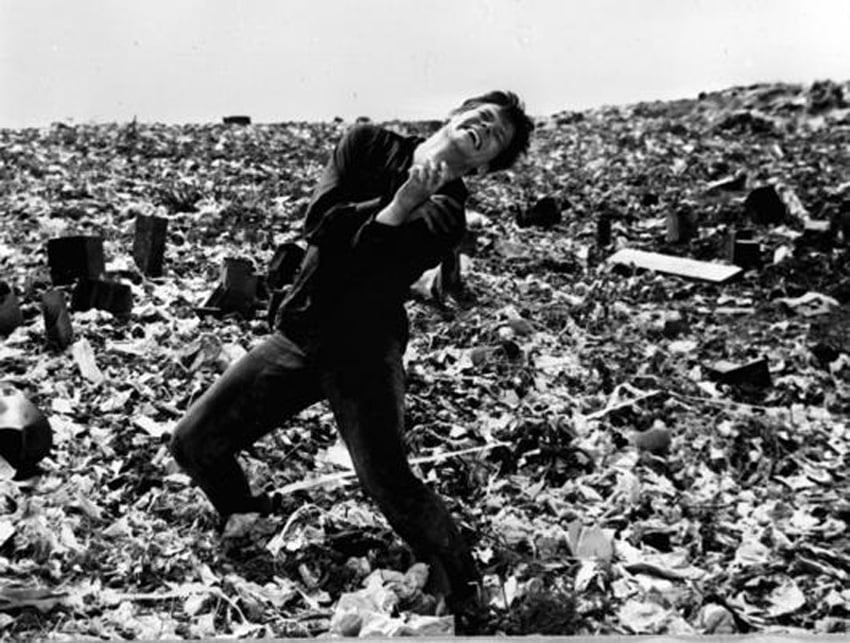
Scene from the film Ashes and Diamonds by Andrzej Wajda 1958. In the photo: Zbigniew Cybulski, photo: Studio Filmowe Kadr / Filmoteka Narodowa / www.fototeka.fn.org.pl
You are the author of a number of books, which for various reasons were not published, and one of them was about Zbigniew Cybulski.
I worked on that Cybulski book enthusiastically. Of course, I needed to meet him. I was told: he will not say much to you, he is quite an eccentric, very shy... and all of that was generally true. Wajda said Cybulski is interested in everything around him. Wajda actually acted it out for me: here, you arrange a meeting with Zbyszek at a restaurant, you sit opposite him, talk to him and the whole time he’ll fidget and observe – who came in? what’s happening over there? Cybulski’s curiosity knew no limits. He absorbed every experience like a sponge. If he ever paused for a moment of self-reflection, he kept it to himself. Thus, I prepared for our meeting.
Krystyna Garber was good friends with Cybulski and she invited us both to her place. He came early. It was 1965 or 1966 and he was already a bit heavyset. Along with the book, I had prepared a big television programme about him. He was proud and happy and said that he would absolutely come to Moscow. The broadcast occurred at the beginning of 1967, literally on the day he died. But according to Krystyna, Cybulski made no plans to come to Moscow. He only smiled and said he was upset with Russia, but knew so little about it. It surprised him that everyone who visited from Russia was nice. And when I asked him about the Moscow Film Festival of Youth and Students he said that it was wonderful there. He would long remember the days he spent in Moscow with Bobek (Bogumił Kobiela). I had a whole list of questions. Cybulski looked at me sideways and said: ‘Let’s talk!’ And then smiled his white-toothed smile.
Several books about him were published, but not one interview. When I later talked about this with Wajda, he answered: ‘Yes, he that’s the kind of guy he was… Once we were putting on the show Two for the Seesaw and I said, “Zbyszek, let’s chat.” “Let’s. What’s wrong?” “Nothing in particular. Just that we should try something different here, change it up a little.” “Ok, now you and I are going to a house, the host there is such a beauty and so cheerful, simply Marilyn Monroe…” “Zbyszek, what Marilyn Monroe? I want to talk!” “And we are talking!”. Well, you can imagine how that conversation went.’ And I really regretted that I did not get another chance to speak with Cybulski – neither in the journalistic or academic sense. I did not know him as a person. I only saw some sort of mask, a character.
And you never finished your book about Cybulski?
The publishing house Art (Iskusstvo) planned on publishing the book in the Masters of Foreign Film Arts series (in 1973 my Konrad Wolf appeared in that series). I had a very good relationship with the editors, including Victor Dyomin and Valeri Fomin, famous critics, excellent editors. But when the 1970s arrived, some unrest began in Poland and the Central Committee of the party created lists of banned works and artists. One by one, Polish names disappeared from the Soviet Encyclopedia’s Film Dictionary. Then, a semi-official letter came to me stating that my book on Cybulski could not be published.
Since you were studying Poland, how often did you feel discomfort knowing that not all of what you wanted to write could be published? Despite the official views on Polish cinema you had already begun your dissertation, which would become your first book Polish Film: Films on War and Occupation (Польское кино. Фильмы о войне и оккупации).
My problem was not with Poland, but with my academic advisor, Professor Yurenev. I was to give an overview of the literature on Polish film in my dissertation. At the time, serious publications in Russia were printing almost nothing on Polish film except that article by Yurenev on revisionism in Polish film. Yurenev’s article was the largest text on the topic. I didn’t discuss it at all. I simply wrote – and I feel like I expressed it well – that the view of Polish film in this work reflected the basic level of understanding of the subject... (laughs). They say, what is not known is not understood. Yurenev became furious, banged his fist on the page with this sacramental phrase and stated that he refused to be the academic advisor of this dissertation. He stood up and very theatrically left. Poor Boleslav Iosifovich Rostotsky, the replacement for Igor Boelza for head of the department, called me that night and asked if I would not object to him being the editor of the book that was planned for the publication Science. I answered: ‘I worship you! You are really helping me out.’ Preparing for my dissertation defence was no less intense. Many refused to go against my former advisor: ‘I heard you have a conflict with Yurenev? You understand we are colleagues, we work at theState Institute of Cinematography…’ Georgy Aleksandrovich Kapralov did not refuse, that was a miracle, and same went for Igor Fyodorovich Boelza.
It was your first clash with the official position. And they did not publish your book about Cybulski. Were there other kinds of difficulties?
When I finished my book on Wajda, Solidarity had begun, and the academic secretary of the Institute for Art Studies Haychenko told me: ‘Let’s put your book on the back burner for now.’ I figured this was because the book wasn’t ever brought to the academic council. Still, I was working on a small book on Polish documentary film: mainly war films, but also on the modern films of Marian Męziński and Władysław Ślesicki. I finished this book in 1968, which was also the year I signed a letter in defence of Ginzburg and Galanskov. This is where the next part of the ‘witch hunt’ began. And although I was far from the most famous person to sign it, Haychenko said: ‘Everything is fine. The book is already written.’ And it disappeared. Later, I tried to recover it, but I had only saved fragments. The entire manuscript was not even in the archives of the Institute. But I don’t even regret it. I do, however, regret the Cybulski book. I regret that I was not able to finish it.
In your opinion, what could Soviet filmmakers learn from Polish cinema?
A few years ago at Gosfilmofond, there was a roundtable on the lessons of the cinema arts from former Socialist countries. The organisers published the statements of a few directors: if they been influenced by foreign cinematography, in what way. The majority commented superficially. Only Sergei Solovyov thoroughly examined the essence of the subject. He arrived at the same conclusion, which I had mused about long ago. In the 1960s, when the Thaw began to decline, Soviet cinema was brilliant but had stalled in development. Innovation comes from difficulty; it does not simply happen. The model for innovation, though not publicly acknowledged, came from the outside. It was Polish cinema, mostly Wajda’s films shown in closed or semi-closed screening. One of the Polish delegations gave a copy of Ashes and Diamonds ( to VGIK (Thanks!), and ever since, each new generation of students has watched this film. Wajda was the uncrowned leader of the time – meaningful in the modernity of the language and in the method and mannerisms of the actors. Personality and story were also inherent in Soviet cinema, but vivid, full-bodied commentary was rare. No other Soviet filmmaker ever reached the heights of Andrei Tarkovsky’s Andrei Rublev.
Tarkovsky, incidentally, acknowledged that the experience of Polish cinema had been valuable to him. There was a time when we lived near each other and spoke often. Once when he was offended by changes to Andrei Rublev he told me: ‘I am so sick of them all! I told them: you will torture me and I will leave, I will go to Poland and be hired as a cameraman by Wajda. He will take me on. He can’t not take me! I have an uncle who fought in Piłsudski’s Legions. Later, Wajda told me that a young Andrei Konchalovsky came to Poland and searched for opportunities to work there, ideally, of course, in film. For Soviet film, Poland was a beacon.
But an unreachable beacon, as no one achieved these dreams…
Of course, the level of freedom was completely different. Recently a wonderful book by Tadeusz Lubelski came out in Poland called Historia Niebyła Kina PRL (editor’s translation: The Non-Existent Story of Polish Cinema). To be fair, it would be impossible for us Russians to write such a book because it would have so many volumes. Yes, in Poland the censorship was lighter. The censors were not interested, for example, in the style, form, language, which for us had been regulated for a long time. But people thought that they could come to Warsaw and do whatever they wanted. And this, of course, wasn’t true.
But they allowed more?
Without a doubt. Polish censorship didn’t touch anything concerning form or style. It didn’t pay attention to those ‘details’. But in the USSR, there was a formal doctrine, a code of rules, that included style and drama.
You participated in the purchase of Polish films for Soviet showings…
A group consisting of distributors, film experts and representatives of the Central Committee Ministry of Culture would go to foreign countries to buy films. Once I went with such a group to Poland and once to Hungary. I’m proud of the fact that I purchased The Saragossa Manuscript by Wojciech Has while in Poland. The distributors were rapt by this film; in fact, it was what is now called a ‘blockbuster’. The representative from the Ministry of Culture was a film expert by education, professed moderate views and we voted to buy it. The people rushed to see The Saragossa Manuscript. It ran for a long time. The then-head of Goskino Ermash said, pointing his finger at me: ‘This is the one that bought this harmful film!’ He believed it was harmful, and when someone at the reception at the Polish Embassy asked what the problem was, because the film was so good, Ermash explained: ’Sure it’s good, but you must understand…’ Even now I don’t understand what needed to be understood. I don’t remember any movies from our trip to Hungary that we wanted to fight over. Other than purchasing them, I felt no connection.
Despite the strict control over the films shown festivals, in 1979 at the Moscow International Film Festival, Krzysztof Kieślowski’s Camera Buff ( was entered into the contest and won the Grand Prix.
It was a game. The reputation of the Moscow Film Festival (MMKF) was heavily tarnished at the time. It was believed that it was controlled from behind the scenes and that the jury decided nothing. I don’t know who selected Camera Buff; possibly it came from some sort of agreement with the Polish cinematography leadership. I guess that someone from the Polish ideologues told them: here’s a film about work, it’s director hasn’t disgraced himself, and there’s no connection with the Worker’s Defence Committee. It was hard to fix the reputation of the MMKF, but this was probably an attempt. However, no one understood that Camera Buff was an example of the trend of the Cinema of Moral Anxiety. If they had known that, they wouldn’t have shown it.
What can you say about new Polish cinema? In recent years, it has really changed.
My knowledge of it is sketchy… Of course, it has radically changed in comparison to the Polish School and Cinema of Moral Anxiety, although some crumbs from the latter still remain. There are some lovely films as well as ones I am not crazy about. I may be mistaken, but it seems to me that this cinema can’t inspire society – though now society is quite different, so it must be roused by something different. Right now Polish cinema, as a rule, is highly professional. Highly-trained people are doing it. It’s especially apparent in the visuals. I am not inclined to see reasons for this within Polish culture. Instead, look at the world of cinema as a whole, or at least European cinema. It is absolutely colourless, nothing is happening there. It does not inspire a moving social response.
Irina Rubanova, your professional interests include Hungarian and German film and of course, Bergman, but still, Poland holds a special place both in your work and in your life.
Undoubtedly. Poland means so much to me – despite the fact that lately, it is often possible to meet with unfriendly reactions to Russians, and I’m not talking about Russia as a state. Poles have many reasons to be upset with Russia – both historically and in the present. I remember I spoke a bit about this with film expert Yura Hanyutin. In Poland, a sort of fermentation is just beginning. He also loves Poland and said: ‘What a wonderful country! They are always unhappy and they never get used to anything.’ And I thought: indeed he’s right. Poles have something in them, like a stainless Komsomol-like motor, that is always waiting for something to start it up over and over and over again.
Interview conducted by Denis Viren, 14 Jan 2015; Translated by KA, 25 Feb 2017