Can Only Pretty Girls Emancipate Themselves?: Polish Selfie-Feminism
In 2015, Richard Prince – one of the leading representatives of appropriation art – produced one of his most famous works, 'New Portraits'. The use of borrowed imagery is normal for Prince, but this time, the images were slightly different than before.
Adjusting vision
The artist used 38 photos from Instagram published by women ranging from Kate Moss to much less – or not at all – publicly recognisable women living in precarity. When Prince reached for theoretically private photos, without asking their authors for permission, the field of impact was much greater than when he had used the recognized cowboy images from Marlboro commercials years earlier. Zofia Krawiec summarized her reactions to Prince's project:
The young journalist Karley Sciortino, author of a sex column for Vogue, wrote that she was very honoured to be part of the work of such a great artist. Sita Abellan, a Spanish model, DJ and Instagram star, admitted she felt honoured but understands why other girls might not have liked it. And finally, Anna Collins, a working student, expressed unequivocal opposition and confessed that she felt used and robbed.
Among the photographs appropriated by Prince, there is also a photograph of a young artist from Los Angeles named Audrey Wollen. Wollen is lying naked on a bed, copying the pose from the famous painting by Diego Velazquez The Rokeby Venus, only that in this case the mirror has been replaced by a computer screen. With this photograph, Wollen started her selfie-feminist mini-revolution. It is no coincidence that Wollen chose this image from dozens of famous modern representations of Venus. The Spanish painter's work was attacked with an axe by the suffragette Mary Richardson in 1914 as a symbol of patriarchal oppression, an image of a passive woman reduced to an object of gaze and sexual desire. Wollen also devoted a video work to this event, presented last year at the Museum of Modern Art in Warsaw for the exhibition Ministry of Internal Affairs. Intimacy as Text.
Although the iconoclastic act of destroying the painting has been described by more sympathetic commentators as radical, by less forgiving ones – as mad, there is no denying that the art-historical analysis of the painting's meaning was quite to the point. Many years later, the artist and art critic John Berger, in his famous series of mini-documentaries made for the BBC and subsequently published as a book under the title Ways of Seeing, made a more detailed analysis not only of this painting, but of the classical motif of the female nude as such (while refraining from blows).
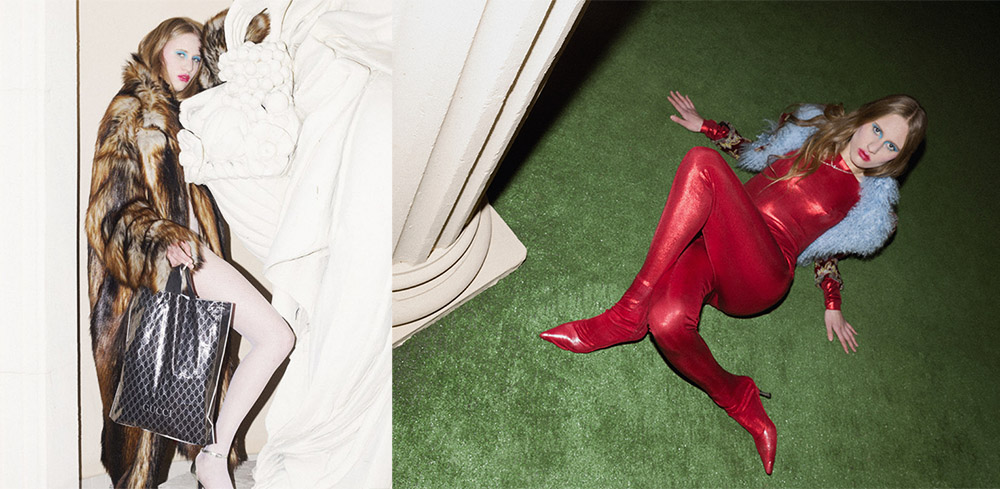
Coco Kate @coc0m0
The self-portrait in the Venus pose was followed by numerous other photos of Wollen published by the artist on her Instagram. Wollen crying, bruised, sitting in a doctor's office... The LA-based artist became the godmother of all feminist selfies, the creator of the theoretical foundations for emancipation through selfies with smudged glitter and skimpy outfits – the Sad Girl Theory. A girl who, instead of internalising her oppression, externalises it, thus undermining abusive mechanisms, or at least bringing them to light, sharpened by using an appropriate filter. Why girls and not women? It's not just the young age of the artist – since patriarchal society infantilises women, Wollen takes up this game and searches for tools of resistance in girlhood. Reaching into the past, Wollen found quite a rich tradition of sad pioneers – from the mythological Persephone and Catherine of Siena to Virginia Woolf and Sylvia Plath. The sad girl stood in opposition to the demands of self-acceptance and exuding strength that, at least in her view, contemporary feminism enforces.
For Wollen, Instagram became the most obvious territory to conquer. After all, it is there that girls voluntarily fight to create the perfect image. It is there that the slogan of second-wave feminism ‘the personal is political’ finds its literal illustration; intimacy and the public sphere merge into one. In 2014, when the Sad Girl Theory was born, according to a study by the Pew Research Center, the selfie was published online by nearly 70% of representatives of the millennial generation, and only less than one in five by representatives of generation X. The willingness to show off one's image online is a generational thing, and so is snapping a selfie in the name of feminism.
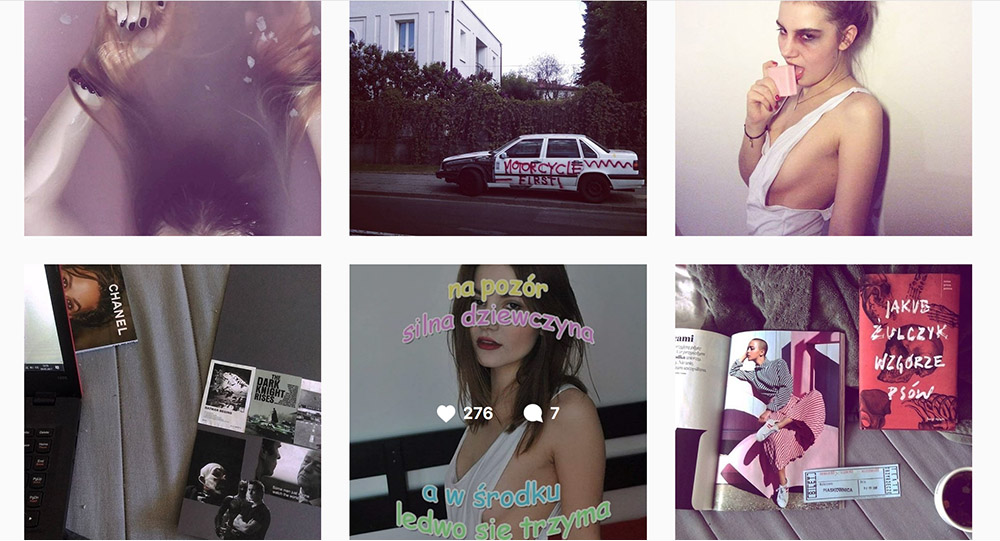
Karolina Suboczewska @ksuboczewska
A slightly different strategy from Wollen’s and her sad followers’ was adopted by Amalia Ulman, who in 2016 produced the series Excellences & Perfections. Ulman did not show her weaknesses or quote feminist classics in her photo descriptions. Instead, she consistently created the persona of the ideal insta ‘it girl’: a young, beautiful and rich sugar daughter, bragging about her travels, her nights in luxury hotels and her own body, learning to pole dance and surgically enlarging her breasts. As the Instagram community swallowed the hook, the story concocted by Ulman began to unfold. The second chapter was dramatic in tone, with the artist reporting an episode of her alleged addiction to pills and rehab. This had to be followed by a triumphant comeback, of course, thanks to yoga and healthy eating. Ulman had thus incorporated stereotypes from both social media and pop culture.
The mimicry was so good that it did not resemble any caricature depicted by Dorota Masłowska in Kochanie, zabiłam nasze koty (Honey, I Killed Our Cats). Ulman's creation was believable. Of course, some people caught the satire contained in Ulman's Instagram creation. Far more often these were women than men, less aware of the extent to which their imagined model of a woman is a cultural construct. The main strength of Ulman's project lay not in the photographs themselves, but in the fact that they did not form a series ready to be shown inside galleries, but were placed on the Internet, where they became a mirror for the Instagram community. The artist had fans who complimented her on her beauty as well as photos of her fancy brunches, but also fierce haters who, in her drug phase, couldn't hide their joy at the fact that a perfect girl leading a perfect life had fallen by the wayside. The art world also reacted – when she was about to exhibit her work in a Los Angeles gallery, she was urged to stop posting selfies in her underwear because she would no longer be treated as a serious artist.
Selfie-inequalities
There are also girls in Poland who are picking up the strategy enacted by Wollen. Zofia Krawiec – a critic, curator, instagrammer, artist, practitioner and promoter of the Sad Girl Theory – was the first to bring it to Poland’s art world. After a text, simply titled 'Selfie-feminism', was published at the beginning of 2017 in Szum magazine, critique surfaced. Agata Pyzik mostly contested with Krawiec, answering her with her own declaration: ‘If I have to undress, I do not want to be part of your revolution.’ Pyzik wrote:
If [...] the inflation of images of ourselves only led to an increase in being body-positive and the acceptance of unconventional beauty, such a strategy could be considered positive; but instead, Kim Kardashian and other totally conventionally attractive girls have the most followers. I wonder why? Maybe because this medium ultimately ends up promoting and reinforcing convention and patriarchy. [...] selfie-feminist practices [...] continue to favour conventionally attractive, young and, unfortunately, also white girls.
And she added:
The female body’ is not at all the universal experience of women, because there is no social equality of bodies. Besides, it seems bizarre to say that the female experience must be contained within the body – isn't this a confirmation of the worst stereotype that denies women reason and rationality?
Thus, some did not want to identify with selfie-feminism. As Karolina Plinta stated:
The big absentee from the exhibition "The Girl May Seem Strong but Inside She Barely Holds On" at lokal_30 is Zuzanna Bartoszek, who is slowly starting her career in the fashion business and appeared in the first issue of Vogue Polska. Bartoszek has blatantly distanced herself from selfie-feminism in the past, and yet her resemblance to other female insta-friends is striking.
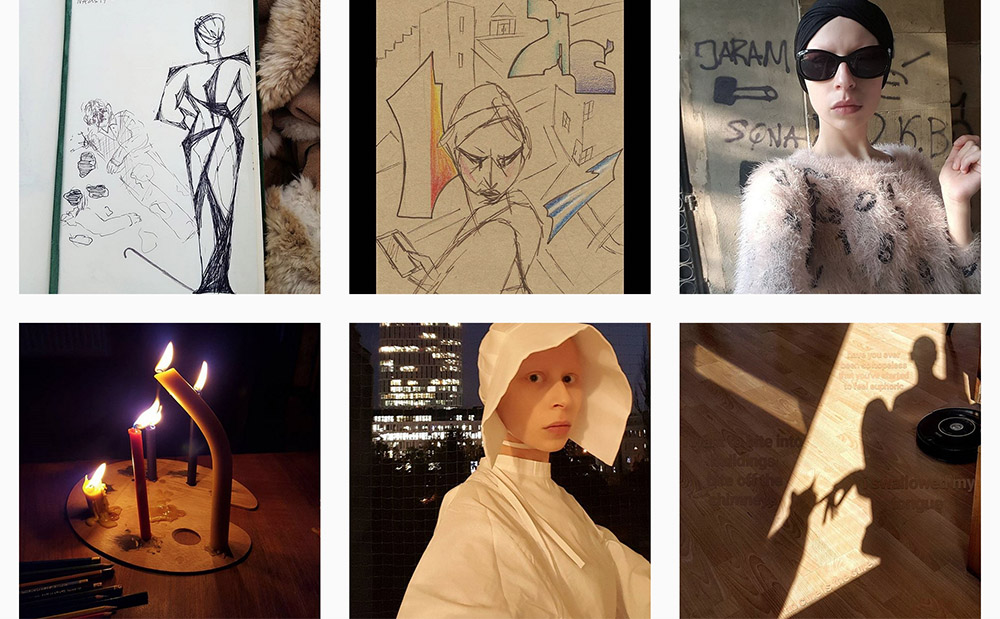
Zuzanna Bartoszek @zuzannabartoszek
The social equality of bodies mentioned by Pyzik does not exist in a racial context. Since Poland is even more mono-ethnic than Iceland, which is located in the Arctic Circle, this aspect is less important in the domestic context. Equally important, however, are inequalities resulting from social position, age, queer otherness or deviations from the prevailing canon of beauty. Thus, emancipation through the selfie does not, as some would have it, create a fourth wave of feminism. Rather, it constitutes an epilogue to the second wave, represented by white heterosexual women of privileged class. It turns out that the selfie proves questionable as a tool in the struggle for visibility waged by ethnic and sexual minorities.
Selfie-feminism in principle does not have to fight for visibility in public space, because its practitioners are by definition exposed to being viewed publicly. They are just trying to direct these views differently. A similar strategy is well known from pop culture. The crowning example is Nicki Minaj's video to Anaconda, in which the rapper mocks the clichés her body is pushed into, twerking in the jungle or, dressed as a Japanese lolita, spraying herself with whipped cream. At the end, she dances in front of Drake, the epitome of the modern macho, ostentatiously turning around and walking away when he reaches out to touch her. The question is whether female selfie-feminists, who are generally far from treating their images with distance and who in many cases take selfies that Kim Kardashian would not be ashamed of, really oppose the power of the male gaze. Agata Pyzik indicated the underrepresentation of women among selfie-feminists who are other than young, slim, attractive girls who, with subversive slogans on their lips, are dangerously close to ‘soft-porn’ and visually meet ‘all the preferences of sexist men who objectify women’.
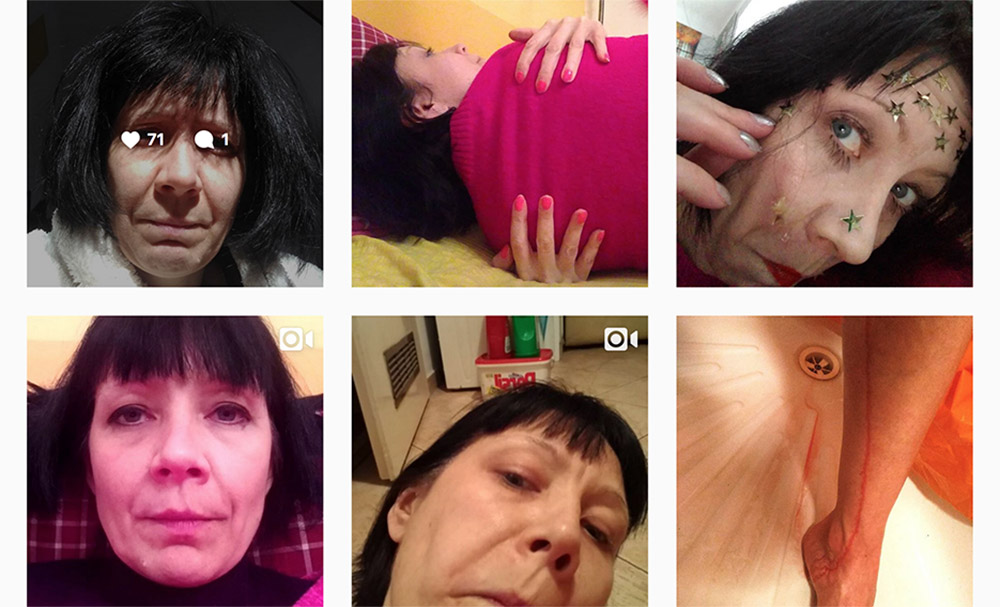
Iwona Demko @iwonade
She was succoured by Iwona Demko, an artist who does not belong to the generation of young and beautiful Wixapol party regulars, who started posting photos on her Instagram, describing them as ‘the real selfie-feminism’. Not only does she emphasise her age, unwashed make-up or fatigue in them, but she also deliberately disfigures herself by taking photos in the fashion of awkward selfies from a time when the Internet was still young and the quality of photos from phones cried out to heaven for vengeance – at unfavourable angles, in frames that were too small. Demko was finally included by Krawiec in the pantheon of Polish selfie-feminists at the exhibition The Girl May Seem Strong but Inside She Barely Holds On at the lokal_30 Gallery. The exhibition also featured other slightly older artists and girls whose beauty type differs from Krawiec's own.
One of them is Alicja Gąsiewska (@existinamoeba), who posts in a funny and bitter tone on the life of a contemporary precariat woman, with a particular emphasis on everyday domestic life. The reference point for this practice is the Twitter account SoSadToday, created back in 2012, consisting only of the depressive-ironic entries of an anonymous sad girl (who revealed her identity a few years later – her name is Melissa Broder and she is a poet from California) or the activity of the main protagonist and actress of the TV-series Girls. In a sense, Krawiec's exhibition is a step backwards when considering the exhibition Ministry of Internal Affairs. Intimacy as Text curated by Natalia Sielewicz at the Museum of Modern Art in Warsaw, where the strategy of the selfie-feminist was inscribed into the broader context of confessional art from various sources. That exhibition featured, among others, a classic of Polish performance – Ewa Zarzycka – as well as new explorations in the field of contemporary poetry completely unrelated to feminism. Krawiec’s project, although it broadens the canon of female bodies, which argue with the patriarchal gaze, nevertheless remains indifferent to the current social context and class issues, as if it arose on the sentimental wave of sad-girl enthusiasm in 2015. As Karolina Plinta noted:
The melancholic figure is reserved for the upper classes – a factory worker could hardly lie in bed all day and write sad poems, similarly the contemporary corporate worker moves in a different reality and has different problems. The girls presented at the exhibition in lokal_30 can hardly be called fighters for a better feminist tomorrow – they are rather a fashion-lifestyle subculture, in which politics function a bit like jewellery or a small toy dog, an instagram leitmotif.
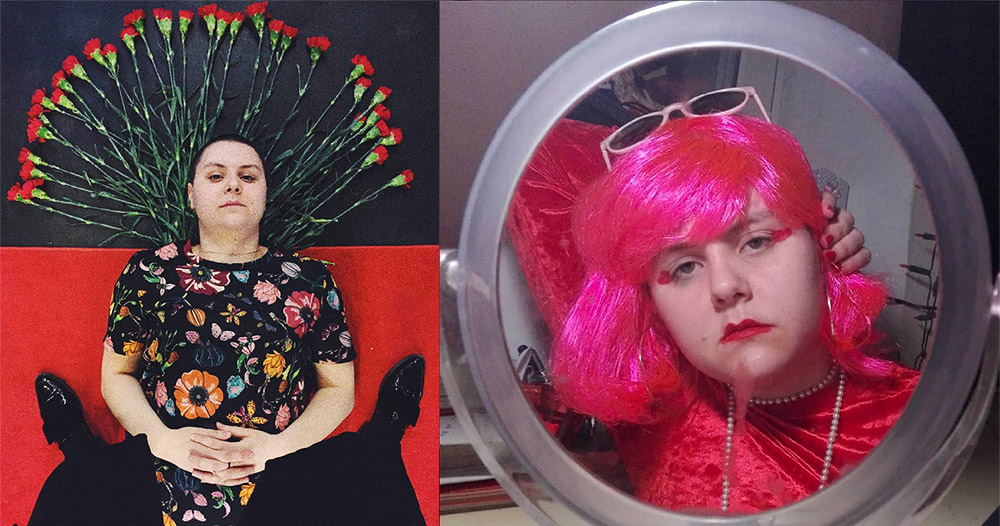
Alicja Gąsiewska @existinamoeba
Class issues were already recognised some time ago by the aforementioned Amalia Ulman who, continuing the theme from Excellences & Perfections, impersonates a pregnant corporate employee in the series Prestige. The photographs moved away from realism towards the grotesque and surreal. Ulman played with photoshop to become, among other things, a multi-armed employee, an advanced pencil pusher resembling a Hindu goddess. As Dorota Michalska commented:
The reality shown in “Prestige” seems to be a cross between a psychological horror and surrealist film. Unusual shots and the films’ poor quality additionally intensify the feeling of threat and paranoia. The installation's protagonist is entangled in a nightmarish, schizophrenic reality, which arises from an extreme sense of alienation.
Rules of the art world
Zofia Krawiec's exhibition should, however, be given justice for the inclusion of female participants who function exclusively on Instagram and not in the art world. Jerry Saltz referred to the selfie not as the next stage in the development of (self)portraiture, but as a new artistic genre – the first one that is not dominated by professional artists or invented by them. Nevertheless, the rules of the art world work in such a way that when a selfie appears in an exhibition, it is usually in the artists' edition, even if these are only photos from their Facebook. This was the case with the exhibition From Artificial Reality to a Selfie. Self-portrait in the Art of Contemporary Polish Artists at the BWA Gallery in Wrocław. The selfie is perhaps democratic as a medium, but its circulation in institutions – very rarely.
Embeded gallery style
Display slider (default)
But even this story has two sides. The reverse of the exhibition at lokal_30 are the inexorable laws of exhibiting. In short – an insta photo on the Internet looks good, insta photos printed out and attached to a wall – peculiar. As Camille Henrot showed in her work Office of Unreplied Emails, or even the aforementioned Richard Prince in his New Portraits, it is possible to print from the Internet in such a way that the effect is not visually miserable, but this requires both a good concept and an appropriate budget. At the Warsaw exhibition, on the other hand, we got a space arranged into a boudoir lavishly decorated with poor quality A4 printouts of Instagram comments.
The Girl May Seem Strong But Inside She Barely Holds On is further evidence that Polish artists (and curators) are not quite up to the task of using digital conventions in a gallery setting. Another recent example of this was the Frame Me exhibition at Poznań's FWD Gallery. The gallerists, celebrating the birthday of their space, decided to lure in as many new viewers as possible into the gallery by showing frames designed by the invited artists in which one could take a selfie. To quote a joke made by a British journalist, it can be compared to the efforts of a ‘cool’ catechist who enters the classroom and says: ‘I was on Facebook yesterday and you know who I met there? Jesus!’ The PanGenerator collective's somewhat gadget-like work hash2ash: Everything saved will be lost, which in the fashion of the centuries-old vanitas tradition of juxtaposing images of women looking in mirrors with skeletons lurking around the corner, slowly transforming the visitors' selfies into pixel dust, may also discourage. So, if we would like to search for the emancipatory potential of the selfie or its potentially subversive significance for art history, we should rather not do it in galleries. At least not by the Vistula.
Translated from Polish by Agnes Dudek