Celebrating the centenary: revisiting history
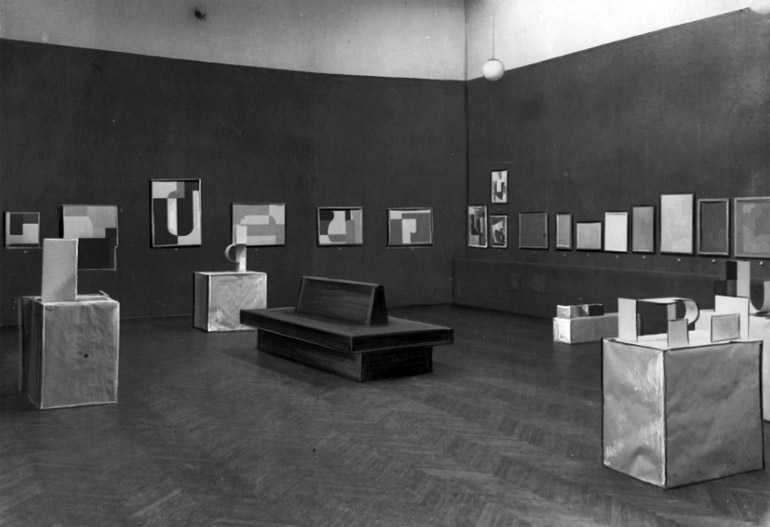
An exhibition of the Plastycy Nowocześni group at the Instyt Propagandy Sztuki (Art Propaganda Institute) on Królewska Street in Warsaw. An exhibition hall with works by Henryk Stażewski, Katarzyna Kobro and Władysław Strzemiński, July 1933, photo: Narodowe Archiwum Cyfrowe (National Digital Archives)
As part of the celebration, the National Museum in Warsaw will present an exhibition of rare graphics and drawing from Polish avant-garde artists. Visitors will have the opportunity to see works from members of the most important avant-garde groups – Expressionists, Formists, L’viv Surrealists, Buntu, BLOK, Praesens, a.r., and the Kraków Group. The Chancellery of the President of the Republic of Poland, together with the National Museum in Kraków, is preparing two exhibitions for the occasion:
- The first, entitled The Formists, will be devoted to the sacral art of the Formists and will be presented in the foyer leading to the Chapel at the Presidential Palace in Warsaw;
- The second exhibition, organised together with BOZAR in Brussels, is entitled Power of the Avant-garde and will take place in the Szołayski House, a branch of the National Museum in Kraków. The exhibition will feature works by key figures of the global avant-garde including Edward Munch, Kazimir Malevich, Marcel Duchamp, Fernand Léger, and Georges Rouault, alongside Polish avant-gardists like Leon Chwistek, Katarzyna Kobro, Władysław Strzemiński, Andrzej Pawłowski, and Marek Piasecki.
The National Museum in Poznań will present Hans Arp and Polish Art, which will explore the relationship between one of the most important artists of the European avant-garde with Poland.
A series of exhibitions with the goal of re-introducing the Polish avant-garde to the global art world is planned by the Museum of Art in Łódź, the institution most closely linked to the history of the avant-garde in Poland. The most important of these is the monographic exhibition of works by Katarzyna Kobro and Władysław Strzemiński, co-organised by the Museo Nacional Centro de Arte Reina Sofia in Madrid. This exhibition marks the first such full presentation of the work of these key Polish avant-gardists in a museum of such prestige.
The history of the avant-garde will also be revisited in five exhibitions organised in Łódź:
- Natureculture: Avant-garde and Environment addresses the impact of proto-ecological thinking on avant-garde movements;
- Enrico Prampolini and the Theatre of Mechanical Constructions: Futurism and Staging Techniques of the Polish Avant-garde attempts to demonstrate relationships between Futurism and the Polish avant-garde and to juxtapose their scenographic experiments;
- Montages: Debora Vogel and New Urban Legend recounts the avant-garde landscape of interwar Poland from the perspective of an eminent Polish-Jewish writer and theorist;
- Life Organisers: De Stijl and Avant-garde Design in Poland explores the international contexts in which modern Polish architecture and design have evolved;
- Moved Bodies: Choreographies of Modernity is devoted to one of the key issues of organisation and rationalization of the modern movement, and adopting the theory and practice of Katarzyna Kobro as a reference.

Władysław Strzemiński, Landscape of Łódź from Retkini, 1941, photo: Muzeum Narodowe in Kraków
To correspond with the program in Łódź, the National Museum in Wrocław will present an exhibition on Andrzej Wajda’s last film, Afterimage, a portrayal of the final years of Władysław Strzemiński’s life. Additionally, the Silesian Museum in Katowice and the Museum of History of Katowice have prepared an exhibition dedicated to the fate of the avant-garde in Śląsk.
In October 2016, the National Museum in Warsaw will resume its annual series of lectures Breakthrough, continuation, or dialogue? Art of the 20th- and 21st-century in the context of ancient art. During the ‘Museum Tuesdays’ series there will be talks on ‘Tradition vs. avant-garde: Polish artists regain independence’ and ‘Cubism, futurism, surrealism, and abstraction’ in the 20th- and 21st-Century Art Gallery. The museum also invites young people and families to a special series of workshops: ‘Modern art for beginners’, ‘Art from circles and squares’, and ‘Gallery of contrasts’.
The Museum of Tadeusz Kantor Cricoteka in Kraków will present a recent project in an exhibition, a conference, and a publication dedicated to the Cricot Theatre, founded in Kraków in 1933 by a group of young artists and avant-garde writers, led by Józef Jarema. A second Kraków museum, the Museum of the History of Photography, will hold screenings and lectures on the pre-war film avant-garde (including Feliks Kuczkowski, Janusz Maria Brzeski, and Jalu Kurek) and films created in the post-war avant-garde milieu.
The Zbigniew Raszewski Theatre Institute will present a series of events – Recovered Avant-garde – aimed at promoting the lesser-known achievements of the Polish theatrical avant-garde of the 20th-century. The Nowy Theatre in Łódź will organise an open competition for a script dedicated to the avant-garde. There will also be a series of concerts performed to accompany the projects related to the centenary celebration.
The ‘Warsaw Autumn’ International Festival of Contemporary Music has prepared a special program for the celebration. The Wielki Theatre in Łódź will premiere Aleksander Tansman’s Golden Rune and the Academy of Music in Łódź will present Pillars of the Polish Musical Avant-garde, a series that allows audiences to familiarize themselves with the rarely performed works of Józef Koffler, the first Polish dodecaphonist, as well as works by Polish composers inspired by the art of Kobro and Strzemiński.
2017 will also bring a number of publications devoted to the avant-garde. Among these, the Institute of Architecture in Kraków will publish an anthology of theoretical and critical texts devoted to modern architecture in Poland, together with a collection of essays and commentaries. The Museum of Modern Art in Warsaw will release a text on the history of the radical avant-garde by Andrzej Turowski, one of the most important Polish scholars of 20th-century art. Along with their series of exhibitions, the Museum of Art in Łódź will publish a revised version of Władysław Strzemiński’s Theory of Vision, one of the most important theoretical works in the history of Polish Modernism. In cooperation with a popular press, they will also launch a series of monographs devoted to important figures and phenomena of 20th-century Polish art.