(De/re)construction
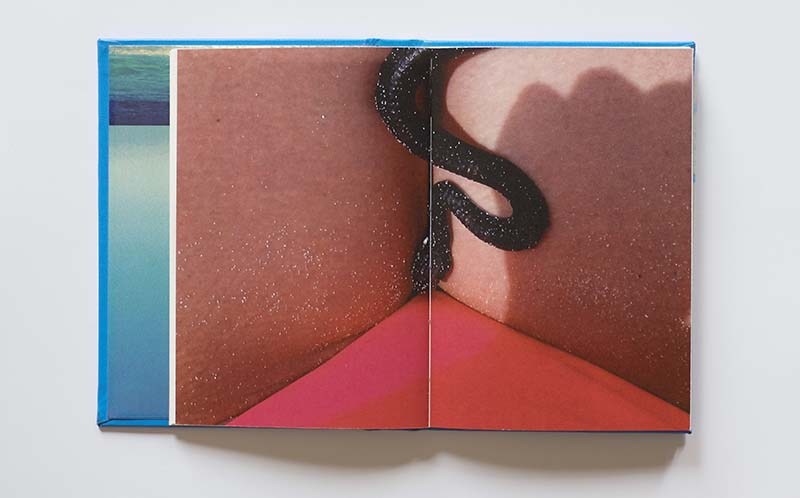
With its hard cover with an elastic band to seal, inside an expandable pocket and sewn pages for notes, always right at the fingertips, Magda Buczek’s photobook, designed together with Emilia Obrzut, is a visual notebook from a journey, resembling the iconic Moleskine notebooks in form. The reader can choose to either read in linear order, or look at several sequences at once, as the pages are joined in such a way as to resemble a commercial brochure or a guidebook folded like an accordion.
The photographs create the main narration. Their configuration is not – as it could appear – an effect of improvisation, but a result of using an algorithm transferred from the computer screen right onto paper. The change of medium – from a digital to a traditional one – brings with it a certain discomfort and limitation. The photographic blog of the author is ordered vertically, whereas the pages of the book are turned horizontally. This is why some of the images are cut, as if they were unfinished, ephemeral – they undergo de(con)struction. A similar effect of a fissure, a breach, is achieved during a display of images in an art gallery.
However, not all the photographs in Random Selection are subordinate to mathematical rules. Some of them were printed separately on photographic paper or foils that can overlay the prints like Instagram filters. The viewer can, or perhaps even should, tamper with the work, remould its inner relations, create his or her own versions of the story. This consent to intervention is congruent with Umberto Eco’s concept of the open text that allows for a more free (though not arbitrary) interpretation by employing the movability of the work’s elements. The author is thus inviting the viewer to co-create the project.
Journey
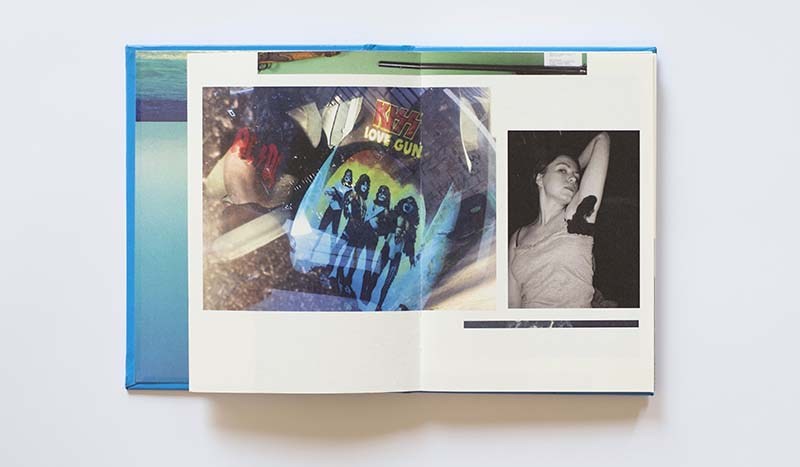
Spread from Random Selection by Magda Buczek, graphic design: Emilia Obrzut (Obszar Roboczy), 2016, photo: Eliza Dunajska i Max Zieliński
The publication conjoins elements of a picaresque novel (particularly visible in another work of the artist, Justina&co.uk) and the figure of a contemporary flâneur. From the former it derives the model of feisty autobiographical narration (the record of the author’s private journeys) whose action not only doesn’t stop, but also keeps on gaining momentum. The figure of the ‘vagabond’ manifests itself in the critical, slightly ironic way of looking, and a liking for ambiguity, novelty, playing with the contexts. The contemporary flâneur replaces the natural space of the urban street with virtual world, setting his or her senses, instead of the body, in movement. The image of reality, changeable and multiplied by digital media, is perceived not only through sight, but also hearing and touch. Thus, astute observation turns into sensual experience.
In Random Selection we are dealing with a real journey on the one hand, and pictures posted on the Internet on the other (the difference being paper replacing the screen). Recollections are stored not only in memory, but also on the hard drive. This can be interpreted as a form of digitally intermediated participation, a state of limbo between being online and offline. The photographs exploit the poetics of error, scrunch, repetition; some photographs overlap, either becoming illegible or, on the contrary, their meanings are multiplied. They solidify the intense, multisensual experiences accompanying changing the surroundings to unknown ones. They are shaped into a travel journal, a record of impressions, impulses that are still fresh, untamed.