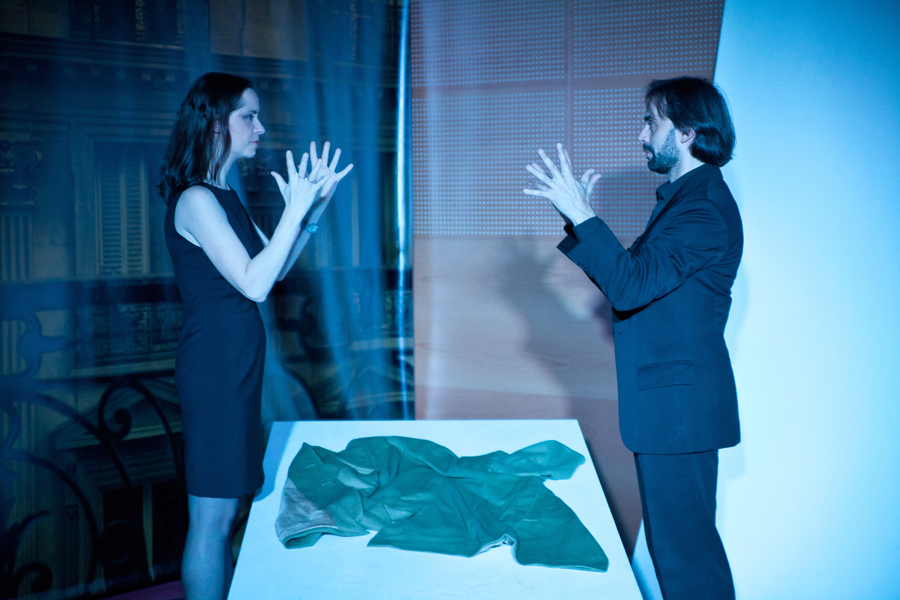
Actors Joanna Rzączyńska and Piotr Sierecki. Photo: Andrzej Wencel
Warsaw's Jewish Theater stages Małgorzata Sikorska-Miszczuk's gripping play about the struggle between the desire for oblivion, and the desire to open up to the truth about a traumatic past
Playwright Małgorzata Sikorska-Miszczuk based the idea of "The Suitcase" (alternately, "Pantofelnik's Suitcase") on the real-life story of Michel Leleu, who fled with his mother to the Swiss Alps in order to escape the persecution of the Nazis. His father, Pierre Levi, was arrested in 1943 and sent to his death in Auschwitz. Leleu also tried to suppress the trauma of war and forget, however the discovery of his father's suitcase in had a profound impact on his life. He took back his father's name and launched a search for more family relics. The production directed by Dorota Ignatjew enjoyed a successful run at Warsaw's Jewish Theatre last spring and is back on the stage for a run this fall season.
Małgorzata Sikorska-Miszczuk's hero Fransua Zako has done everything he can to forget the Holocaust and erase all traces of his father, Leo Pantofelnik. Yet he could never do away with the past, constantly tormented by a melancholia and pain he cannot explain. Pantofelnik, writes a letter to heaven trying to reach his lost father. As a retired fellow in the autumn of life, he takes a trip to the Holocaust Museum, partly out of boredom, partly out of curiosity for that voice inside urging him to find the 'truth'. With the help of a Miserable Tour Guide who becomes newly inspired by the story, Fransua embarks on his quest. Among the displayed items, belongings salvaged from Auschwitz, Fransua discerns his father's suitcase, who perished in the camp. His life is irrevocably altered. The discovery of the suitcase opens Fransua's heart to the truth.
"The Suitcase" is about the praise of life, its affirmation. For me the irreversibility of what has happened, the immensity of suffering displayed in museums, portrayed in photos, preserved in buttons, dolls, broken glasses is unbearable. The character of Miserable Tour Guide in the Museum of the Holocaust depicts what I think and feel about it: it is unbearable. That character asks the question: why should we remember, collect and display all of this if it only preserves the pain and weighs heavily on our everyday existence? Life requires 'living', and forgetting things seems to be an easy way to live. My hero didn’t want to remember and sought to live 'normally', applying that trick of forgetting. I can understand him, I am him as well as I am that Tour Guide, but in my story he only began to live after he had opened the suitcase with the past.
- Małgorzata Sikorska-Miszczuk in an interview with Justyna Jaworska for the Dailog monthly, nr 9/2008
The play premiered at the Jewish Theatre earlier this year. It has begun making its rounds of the world, beginning with a reading at the Atwater Village Theatre in Los Angeles at the end of November, 2011.
Culture Spot LA critic Dara Weinberg compared the playwright's style and surrealist techniques to the likes of Sarah Ruhl, but with sharper edges, adding
The facts of history and the characters’ confused psychological responses to those facts give these plays teeth. Her dramatic sensibility, unlike Ruhl’s, does not necessarily move towards the happy ending. It may be more accurate to compare her to Tony Kushner; or it may be that there is no exact analog for her writing in the English-language theater. LA residents will have a chance to decide for themselves.
Małgorzata Sikorska-Miszczuk has written film and TV scripts, short stories, and radio plays, in addition to dramatic works for the stage. "The Suitcase" won the Metaphors of Reality competition organised by the Polish Theatre in Poznań. The play also received an award at the Festival of Polish Contemporary Plays in Gdynia, and the radio production of The Suitcase was awarded the Grand Prix of the Polish Radio and Television Theatre Festival in 2009. "The Major", a play about the human drama behind the Jedwabne Pogroms" gained a great deal of attention. Sikorska's plays have been published in a number of anthologies of contemporary Polish drama, translated into French, German, Swiss, and Romanian, in addition to English. She lives in Warsaw.
"Walizka" / "The Suitcase"
Written by: Małgorzaty Sikorskiej-Miszczuk; directed by: Dorota Ignatjew; set design: Rafał Sisicki; music: Teresa Wrońska; cast: Joanna Rzączyńska, Ernestyna Winnicka, Andrzej Blumenfeld, Henryk Rajfer, Piotr Sierecki, Szymon Szurmiej, Jerzy Walczak, Marek Węglarski.
Performances in autumn 2011: 4th-6th of November, 9th-11th of December.
Ester Rachel and Ida Kaminska Jewish Theater
Plac Grzybowski 12/16, 00-104 Warsaw
tel: (22) 620 62 81, (22) 620 70 25
www.teatr-zydowski.art.pl
Source: Ester Rachel and Ida Kaminska Jewish Theater