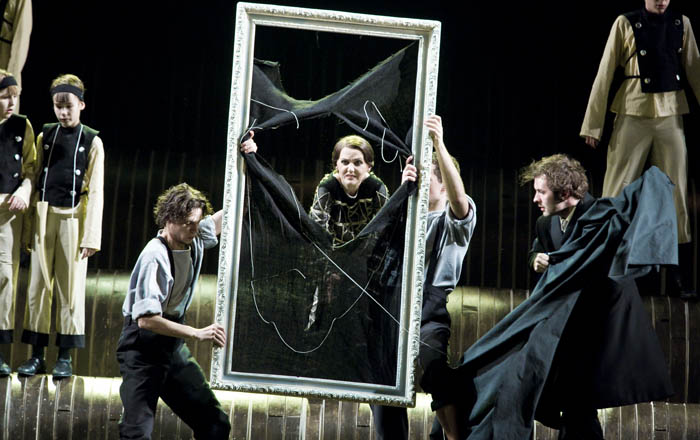
Production still from Qudsja Zaher, photo: Krzysztof Bieliński / Teatr Wielki - National Opera archive
The National Opera in Warsaw stages the premiere of Paweł Szymański's perplexing new opera. The libretto, written by Maciej Drygas, intertwines the contemporary fate of political refugees with a mythic reality
Paweł Szymański first took up the tast of writing Qudsja Zaher in 1999 and he completed the opera in 2006. Years passed before its staging, with the premiere postponed several times. It was last called off in 2010, and the composer, together with the director of the National Opera, Waldemar Dąbrowski, isssued a statement that they wanted to ensure the highest artistic level for the staging and required more time.
The author of the libretto, Maciej J. Dygras, is a renowned Polish documentary filmmaker. The production is directed by acclaimed Lithuanian director Eimuntas Nekrošius and his regular collaborators including stage designer Marius Nekrošius and costume designer Nadežda Gultiajeva. In an interview for Rzeczpospolita magazine, the conductor for Qudsja Zaher, Wojciech Michniewski, commented on characteristic musical traits in Szymański’s operatic debut:
[…] There is virutally no action here and no psychological relations between the characters. Nobody loves anyone, no one kills, there is no intrigue and thus the staging is really a difficult task. […] Another challenge lies in the fact that Paweł Szymański composed a piece that is typically sublime, as is his style. The staging brings with a real danger of making the music a mere background, while visual frenzy takes over the stage. But the heroes of the Qudsja opera are the musical powers, their musical narration and not staged action.
In his work on the libretto, Drygas juxtaposed two orders: a naked reality, based on his own documentary experience, and that of a mythical world. The first story is based on the fate of Qudsja Zaher, an Afghan refugee for whom Poland was one attempted stops on a long journey in exile. She was a hero of Drygas’s documentary portraying the dramatic fates of refugees fleeing their homeland on damaged boats, frequently denied asylum by border guards, and often drowned.
In the opera, Zaher, sung by Olga Pasciecznik (and Katarzyna Trylink, for one performance) throws herself with desperation into the Baltic Sea, where she is confronted with a mythical world. She attempts to pay for her journey into the World of the Dead, only to be told by the Teacher (Andrzej Niemirski) that she has already been there a thousand years before. The score includes two choirs that sing independently, the Chorus of the National Opera and the Boy's Chorus of the Fryderyk Chopin University in Warsaw, and blends various languages – Polish, Lithuanian, German and Greek – so persistently present in Szymański’s vocal works.
The mingling of contemporary and ancient music and a dialectic are recurring motifs of the composer’s work. Thanks to these means, his music seems universal and balances between different worlds, not choosing any of them. Qudsja Zaher has been called the first Polish eschatologic opera.
Its premiere took place on the 20th of April, 2013 in Warsaw, and performances continue through the 24th of April.
Author: Filip Lech, translated with edits by Paulina Schlosser