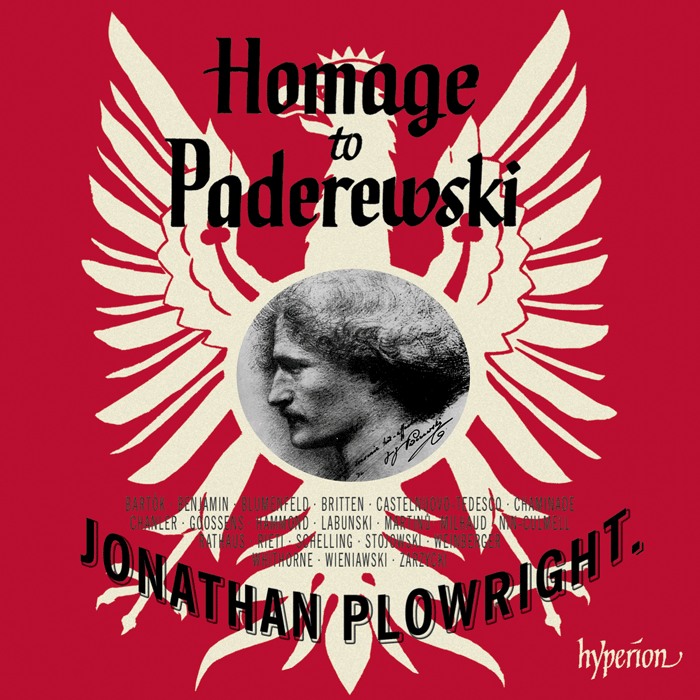
The release of the new album by the acclaimed British pianist Jonathan Plowright celebrates the 70th anniversary of the death of Ignacy Paderewski, one of the greatest composers of the twentieth century
Jonathan Plowright, a British pianist renowned in the world music scene, is the first artist to record an album with works written in homage to Ignacy Jan Paderewski on the anniversary of 70th anniversary his death. The memory of the brilliant composer, pianist and politician is being honoured by these virtuosic compositions, which were inspired by his unmatched musicality.
Jonathan Plowright became interested in Paderewski at an early age after his grandfather walked fifteen miles from his village in Yorkshire in England to listen to Paderewski's concert – such was the strength of the unique artist's appeal at the time. His music is well known to the Polish public thanks to his recordings of works by Stojowski, Melcer and Paderewski and also thanks to his often concerts with the National Philharmonic Orchestra, the Polish Radio Symphony Orchestra, the Łódź Philharmonic Orchestra, the Szymanowski Quartet and also thanks to performances at the Festival of Polish Music in Kraków and festivals in Zakopane and Powsin.
Plowright is a prominent figure in the field of recording the Polish romantic repertoire and also recording Paderewski in unusual combinations. He was invited by the Paderewski in Memoriam Foundation to play a recital, which finished the celebrations of the Paderewski Year (2001) in Warsaw. In 2006 Plowright played a leading part in revitalising the Paderewski Festival in Paso Robles in California, where the composer owned a vineyard and spent a lot of time between his frequent concert tours of the United States. In the year 2010 Plowright was once again invited to Paso Robles, to play a concert on the 150th anniversary of Paderewski's birthday.
Jan Ignacy Paderewski was one of the most famous artists in the world. Vituoso, composer, politician (first prime minister of independent Poland after the I World War), philanthropist and orator, declared a "modern immortal" by Franklin D. Roosevelt. The awards bestowed upon him ranged from the Legion of Honour and Order of the British Empire to Poland’s Virtuti Militari, along with many honorary doctorates from European and American universities. Camille Saint-Saëns described him as "a genius who happens to play the piano". A superstar of his time, he was idolised by the public, and owing to the immense popularity of his Minuet in G he became a household name. In 1932 he attracted to his musical performance the biggest audience in the history of New York's Madison Square Garden. In the same year he played a solo recital at Carnegie Hall. He was the highest-paid musician of his day in the world.
"Homage to Paderewski" is Plowright's ninth album published by Hyperion. The pianist's previous recording "Hommage a Chopin" was one of the best-selling titles in 2010 and gained acclaim from a wide array of critics: "what a leniency in intimacy… he's such a great virtuoso" (Gramophone), "Plowright's dazzling playing is flawless" (Sunday Times). Amongst the many prizes won by the album, the prestigious Preis der Deutschen Schallplattenkritik and the Diapason D'Or granted by the French classical music magazine Diapason are most noteworthy.
The album consists of sixteen pieces, which are a musical homage to Paderewski paid by composers including Bartók, Martinů, Milhaud, Stojowski and Tedesco. The further six compositions, dedicated to Paderewski, including the Mazurka for two pianos written by Britten, also play an important part in the album. Works by Polish composers are also present. Étude Op 44 No 22 by Józef Wieniawski opens the album. Wieniawski was the younger brother of the more famous violinist/composer Henryk. Like his brother, he was born in Lublin and studied in Paris where he took first prize in piano at the Paris Conservatory at the age of twelve in 1849. He settled in Warsaw and became the second director of the Warsaw Musical Society until in his later life he moved to Brussels to teach at the conservatory. Wieniawski's music was once described by one of his contemporaries as being "full of original ideas". Threnody is another Polish composition amongst the Homage to Paderewski selection, written by Feliks Łabuński. He was especially indebted to Paderewski, who, following their meeting in Paris in 1928, funded the remainder of his studies with Dukas and Boulanger. In addition to his Threnody, a very intense piece with a beautiful cantabile middle section, Łabuński also dedicated a symphonic poem entitled In memoriam to his mentor. Chant du printemps Op 34 No 1 by Aleksander Zarzycki is one of the last pieces on the album. Zarzycki was born in Lviv, studied in Berlin and Paris, and settled in Warsaw. He was a co-founder and the first director of the Warsaw Musical Society as well as the choir conductor at St John's Archcathedral where Paderewski's remains are entombed in the crypt.
Although this recording presents only a condensation of works by leading contemporary composers it also tells a fascinating story of the effects of war on the cultural life of Europe. Many of these artists emigrated to the United States, fleeing from the Nazi oppression and clearing a path for America to become the international leader in creating new trends in Western music after the II World War.
- The Daily Telegraph
The Independent's Anna Picard has called the tone of the recording "dreamy at times (Józef Wienawski's Etude), at others briskly unsentimental (Martinu's Mazurka)".
Jonathan Plowright - Homage to Paderewski
Hyperion CDA67903
Playlist
1 Józef WIENIAWSKI (1837–1912) Étude Op 44 No 22
2 Ernest SCHELLING (1876–1939) Nocturne (Ragusa)
Homage to Paderewski (Boosey & Hawkes, New York, 1942)
3-5 Béla BARTÓK (1881–1945) – Three Hungarian Folk-Tunes Sz66
6 Arthur BENJAMIN (1893–1960) – Elegiac Mazurka
7 Theodore CHANLER (1902–1961) – Aftermath
8 Felix RODERICK ŁABUŃSKI(1892–1979) – Threnody
9 Mario CASTELNUOVO-TEDESCO (1895–1968) – Homage à Paderewski
10 Eugene GOOSENS (1893–1962) – Homage
11 Richard HAMMOND (1896–1980) – Dance
12 Darius MILHAUD (1892–1974) – Choral
13 Bohuslav MARTINŮ (1890–1959) – Mazurka H284
14 Joaquín NIN-CULMELL (1908–2004) – In Memoriam Paderewski
15 Emerson WHITHORNE (1884–1958) – Homage Op 58 No 2
16 Vittorio RIETI (1898–1994) – Allegro danzante
17 Ernest SCHELLING – Con tenerezza
18 Karol RATHAUS (1895–1954) – Kujawiak
19 Sigismond STOJOWSKI (1870–1946) – Cradle Song
20 Jaromir WEINBERGER (1896–1967) – Etude in G major
21 Benjamin BRITTEN (1913–1976) – Mazurka elegiaca for two pianos Op 23 No 2 with AARON SHORR
22 Aleksander ZARZYCKI (1834–1895) – Chant du printemps Op 34 No 1
23 Cécile CHAMINADE (1857–1944) – Étude symphonique Op 28
24 Felix BLUMENFELD (1863–1931) – Kujawiak – Obertas No 2 from Second Suite Polonaise Op 31
Sample the album on Itunes.
Source: Salzman Music