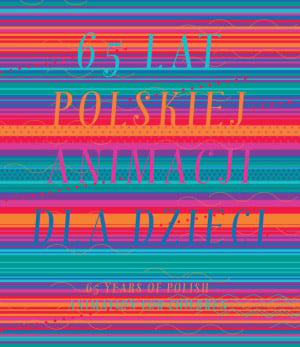
A journey through the world of animated characters, the album 65 Years of Polish Animation for Children is comprehensive and multifaceted. Chapters are divided into a short history of animations, profiles of the masters and their great achievements, a short explanation about different kinds of animated films and techniques, and a presentation of short films, film series, feature films and animation studios.
Edited by the film and music critic Jerzy Armata and Natalia Chojny, the book appears on the 65th anniversary of the first Polish animation film created for children. It contains previously unpublished stills, archival pictures from sets and sketches of children’s favourite cartoon heroes.
"Polish animated films directed towards child audiences did not exist in pre-war Poland", writes Jerzy Armata, the album’s editor, in his brief introduction. "Their history began in 1947 with Zenon Wasilewski’s animated puppet film – In the Time of King Krakus. During the 65 years of their existence Polish animated films for children have had great success, gaining numerous awards at prestigious festivals, including an Oscar for Peter and the Wolf."
Polish animation films remained out of the mainstream for decades, with industry attention devoted to feature films, but its creators continued to develop their techniques and expand their portfolios. Zenon Wasilewski, Lechosław Marszałek, Władysław Nehrebecki, Edward Sturlis, Witold Giersz, Tadeusz Wilkosz, Ryszard Antoniszczak, Piotr Dumała - these are but a few of the major names in Polish animation with capsule biographies in the book. "Polish animation was ambitious from the start", writes the Polish Cultural Institute in NY in introducing their animation screening titled A Short History of Polish Animation. "Ladislaw Starewicz worked with puppets and stop-motion; Witold Giersz with oil-based paints; Jan Janczak with collage; and Miroslaw Kijowicz with deceptively simple line drawings that belied their subversive political underpinnings."
The lack of experience, professional techinicians and technical means made the production of animated films a challenge after the war ended in 1945. Then the rapid growth of television in the 1960s brought new interest in animation. Kusza / Crossbow (1963) by Władysław Nehrebecki gave rise to the career of Bolek and Lolek, the two most popular characters of Polish animation for children in its history. In Reksio (1967), the sympathetic little dog made his debut in the film by Lechosław Marszałek. With Reksio poliglota / Reksio the Polyglot and ever since, the dog’s adventures returned to the screen - for 23 years.
Animations for children were limited to television production until the end of the 1980s. After the change of political system in 1989, Polish cinematography switched to market-economy financing schemes, which resulted in a sharp crisis, especially of the animate-film section. The Polish Parliament passed a new bill in 2005, on the basis of which the Polish Institute of Film Art was founded. The Institution provides financial support to ambitious projects, with special preference given to those designed for the youngest audiences. Today, Polish animation studios including SeMaFor, SFA Studio Kraków, Platige Images and Studio Miniatur, and Polish acclaimed animation artists, are immersed in the international arena.
65 Years of Polish Animation for Children
Concept: Jerzy Armata, Natalia Chojna
Author of texts: Jerzy Armata
Graphic Design: Ola Kot
Choice of illustrations: Natalia Chojna
Published by: Polish Film Institute, the Museum of Cinema and Photography in Łódz and the National Film Archive.
Sources: Based on the original article by Bartosz Staszczyszyn for culture.pl, Melbourne International Animation Festival, Play Poland, PISF, Polish Cultural Institute NY
Editor: Marta Jazowska