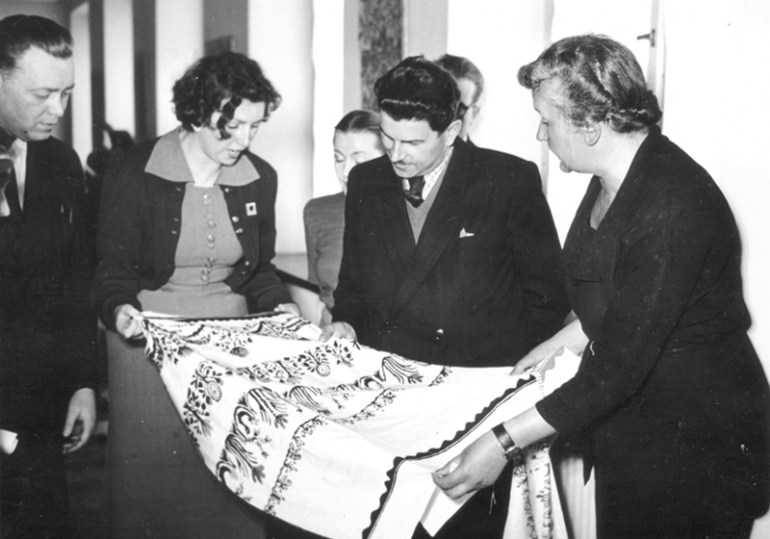
A very specific method of designing was particularly important to Telakowska. Its objective was to have specialists and amateurs – folk artists, children and youth – co-operate in so-called designing teams. The first of such groups were formed in the 1940s, whereas the last ones, in the 1970s. They chiefly designed patterns for printed fabric and woven fabric, as well as embroidery and lace. Sketches done by the teams were later perfected and produced in the Institute’s workshops. Some of these were then put into factory production. Telakowska was convinced that this method would make Polish designing not only genuine and Polish but also modern and vital.
In 1978, when Telakowska retired, she helped arrange the Institute of Industrial Design’s donation to the National Museum in Warsaw. She did not want the projects, models and prototypes that had been gathered since 1945 to be scattered.
Telakowska’s work was frequently used – against her will – by the authorities as a smokescreen, in order to keep up the appearance of prosperity and dynamic development under a socialist economy. The Institute of Industrial Design’s unique works were presented at international exhibitions as a sign of high living standard in Poland under the communist regime. Often, they were prototypes unavailable to the mass audience.
Her position amongst other designers changed over the years. After the Polish thaw in 1956, many young designers deemed Telakowska’s views conservative and wrong. Her designs were believed to derive from applied arts, which was something contrary to the vision of modern design. Neither her fascination with folk art nor the idea of cooperation between visual artists and amateurs was understood.
Wanda Telakowska was special in many respects. Her wit and brilliance were fabled. The album that she left behind – full of her sketches, caricatures, poems and dedications to many writers, artists and politicians – is not only a fascinating document but also a peculiar portrait of this exceptional woman.