Both Barbara Wanda Brukalska and Stanisław Brukalski participated in the Le Corbusier-run international movement of modernist architects (CIAM) and in the Polish avant-garde movement concentrated in the Praesens group, where Barbara Brukalska was the sole architect at the first Praesens Exhibition at Warsaw’s Zachęta Gallery in 1926. Barbara held a prominent place in the first generation of Polish female architects; and with her professorial nomination after the war, she became the first woman at the Architecture Department of the Warsaw Technical Academy.
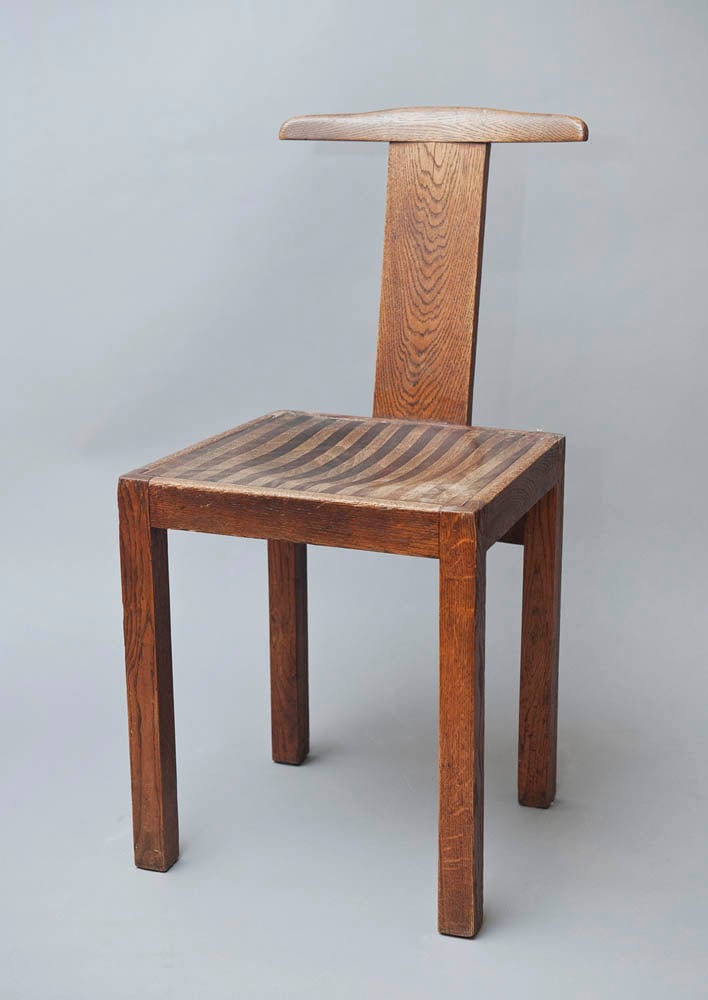
Barbara i Stanisław Brukalscy, child’s chair, Barbara Brukalska, 1932, collections of the National Museum in Warsaw, photo: Michał Korta
The first avant-garde project in Poland was the Brukalskis’ home and architecture studio in Warsaw’s Żoliborz Urzędniczy on Niegolewskiego Street (1927–1929), whose purist radicalism a counterpart to the Dutch neo-plasticism of the avant-garde De Stijl group, and in particular, to its architectural manifesto: Ms Schröder’s house in Utrecht (architect: Gerrit Thomas Rietveld, 1924).(1) The Bruksalskis’ house, with its facade designed in accordance with the neo-plasticist principles of composition, and its interior inspired by Le Corbusier’s La Roche Villa, has its place in the history of the international avant-garde. From its inception it astonished the critics, who called it the "most trademark example of modernist architecture in Poland."(2) As proof of this recognition, the design was awarded a bronze medal at the International Exhibition of Art and Technology in Contemporary Life (Exposition Internationale des Arts et Techniques dans la Vie Moderne) in Paris in 1937.
According to the designers, the Brukalskis’ house was meant to show that its creators were among the newest progressive elite. The Brukalskis were among those modern architect couples who worked together and thus created a miniature artistic group. In the first half of the 20th century this arrangement was practically the only way women were allowed to work in this profession and overcome the limitations contemporary society imposed upon them. Confessing in her memoirs that she had "a longing for architecture,"(3) Barbara chose this profession consciously and treated it in a way typical of the avant-garde, as a means to realize the ideas of the new aesthetic through a synthesis of all the arts. She realized this modernist attitude in designing houses, housing estates, interiors, and furniture; though from the work of this married duo it was not always clear which work was done by Barbara and which was done by Stanisław. One of the "feminine" touches was the very elaborately developed garden that accompanied the home, district, and park designs, which were a sign of Barbara’s "first love" (In Puławy, her first studies were in agriculture, a major frequently chosen by daughters of the gentry).
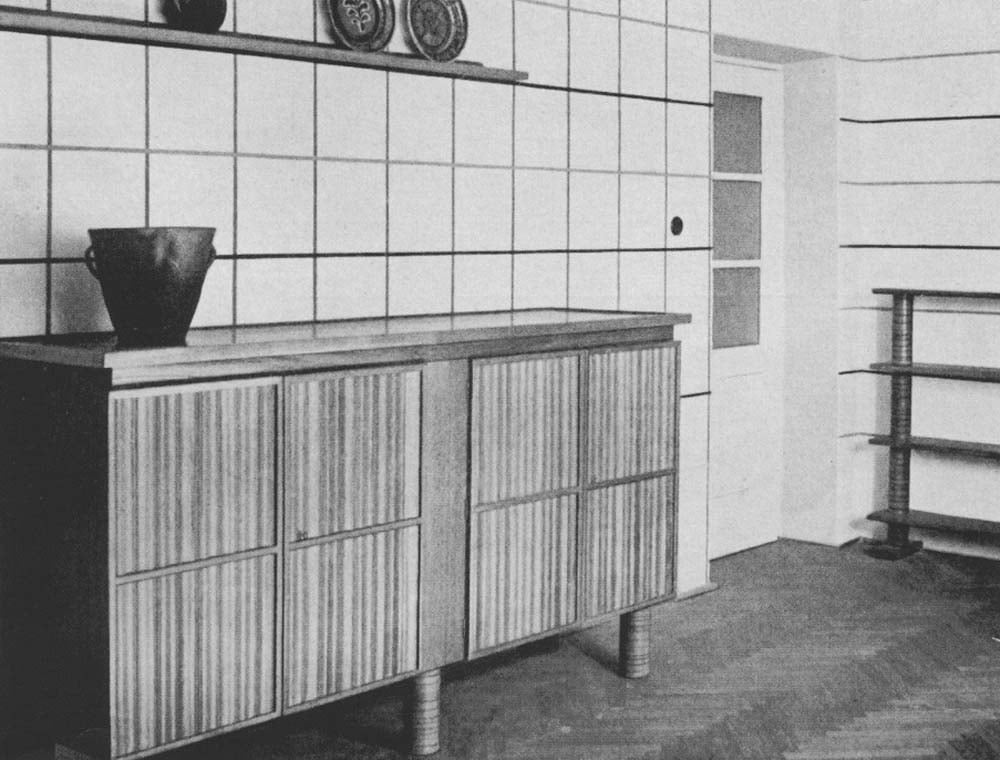
Barbara i Stanisław Brukalscy, furniture prototypes, by Barbara Brukalska, for the model interior at the Residential Construction Exhibition of the National Economy Bank in Warsaw, 1935, photo: Czesław Olszewski / IS PAN
From the beginning of their careers, the Brukalskis were affiliated with the avant-garde and belonged to the "second generation" (i.e., born after 1895) of architects known for "youthful rebellion" and the international style.(4) However, their understanding of modern architecture had nothing to do with the orthodox leftist architects who gathered together in the Blok group. Both were conscious of the social responsibility of the new architecture, which they defined as a combination of classicism and modernism. Stanisław’s studies in Milan, where the avant-garde futurists were in full swing, and his fascination for Italian culture had a visible impact on this. Barbara’s studies at the Central Agricultural School, though not completed, pointed her toward neo-romanticism, which was why she brought picturesque garden premises with their natural elements (e.g. the park/architecture complex in Zułow, the birthplace of Marshall Piłsudski) to the purity of the international style and to her husband’s preferred modernized Italian-style classicism. The emotional effect of these motifs mollified the "hard" modernism of the international style. Subscribing to the idea of the garden-city transformed the metropolitan districts into a kind of "urban idyll," seeking to reconcile civilization with the romantic "dream of nature." This concept comprised the general drift of the advice furnished by Barbara Brukalska and her friend Nina Jankowska, an architect, in "House and Garden Advisor" and in articles and designs published in the pages of the Warsaw Housing Cooperative magazine "House – Neighborhood – Apartment."(5) Barbara never departed from this position, treating the home and its residents as a part of nature. The neo-romantic park inside the functionalist district was meant to create a "neutrally green" integrative public zone, democratic and "optimistically" open to all. A similar process of deconstructing the "hard" avant-garde is also visible in the new interior designs developed by the female duo of Brukalska and Jankowska in projects for the Warsaw Building Cooperative in Żoliborz (Barbara and Stanisław designed parts of the housing estate). In creating a new aesthetic, the architects were assisted by artists affiliated with the Warsaw School of Fine Arts, and gathered together in the Ład Visual Artists’ Cooperative. The Ład aesthetic represented a neo-avant-garde modernity that resembled Scandinavian concepts – design based on folk motifs and handwork techniques. This was a compromise between two aesthetic programs: the functionalism of architecture hailing from the extreme European avant-garde (the international style) and the "tamed" modern inflected with folk culture, characteristic of the design of the 1930s. From this perspective the Warsaw Building Cooperative was a model example of this new aesthetic policy aimed at the intelligentsia.
Barbara Brukalska’s capital achievement in design was the Lounge Room, arranged for the Polish Pavilion of International Exhibition in 1937 in Paris. Unofficially called the "hall in the airplane builder’s villa" or "airplane builder’s room," with its famous armchair covered with white sheepskin, it combined avant-garde strains with neo-romanticism and classicism (the erotic sculpture of August Zamoyski). One of the model residential interiors presented in Paris was the quintessence of the "proper" style of 1937: an exclusive and elite interior whose furniture had soft, flowing shapes, a contrast between refined rusticity and the avant-garde – simple, compact, technicalist forms and the limitations of natural materials, naturalism (the column-tree), and primitivism. The critics admired the ingenious pairing of the erotically-charged armchair/nest covered with sheepskin, the stone-and-brick chimney, the light glass and aluminum table, and the heavy ash-wood bench contrasted with the sofa wrapped in costly shining strawberry-colored leather. This use of contrast, recognized as part of the interior-decor canon of the 1930s, was in Barbara Brukalska’s projects characteristic of the European movement of New Regionalism, as a representation of a new aesthetic and a new type of "humanist" interior. The Leisure Room appealed to intimacy but without the pseudo-folk culture of the Ład designers, the torch-bearers of art déco from EXPO 1925. Barbara’s Parisian interiors also sprang from the new exhibition culture of the 1930s, aimed at a modern democratic society.
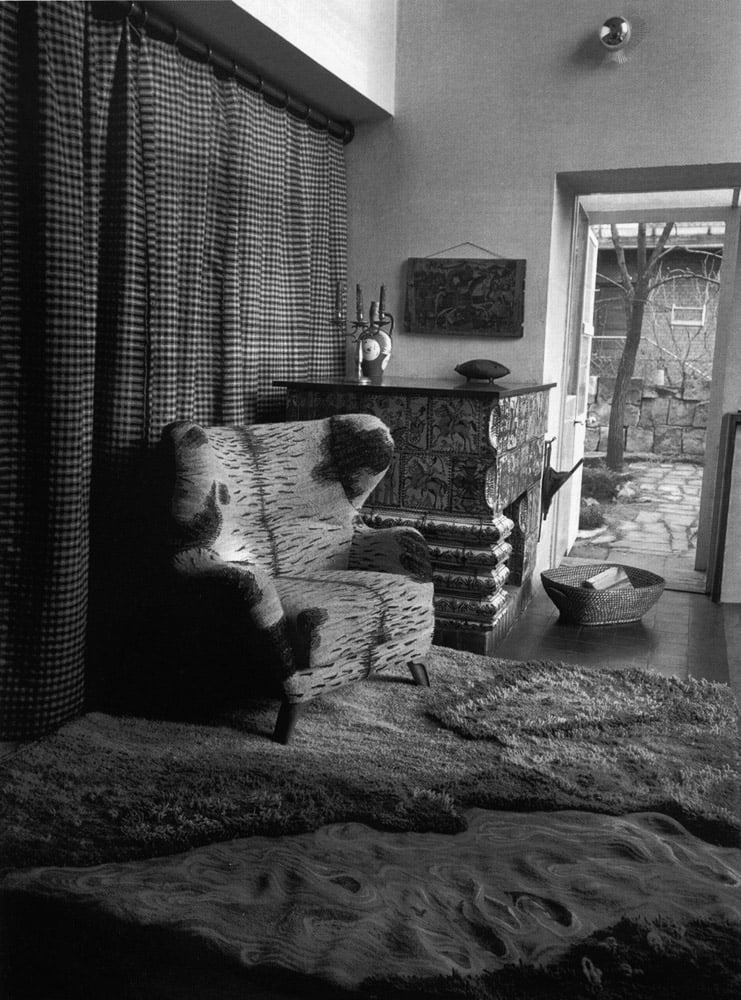
Barbara i Stanisław Brukalscy, Leisure room at the Polonia Pavilion of the World Expo in New York, Barbara Brukalska, 1939
But Barbara had already earned her name before that with model avant-garde kitchen, designed in 1927 by Barbara Brukalska for the model apartment in the housing estate of the Warsaw Residential Cooperative, a Polish equivalent of the famous Frankfurt Kitchen by German architect Greta Schütte-Lichotzky, whom the Brukalskis met at CIAM congregations. The figure in the drawing of the kitchen laboratory at the Warsaw Residential Cooperative seems to be a self-portrait of the designer herself. It is an image of a young woman in sporty shoes, comfortable modern attire and a hairdo à la Josephine Baker, the image of the New Woman, the modern housewife who approaches household chores in an entirely rational manner.(6) In the same spirit, the Brukalskis designed a new type of "hygienic" furniture, finished with what was then a new material (linoleum), which they developed in the framework of the "Compact Apartments" Program (1930) initiated by the Praesens group.
The Brukalskis’ designs often reveal their fascination for Le Corbusier, whom they met as participants in CIAM congresses. In fact, Barbara was so taken with Corbu that her graduate work, entitled Apartment House (1934), with its two-floor interiors with great glass strips of windows, spiral stairs, and gangways plagiarized Le Corbusier, emulating the interiors of the villa of La Roche-Jeanneret in Paris (1923–1925). Even the openwork pipe furniture in Barbara’s sketch are a replication of designs by Le Corbusier’s co-worker, designer Charlotta Perraind, the real creator of the famous No B306 couch (1928).
Barbara Brukalska often accentuated her feminine identity in her work. Writing on architecture, she lifted her language straight from "ideal housewife" guides. For example, she spoke of "sweeping the garbage out from under the wardrobe" (eliminating the places in the city that were most neglected), and called the architect the "perfect cook," remarking that "making a tasty and healthy cake" of contemporary architecture "requires the ennobling of everyday architecture."
After the war, the Brukalskis tried to pass on their experience to the students of the Architecture Department of the Warsaw Technical Academy. Brukalska published a textbook called Social Principles in Designing Housing Estates (1948), which was ultimately withdrawn from circulation, however, for political reasons. She taught a multifaceted approach to every design issue, regardless of its scale.
The consistency in the planning of residential space, the functionality of the model kitchen-laboratory (whose module developed by Barbara in the 1930s was the model design in Polish offices till the 1980s), the charm of Barbara’s garden designs and the comfort of her furniture – all this places Barbara and Stanisław Brukalski among the most outstanding creators of modernity. Barbara herself, as a furniture designer, holds one of the most important positions among the modern inter-war designers.
Barbara Wanda Brukalska (née Sokołowska) (1899-1980) was a graduate of the Architecture Department of the Warsaw Technical Academy (1921-1932); Stanisław Brukalski (1894-1967) graduated in architectural studies at technical academies in Milan and Warsaw (1918-1925). In 1927 they began co-designing projects, including: housing districts for the Warsaw Housing Cooperative in Żoliborz (continued after 1945: Home for the Lonely and Cultural Center); their home in Warsaw on Niegolweskiego Street 8 (1927-1929); pavilions for the State Monopoly at the Eastern Fair in Lwów (1927), for the Magistrate of the Capital City of Warsaw, and for the Elektrolux Company; and passenger ship interiors for: the "Hanusia" and the "Wanda" (ca. 1928), the "Piłsudski" (1935-1936), the "Chrobry" (1939), the "Sobieski" (1937-1938), and the "Batory" (1937 and 1948-1950). Stanisław and Bohdan Pniewski co-created the Polish Pavilion for the International Art and Technology Exhibition in Paris 1937, and Barbara designed one of the interiors (Grand Prix). She also received an award for her interior design at the International Exhibition in New York (1939). They took part in avant-garde exhibitions: the 1st International Exhibition of Modern Architecture in Warsaw (1926); the Modernists’ Salon in Warsaw (1928) and in Wilno [today Vilnius, Lithuania] (1928); the 1st exhibition of the Praesens group in Warsaw (1926); the Machine Age Exhibition in New York (1927); and the Fall Salon in Paris (1928). In 1928 they became members of the Polish Architects’ Association, the avant-garde Praesens group (1929–1930), and CIAM (from 1929 onward). At the beginning of the 1930s Barbara Brukalska and architect Nina Jankowska ran the "Dom i Ogród" [House and Garden] project. From 1936-1938 Stanisław Brukalski served as designer for the Head Office of the Polish Army on Rakowiecka Street in Warsaw. During World War II he was held in the camp in Woldenberg. After the war both were involved in the reconstruction of Warsaw: Barbara’s projects included the Pod Orłami Bank, the Czapski Palace, and the interiors of the buildings in the Old Town Square; and Stanisław was hired as a co-designer of the reconstruction of the New City. Both were also active in issues of cooperative housing: Stanisław as one of the post-war creators of the concept of the cooperative residential building, Barbara as the author of the book Social Principles in Designing Housing Estates (1948). Both lectured at the Architecture Department of the Warsaw Technical Academy: Barbara beginning in 1946 (as a professor from 1948), Stanisław beginning in 1949. Barbara Brukalska’s designs included churches (Jerzyska k. Węgrowa, 1948–1965; Izabelin k. Pruszkowa, 1952; Troszyn k. Ostrołęki, 1956–1979; Ostrołęka 1958–1961; Sypniewo k. Makowa Mazowieckiego, 1969–1974), the interiors and salons of the Speaker of Parliament, and the Okęcie II Housing Estate.
Author: Marta Leśniakowska
Text originally published in Out of the Ordinary. Polish Designers of the 20th Century, edited by Czesława Frejlich and published by the Adam Mickiewicz Institute (Warsaw, 2011) in cooperation with the Karakter publishing house. Translation by Søren Gauger, edited for the purposes of Culture.pl by Agnieszka Le Nart.
For more information on the book, see: www.karakter.pl
Notes:
(1) M. Leśniakowska, Architektura w Warszawie. Lata 1918–1939, Warsaw 2006, pp. 144–147.
(2) H. Lauterbach, quoted from: "Tèrés Forma" (Budapest), 1930 p. 179, in: Architektura i Budownictwo, 1930, p. I.
(3) B. Brukalska, Wspomnienia, "Architektura" 1983, no. 3, pp. 17–23
(4) L. Niemojewski, Ku syntezie trzech pokoleń, "Kurier Warszawski" 1934, no. 352.
(5) M. Leśniakowska, Wielka Szyba Brukalskiej [in:] Wystawa paryska 1937. Materiały Konferencji Naukowej IS PAN 2007, Warsaw 2009.
(6) M. Leśniakowska, Modernistka w kuchni. Barbara Brukalska, Grete Schűtte-Lihotzky i "polityka kuchenna" (wstęp do architektury modernizmu), "Konteksty. Polska Sztuka Ludowa" 2004, no. 1–2, pp.179–196.

