Sumiński was born into a landed gentry family in 1924 in the village of Badurki (in east-central Poland). His youth – as was the case with his entire generation – was brutally brought to a halt in 1939. As he recollected [1]:
At four in the morning we heard the cannons of the Battle of Mława. At that precise moment I became an adult. […] I was fifteen at the time and was a pupil at a renowned middle-school in Płock – it was called Małachowianka and was famous as the oldest middle school in Poland, it’s over seven hundred years old. From that time on, I was treated as an adult. My father was already dead at that time, so I unexpectedly became the head of family.
Sumiński proved his maturity five years later by taking part in the Warsaw Uprising (Battalion Zośka, code-name Leszczyc). After the war he began studying economics at the Warsaw School of Economics and became an assistant at Katedra Ekonomiki Obrotu Towarowego [editor’s translation: collegium of economics of goods trading]. But he was not destined to pursue an academic career. In 1949 Sumiński was sent to prison. He talked about this in a conversation with Marek Grygiel and Tadeusz Rolke [2]:
I was accused of trying to forcefully overthrow the regime. I got out without a sentence, as there wasn’t enough evidence. Urząd Bezpieczeństwa [editor’s note: Department of Security in Communist Poland, known for its cruel methods, dissolved during the Polish October in 1956 and replaced by a similar institution called Służba Bezpieczeństwa] had its own policy when it came to locking people up. They would never lock everyone from a given circle. They locked up nearly everybody from Battalion Zośka, but left some people free. It was decided that these remaining elements of Zośka should be destroyed. I was held in jail only for six months, but I lost my post at the university.
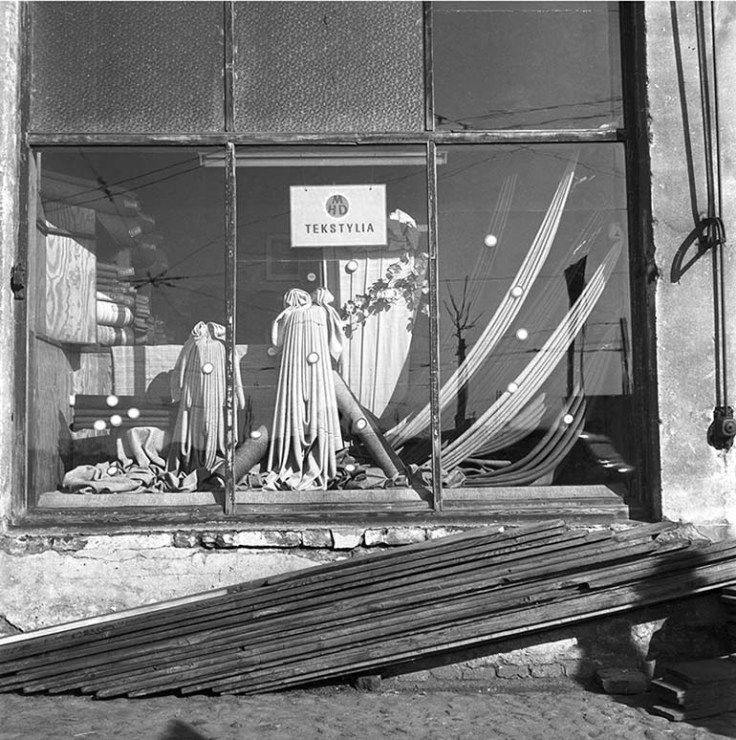
Photo from the Warszawa nieoczywista exhibition, photo: Tadeusz Sumiński, curator: Marta Przybyło-Ibadullajev, courtesy of Fundacja Archeologii Fotografii
After Sumiński got out of prison, he finished his studies (1952) thanks to his thesis supervisor’s support and started working in Spółdzielczy Instytut Naukowy, and afterwards in Instytut Handlu Wewnętrznego (both of these organizations were research institutes). However, it became clear that all his promotion prospects in the field of science were obsolete due to his participation in the Warsaw Uprising and his landed gentry roots.
Postgraduate research: I was told to buy a hammer and knock the idea out of my head… All in all I got fired and this was when I went to Centralna Agencja Fotograficzna [editor’s note: the only public photo agency in Communist Poland]. [3]
From an archivist to a photojournalist
Sumiński became interested in photography while he was still a student. Initially it wasn’t a fascination, but — as the photographer himself claimed — a consequence of coming to realize that he wasn’t particularly gifted when it came to drawing. He did, however, have a huge need to create and could devote himself to it. He would make enlargements by night in his tiny room, wrap the sensitized photographic papers in black foil, and go to the other side of town where he could develop them.
Sumiński’s job was to choose existing photos for scenarios of exhibitions, devoted mostly to the economy. If CAF wasn’t in possession of such photographs, Sumiński had to look for them in private archives. Thanks to this, he met many prominent artists, including Edward Hartwig, whom he considered the greatest Polish photographer of the 20th century till the end of his life.
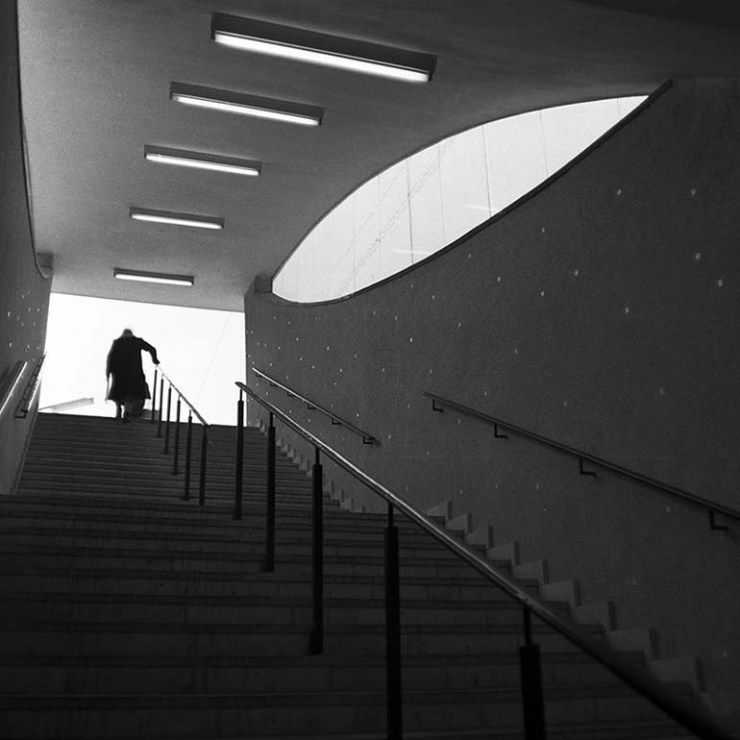
Photo from the Warszawa nieoczywista exhibition, photo: Tadeusz Sumiński, curator: Marta Przybyło-Ibadullajev, courtesy of Fundacja Archeologii Fotografii
After a few years spent in CAF, Sumiński quit and started working in Wytwórnia Filmów Medycznych [editor’s translation: Medical Film Studio], where he filmed (using an Arriflex 35 camera) various surgeries and medical procedures. He spent only a few years in the studio before finding employment in the Institute of Industrial Design, run by Wanda Telakowska, where he was occupied with fashion photography, among other activities.
At the end of 1961, time for another change came: Sumiński began his cooperation with the Polonia enterprise, the publisher of Polska magazines. It was issued in three versions: the first one was intended for Western countries, the second for Eastern Europe and the USSR, and the third one, published in English and French as, accordingly, The Polish Review and La Reveu Polonaise, was printed for Asian and African countries. Sumiński worked for the third issue as a photojournalist. This position was prestigious and gave him an opportunity that was very rare in Communist Poland, namely the chance to travel. He visited Western Africa and Mongolia among other places, but also discovered the many faces of Poland that were unavailable to most people. He sailed on an ice-breaker through the River Odra and photographed industrial parks. In 1964 he was, once more, forced to resign from the job. As he explained [4]:
I had an unpleasant adventure. […] I took a picture in a cathedral in Frombork and Irena [Jarosińska] said it was her picture – allegedly, the negatives were mixed up in the photo lab. I went to great lengths to explain this situation. I have checked and it turned out that I took this photo earlier than she claimed to have taken the picture, but nevertheless… It was one of my best known photographs. But she wouldn’t budge an inch. So I asked her to show me the negative – I’ve shown her mine. It was a weird story. She said she sent the picture to some magazine in Germany and she didn’t have the copy anymore. But it’s impossible to take an identical photo.
Sky in the landscape
Before he started work in the Polonia publishing house, Sumiński managed to become a member of Związek Polskich Artystów Fotografików, an association of Polish photographers. At that time, associateship with that body was a condition that allowed photographers to accept private, freelance work. No institution had the right to pay a private person for service, but it was possible to make an order in Pracownie Sztuk Plastycznych, which in turn hired a photographer, on the condition that he was a member of ZPAF. Having quit his job at the publishing house, Sumiński was able to work as an independent photographer. Most of the times, he was creating postcards commissioned by Ruch, a newsstand chain (this work also required membership in the ZPAF). This activity, slightly looked down at by photojournalists and photographers with artistic ambitions, granted Sumiński not only a decent income, but also an opportunity to have contact with the Polish landscapes, at the top of things – the region of Suwalszczyzna, very much beloved by him.
Sumiński’s first individual exhibition opened on 19th October 1963 in Kordegarda gallery in Warsaw – at that time, the official gallery of the Ministry of Culture and Art. The event gave rise to a series of exhibitions that would be presented over the next years, under the common title of Niebo w krajobrazie [editor’s translation: Sky in the landscape]. In his artistic credo Sumiński declared that he considers the documentative quality of photography as its highest value, but he is unable to get rid of his will to aestheticize. This dualism was noticeable during the 1985 exhibition titled Anatomia krajobrazu [editor’s translation: The Anatomy of Landscape], presented in the now-defunct Mała Galeria in Warsaw.
As the artist explained [5]:
It was constructed according to this rule – I literally entered the landscape, neither ugly nor pretty, and got out ugly and pretty fragments of this landscape.
Sumiński consistently advocated for tradition, simplicity of form and scarcity of formal devices in photography. He invoked the tradition of Jan Bułhak, appreciated Hartwig, thought highly of Paweł Pierściński’s works. In the later period he was also inspired by the works of a classic of American landscape photography, Ansel Adams, whose exhibition Sumiński saw in the Warsaw ZPAF gallery in 1976.
Tadeusz Sumiński died in Warsaw in 2009.
Author: Krzysztof Miękus, May 2016. Translation: Natalia Sajewicz
[1] http://ahm.1944.pl/Tadeusz_Suminski/2/?q=tadeusz+sumiński [accessed: 2.12.2015]
[2] http://fototapeta.art.pl/2004/tsu.php [accessed: 2.12.2015]
[3] ibid
[4] ibid
[5] ibid

