Biography
Dygat was the grandson of Ludwik Dygat, an insurgent of 1863, and the son of architect Antoni Dygat. He came from a Polish-French family. After passing his high school exams in 1935, the future writer studied at the Warsaw School of Economics, then architecture at the Warsaw University of Technology and Philosophy at the University of Warsaw, although he did not complete any of these majors. He made his debut with the story Różowy Kajecik (editor's translation: Pink Notebook) in 1938. He participated in the bohemian life of pre-war Warsaw. He played tennis with Witold Gombrowicz and belonged to a boxing club.
After the September 1939 campaign – due to his French citizenship – he was interned and spent several months in a camp in Constance on Lake Constance. This was reflected in his 1946 debut novel Jezioro Bodeńskie (Lake Constance), which is a kind of settlement with pre-war Poland – prose that undermines native martyrdom, mocking the romantic tradition of Polish heroism.
After returning to Warsaw, he was associated with the cultural underground. After the war, he lived in Kraków, Łódź, and Wrocław, and from 1950 in Warsaw. He was one of the central figures in the artistic and social life of the capital, he gathered around himself a large group of writers, filmmakers, and athletes. He cooperated with many magazines, including Kuźnica, Twórczość, Przegląd Kulturalny, Życie Literackie, Literatura, and Polityka. He was a member of the Polish Writers' Union. As Stefan Kisielewski wrote (Abecadło Kisiela, Warsaw 1990):
Stanisław Dygat – ahh, he's a funny, interesting character. And very talented. I value him because he is a writer who could set himself apart from communism – but not against. He had his interests, his line. [...] He never wrote badly, he wrote everything well. He had an innate talent. And he was nervous and hysterical, and he hid it. Besides, he was very interested in sport, he was friends with Olympic champion Komar.
Works
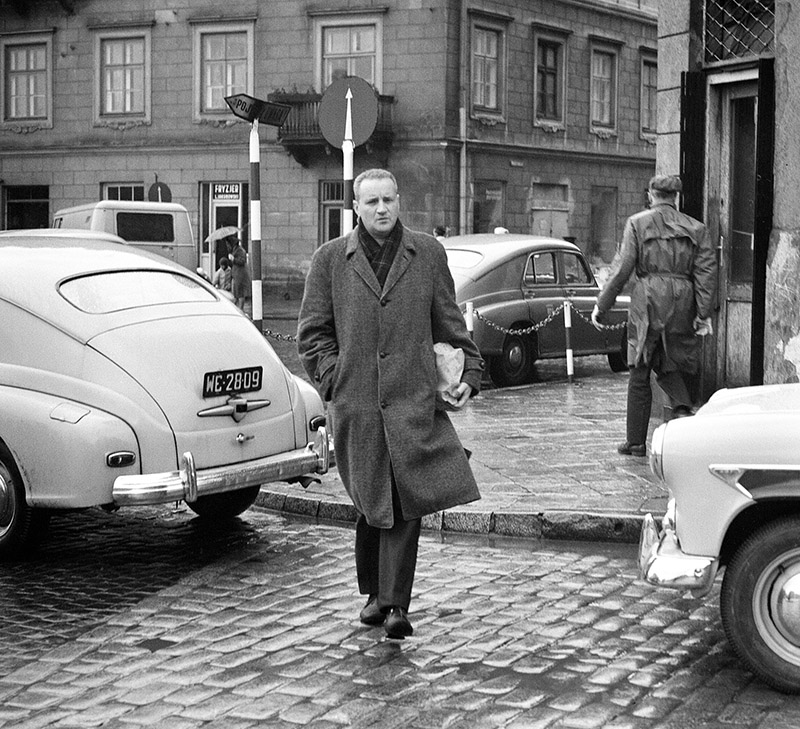
Stanisław Dygat, Warszawa, 1962. Photo: Janusz Sobolewski / Forum
He published novels: Jezioro Bodeńskie (Lake Constance, 1946), Pożegnania (Farewells, 1948), Podróż (Journey, 1958), Disneyland (1965), Karnawał (Carnival, 1968), and Dworzec w Monachium (Railway Station in Munich, 1973) as well as several collections of short stories. His columns from the series Rozmyślania przy goleniu (Meditations during Shaving) were also very popular. As Kazimierz Kutz recalled in Klapsy i Ścinki: Mój Alfabet Filmowy i Nie Tylko (Kraków 1999) -
He considered writing as something embarrassing – as if inappropriate – and considered any conversations or discussions about writing shameful. He once appeared in Wrocław and forced me to go with him to a meeting with the readers at the Journalists' Club and he took a towel with him. [...] A pile of university professors fell down and taught about his books and then put up surprising questions. He was embarrassed in the middle of the room, he held onto a chair and swayed like a stalk in the wind, saying ‘yes’ or ‘no’, or ‘maybe’, or ‘I don't know.’ When he was finally asked what he thought about Bergman's films, he said, ‘Well, I think,’ and he gave me a desperate sign, I dropped the towel, I gave it up.
He co-authored two plays: Zamach (Assassination) with Tadeusz Breza and Nowy Świętoszek (New Tartuffe) with Jan Kott. He translated from English, French, Czech, and Russian: Sartre, Delarue, Euripides, Sophocles, Shakespeare, Szajnin and Hašek. His most important translations are Twelfth Night by William Shakespeare and Sophocles’ Oedipus Rex. Truman Capote was delighted with his adaptation of Breakfast at Tiffany's to such an extent that he gave up his royalties so that the performance of the Warsaw Comedy Theatre could take place in 1965. Dygat’s books have been translated into numerous languages (including English, French, Lithuanian, German, Russian, Swedish, and Hungarian) and have also been adapted for film, theatre, and radio.
Private Life
Stanisław Dygat was married to actresses Władysława Nawrocka and Kalina Jędrusik. With his second wife, the writer had an untypical relationship – in the matter of sex they gave themselves a free hand. ‘A marvelous marriage, immortals, children of the universe,’ commented Kazimierz Kutz, who lived with them for several years, on their passing romances, subsequent break-ups and new beginnings. According to Jerzy Pilch (Dziennik, Warsaw, 2012):
In The Calendar and the Hourglass Tadeusz Konwicki remembers Stanisław Dygat organising a banquet on the occasion of the definitive end of his erotic life. The banquet took place, the farewell took place, but after a few weeks the author meets his friend in the company of a person whose age, sex and beauty, parting with eroticism – most subtly speaking – contradicted. Asked about this ostentatious inconsistency ‘Staś, you promised, not to meet girls whose fathers are younger than our daughters,’ Dygat answered firmly: ‘After Gomułka's speech nothing matters.’
He wrote in Disneyland:
I fell in love the first time when I was seventeen, and then I loved a few times, not all of those loves are attractive enough to be remembered, but each left the same feeling of emptiness and anxiety. Love never meets expectations, and desires lead delusions. It is such a shame that your own and other people’s words suddenly lose their value…
He provided a lot of anecdotes and bon mots which became part of the language of the intelligensia. ‘A woman values no man to such an extent as a man who loves her without reciprocity‘ (Pożegniania). One of Stanisław Dygat's overheard concepts - ‘…since existentialists discovered that man dies…’ was noted by Krzysztof Mętrak (Dziennik 1979-1983, Warsaw 1997). Jerzy Kawalerowicz, on the other hand, liked the maxim saying that ‘laziness does not allow me to do just anything’ (Gwiazdy w zbliżeniu / Stars in Close-up, Warsaw 1995).
Against the regime
Dygat ended his membership in the Polish United Workers' Party in November 1957, as a protest against the refusal by the authorities to agree to issue the monthly Europa. From then on, the writer would avoid all forms of organisational affiliation, without concealing a critical attitude to the actions of the authorities. In 1964, he signed List 34 (Letter 34) in defense of freedom of speech, and in January 1976 he was one of the signatories of Memoriał 101 (Memorial 101), addressed to the Sejm against planned changes to the Constitution. It was enough to place him under the watchful eye of the security forces. As Tadeusz Konwicki recounted in Pamiętam, Że Było Gorąco (I Remember it Was Hot, Kraków, 2001):
I have already mentioned my hotline with Staś Dygat …] We knew that we were being bugged, because one eavesdropper – a gentleman, a worthy man, you could hear it in his voice – interjected and said ‘Gentlemen, it's really overkill’. And we, confused, decided that he was right. But we also gave them some entertainment. We thought that if they were listening, let them have something of it. For example we would start praising the regime very much, admiring its wisdom, far-sightedness. We felt great warmth in the receiver, crazy silent contentment. And suddenly, we would start to swear – consternation.
Stanisław Dygat was called the ‘Prince of Warsaw’ by the security forces. He had his own table at SPATiF club, and in his villa in Żoliborz was an independent salon which Agnieszka Osiecka called ‘the monkey grove’. Together with Kalina Jędrusik, they invited all major directors, actors, writers, lawyers, and athletes. It was said that whoever didn’t visit Dygat’s house didn’t exist.
Last Days
Dygat’s great and undisguised passion was film. He was fascinated by Hollywood and was an expert on American cinema, which he expressed in Film and Ekran magazines. For many years he collaborated as a screenwriter and advisor for filmmakers. He was also the literary director of the Iluzjon Film Group (1956-1957). Occasionally he performed as an actor.
His 1948 book Pożegnania (Farewells) about political changes in post-war Poland was adapted to film by Wojciech Jerzy Has ten years after its publication. In 1967 Janusz Morgenstern made the film Jowita based on the novel Disneyland. In 1986 Janusz Zaorski filmed Dygat’s debut Jezioro Bodeńskie (Lake Constance). In 1977, Stacja Kolejowa w Monachium (Railway Station in Munich) was adapted in the film Palace Hotel by Ewa Kruk. The film premiered in 1983, five years after the writer's death. Said Kazimierz Kutz:
He didn‘t bear changes in weather and all rudeness. Suppressed rudeness – our bleak nationalists from the PZPR - for the screening of the film of his script (Stacja kolejowa w Monachium) drove him in. They pushed him into the corner and knocked him out, and Bohdan Poręba was the leader of this firing platter. His friends, however, let him down too often, in difficult moments, which hurt him most.
He was extremely concerned that there was a discussion in the Film Office, led by Janusz Wilhelmi, deceased, who attacked Dygat terribly, and after him all attacked what Dygat then commented on with bitterness: ‘And my friends were quiet, Konwicki, others, no one spoke in my defense.’ He came home, had a heart attack and died, he was concerned that his friends did not defend him. (Stefan Kisielewski, Abecadło Kisiela, Warsaw 1990).
Dygata was included in the absolute prohibition of printing. SB planned to intensify further actions of ‘neutralizing’ the writer. These intentions were not implemented due to the premature death of the harassed ‘figurehead’.
We agreed with him that we have both a complex against people doing nasty things: we do not dare to look them in the eye, we are confused, embarrassed – we just feel guilty and that's it.
(Stefan Kisielewski, Dziennik, Warsaw 2001).
He wrote in Podróż: ‘There are people whose happiness flashes only for a moment, it will appear for a moment only to make life even sader and more cruel.‘
Author: Janusz R. Kowalczyk, December 2012.
Selected Works
Novels:
1946 - Jezioro Bodeńskie / Lake Constance
1948 - Pożegnania / Farewells
1958 - Podróż / Journey
1965 - Disneyland
1968 - Karnawał / Carnival
1973 - Dworzec w Monachium / Railway Station in Munich
Stories and columns:
1949 - Pola elizejskie / Champs-Elysées
1957 - Słotne wieczory / Rainy Evenings
1958 - Różowy kajecik / Pink Notebook
1959 - Rozmyślania przy goleniu / Meditations during Shaving
1973 - W cieniu Brooklynu / In the Shadow of Brooklyn
1979 - Kołonotatnik / Spiral Pad
1983 - Gucin
Dramas:
1946 - Zamach / Assassination (with Tadeusz Breza)
1950 - Nowy Świętoszek / New Tartuffe (with Jan Kott)

