Before the Shoah
Everything begins to change in 1933 – after Hitler came to power. Vishniac abandons expressionist photography and turns towards documenting the transitions that are taking place in the city: he takes photographs of anti-Semitic posters, swastikas. The Jews were already unable to freely take photographs (not to mention engaging in professional photography) – hence Vishniac would go everywhere with his daughter in order to pretend that he was photographing her.
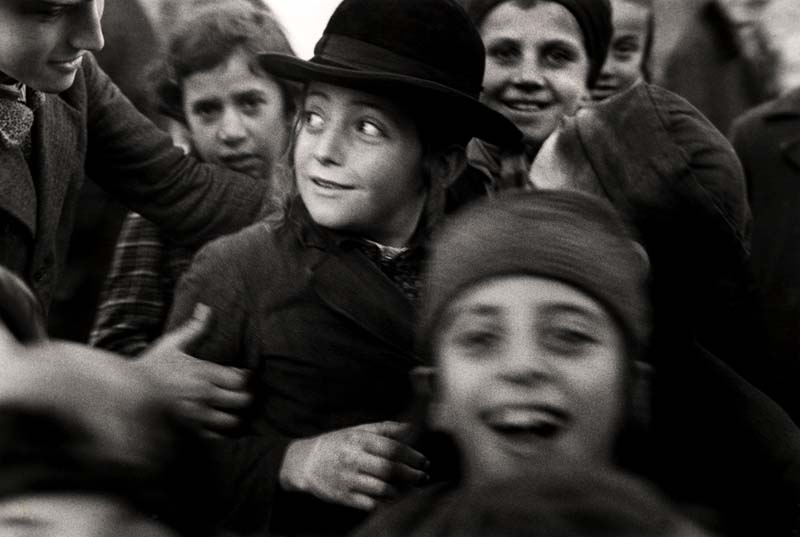
Roman Vishniac, Jewish school children, Mukaczewo, ca. 1935-1938, photo: © Mara Vishniac Kohn / courtesy of the International Center of Photography
At that time the photographer also began to collaborate with various organizations that were helping Jews, whose situation was becoming worse all the time – he was documenting their initiatives, which included providing food, medical aid, education. In result of this activity he was discovered by the members of the American Jewish Joint Distribution Committee (AJDC), a charity organization, which works to this day. In 1935 the organization commissioned Vishniac to document the life of Jews living in Eastern Europe. For this project the photographer visited, among others, the present-day Romania, Czech Republic, Slovakia, Hungary, Ukraine, but nevertheless he spent the majority of that time in Poland. He photographed Jews from Warsaw, Lublin, Cracow, Białystok, and the small, peripheral towns. The images portrayed everyday life of Jewish villages and quarters, children’s games, work environment, prayers, but also the living conditions and the increasingly hostile atmosphere (numerous anti-Semitic demonstrations, boycotts of Jewish shops, etc.) These photographs are considered to be the last consistent series on the Jewish nation and culture that was taken before Shoah. The series from Eastern Europe is very often compared to the now classic collection of photos, commissioned by the Farm Security Administration (FSA – founded in 1935). One of the organization’s fields of action was documentation of the American countryside, residents of which appeared to be those most affected by the Great Depression. Dorothea Lange, Gordon Parks, Arthur Rothstein, Jack Delano, Walker Evans would tour the country, taking pictures of the poverty and its victims. The anthology of photographs, created in 1935-43, is nowadays considered to be a classic example of documentary photography and a poignant record of social effects of the Great Depression. Roman Vishniac’s pictures, similarly to those taken by Dorothea Lange or Walker Evans, although commissioned, are full of humanitarian empathy and attempt to demonstrate not just the imagery, but also the human fate.
Turn of the 1930s. Wieringermeer and Zbąszyń
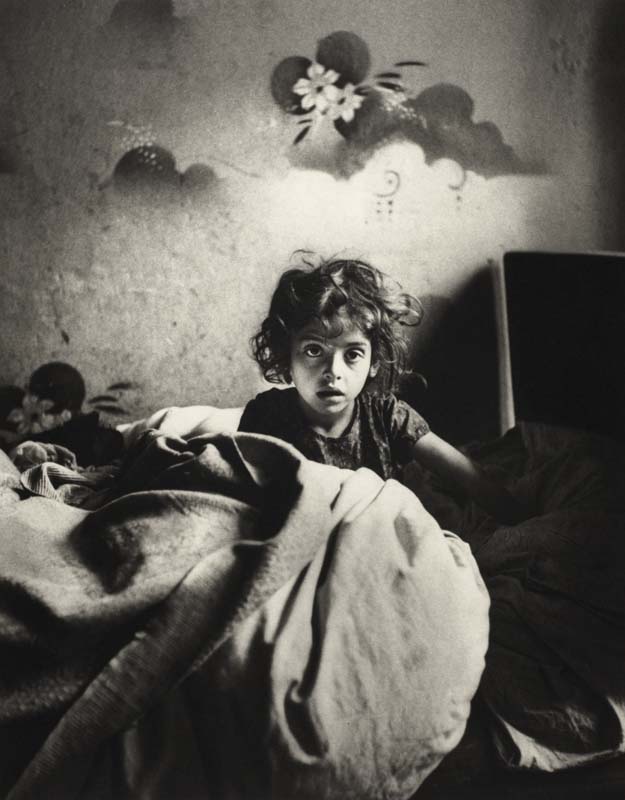
Roman Vishniac, Sara, Warsaw, ca. 1935-1937, photo: © Mara Vishniac Kohn / courtesy of the International Center of Photography
Before the outbreak of the War, Vishniac documents a Zionist camp in Wieringermeer, Netherlands, where the Jewish youth was taught how to farm in order to prepare for their relocation to Palestine, and camps for Jews resettled from various parts of Europe. One of them was a camp for Jews banished from Germany in Zbąszyń (in October 1938 the Germans expelled approx. 17 000 Jews to Poland; 7 000 found refuge in this camp); Vishniac also carried out series about camps in the south of France, in Nice and Marseilles. These cycles, created at the end of the1930s, differ in a lot of ways. Photos from Zbąszyń constitute a horrifying image of people who were living in confinement and unsure of their future; the pictures from French camps, on the other hand, convey unexpected memories of the summer dog-days (beaches, promenade strolls, open air concerts). In the series devoted to the farming training in Netherlands Vishniac returned to the beginnings of his professional career – to the dynamic takes he would create in Berlin. The portraits from Wieringermeer may resemble social realist images of the work leaders – here we can see the engaged, cheerful youth, enthusiastically working in the fields. This farming schooling camp in Netherlands was the first joyful event that Vishniac photographed in years. This is perhaps why he had the possibility to take better care of the formal solutions: scaffoldings of farm buildings erected by the adolescents had inspired the photographer to create pictures in the spirit of geometrical compositions, similar to those made by Alexander Rodchenko in the past.
The United States
On New Year’s Eve in 1941 Roman Vishniac, together with his wife and children, arrived in New York (they escaped on a ship from Lisbon). Soon after that the photographer opened his portrait studio, and simultaneously continued to be involved with the American Jewish Joint Distribution Committee: Vishniac was travelling across the U.S. to present his photographs from the interwar period. In 1947 the photographer’s first monographic album entitled Polish Jews: A Pictorial Record was released: in the following years Vishniac’s works were published a number of times. For instance, they were used as illustrations to Isaac Bashevis Singer’s autobiography A Day of Pleasure: Stories of a Boy Growing Up in Warsaw; they also appeared in the famous exhibition The Family of Man, a substantial overview of documentary photography, organized by Edward Steichen in 1955 at the Museum of Modern Art in New York. In 1983 Farrar, Straus,and Giroux published an extensive anthology of the photographs taken by Vishniac in the 1930s in Europe.
![Roman Vishniac, siostry Marion, Renate i Karen Gumprecht, objęte pomocą National Refugee Service (NRS) i Hebrew Immigrant Aid Society (HIAS), wkrótce po przybyciu do Stanów Zjednoczonych, Central Park, Nowy Jork], 1941. fot. © Mara Vishniac Kohn / dzięki uprzejmości International Center of Photography](https://api.culture.pl/sites/default/files/images/culture.pl/7_icp_vishniac_pressimage.jpg)
Roman Vishniac, Marion, Renate and Karen Gumprecht. The sisters were under protection of the National Refugee Service (NRS) and Hebrew Immigrant Aid Society (HIAS), soon after their arrival in USA , Central Park, New York, 1941. photo: © Mara Vishniac Kohn / courtesy of the International Center of Photography
After his arrival in New York, Vishniac continued his photography work with Jewish institutions. His biological microphotography was published widely in national magazines and advertising. The photographer died in 1990. In 2007, thanks to his daughter Mara Vishniac Kohn, who inherited his property and works, the Roman Vishniac Archive was founded at the International Center of Photography in New York, in cooperation with the United States Holocaust Memorial Museum. In 2012 digitalization of all of the preserved works of the Jewish photographer was completed – today it lends itself for the use of historians, researchers of culture, amateurs of both history and photography.
From January to May 2013, the International Center of Photography held an exhibition of Vishniac’s works – one of the most interesting and richest collections documenting the life of Jews in 1930s Eastern Europe.

