Konieczny's approach to design is far from typical, however. As he has put it, 'Things that are, typical aren't very good. It’s almost as if there was only one shoe size available: it would fit some people, but not most people. It’s the same with typical architecture'.
He founded the architectural studio KWK Promes in partnership with Marlena Wolnik in 1999. The acronym is more than just a simple repetition of the founders’ initials. It is a reference to Silesia, which is where the architects come from and where they work. (In Polish KWK stands for a coal mine, and Silesia is a coal-mining region.) The firm has been recognised for its unexpected solutions and its exploration of new areas, at the same time realising the functional needs of the investors. Since its start, it has been nominated for the Mies van der Rohe Award six times. The Chicago Athenaeum architecture museum declared Robert Konieczny one of the most promising architects under age 40, his Aatrial House and the never-realized Hidden House are considered among the best designs in the world.
'The most important thing in my designs is space, or otherwise that which occurs between the walls. The walls themselves aren’t all that important', Konieczny has said. Indeed, every house he has designed is an answer to some local problem. Although his designs are perceived as unique and unusual, the architect points to their logic and clarity of composition. In an interview for bryla.pl he said,
If I can’t explain something to myself, I stop, I look for the right solution. If I find the appropriate rationale, I go on. If I can explain something to myself I will also be able to explain it to the client I am designing the building for.
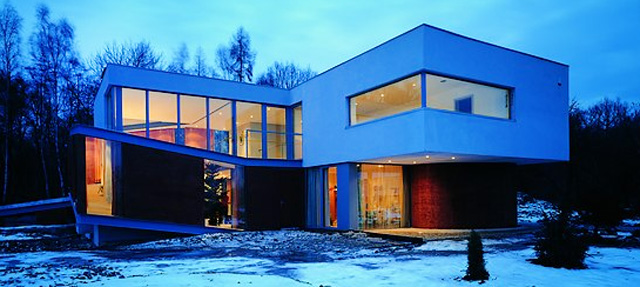
House from the Silesian Land, design: Robert Konieczny, photo KWK Promes
As Konieczny once put it: 'Our projects don’t follow fashion blindly, they always originate from an idea and therefore their forms are a result of that idea'.
The House from the Silesian Land / Dom z Ziemi Śląskiej was designed in 2000. It is a translation into the language of single-house architecture of the phenomena of mining damages, and the faults in the vicinity of mines in Silesia, the results of movement in the heavily excavated land. The house looks as if it was built by putting a few ramps together. The zigzags in the façade were accentuated by the architect: the first floor was painted white and the ground floor was decorated with rust-coloured Corten steel.
Construction of the House from the Silesian Land was completed in 2002. It was praised for its freshness, originality and also for the fact that it referenced the tradition of the place in which it was raised. Who could have predicted that this single-family building will be the first of a broad series of realisations that have earned Konieczny status as the most internationally acclaimed Polish architect? The project won KWK Promes its first nomination for the prestigious Mies van der Rohe Award. Phaidon's Atlas of Contemporary World Architecture also included the House from the Silesian Land in its 2004 edition.

Aatrial House, design: Robert Konieczny, photo Juliusz Sokołowski
He began his next project, Aatrial House, in 2002. The plot of land the house was to be built on was beautifully located amidst the Lower Silesian woods. There was only one drawback – it was accessible by car only from the most attractive southwest side. In order to open the house to this side, the driveway was shifted entirely underground, not interfering with the stretch of sunlit terraces. World Architecture News, the influential internet site, chose the Aatrial House for its House of the Year in 2006.
Safe House was among Konieczny's most unusual commissions, designed between 2004-2005 and built near Warsaw in 2009. The investor desired a villa that made safety a priority in design. The house has mobile walls which may be repositioned in such a way that they completely cut the building off from its surroundings. The movable walls create a buffer between the garden and the street, they separate the private space from the outer world, they may even change the house into a fortress that doesn't allow anyone in.
On the other hand, the Open House in Żory, built in 2005, references the building that used to stand in its place. The old structure had the shape of a cube. In Konieczny’s design, elements protrude from the solid, bringing to mind the open drawers of a chest. Thanks to its shape the Open House offers better access to sunlight and better isolation from the nieghbouring buildings, compared to its predecessor. The private rooms of the dwellers are located in the 'chests' and the space between them constitutes the shared area of the house.
Konieczny designed his only typical house in 2007 – it is so universal that it may be built anywhere, on any given plot. It was eventually raised near Pszczyna in 2011. It has the shape of a sharply cut cylinder - however the shape of the roof may be modified. Thanks to the prefabricated construction from natural materials, the house doesn’t contrast that much from the surrounding nature. The airtight walls ensure that energy is saved - warmth doesn’t escape through gaps - and the circular structure provides a kind of space which may be used very efficiently.
Konieczny's mission is to build objects that shape landscapes. At the same time he isn’t fond of cheap, modern tricks and he doesn’t feel the need to create flashy objects at any cost. In an interview for Ultramaryna magazine, he said:
Warm, cozy - I’m not ashamed of this word because a house simply has to be cozy. I see no sense in entering a house just to admire a hard concrete floor while sitting in a coat by a white neon light.

Aatrial House, design: Robert Konieczny, photo Juliusz Sokołowski
Wallpaper magazine put Konieczny on its 2007 list of the 101 most exciting new architects in the world, distinguished for projects that originate from simple ideas and for the use of technologies, structures and forms harmonising with the concepts of the buildings. In 2009 his design was chosen in the architectural competition for the Breakthrough Dialogue Centre of the National Museum in Szczecin, with construction on the site launched in 2012. The design calls for an urban square, a new quarter of buildings and an underground area that make up the first large, public realisation for the Silesian architect.
Konieczny still keeps doing what he does best: residential houses. He designed the Family Car House in 2012, in which the garage's role is as important as any other space. A car may be driven directly into the interior of the building, and the garage is nothing short of a representative space. In this project the architect removed the boundaries separating the living space from the usually neglected and hidden technical space.

Family Car House designed by Robert Konieczny, photo Olo Studio
Konieczny has built up such a solid reputation in the field that he doesn't have to compromise with quality or creativity. Konieczny has said,
Our clients today are people who have a certain awareness. They don’t have to be persuaded, they expect creative ideas. This gives is the comfort of being able to realize ourselves. And that’s what it’s all about.
The architect embarked on his most personal project in 2012 - his own home. Known as The Ark, the structure 'hangs' from a slope of a mount in Brenna. The elongated solid with a cut ground floor has an exterior that was made entirely from crude concrete.
Author: Anna Cymer, April 2013. Translated by Marek Kępa and edited by Agnieszka Le Nart, May 2013.

