He graduated from the Faculty of Puppet Theatre at the State Higher Theatre School in Wrocław (1995) and from the Faculty of Theatre Directing at the Ludwik Solski State Higher Theatre School in Kraków (1998), where he studied in a cohort led by Krystian Lupa.
In 1996, he was the assistant to Lupa during the staging of Thomas Bernhard’s Ritter, Dene, Voss (Polish title: Rodzeństwo, Stary Theatre in Kraków). Brzyk debuted as a director in 1998, with the performance The Form based on F. Dostoevsky’s writings, staged at the Stefan Jaracz Theatre in Łódź; soon afterwards he returned to the same stage with Sophocles’s Oedipus Rex (1998) and Arthur Miller’s The Crucible (2000), for which he received the Konrad Laurel at the Festival of the Art of Theatre Directing in Katowice.
This play, staged in contemporary Poland is a true explosive, which just needs to be lit. This was done by Remigiusz Brzyk, yet another talented alumnus of the Kraków Theatre School. – wrote Roman Pawłowski – He created a performance which has the potential to blow up the Polish political reality. Its value lies in a precise analysis of the collective hysteria which we have been experiencing in Poland for the past decade. It doesn’t matter whether we are talking about witches, Jews, communists, or security police officers – the mechanism is always the same (Gazeta Wyborcza, 29.02.2000).
In 1999, he also staged The Slaughterhouse by Sławomir Mrożek (Juliusz Słowacki Theatre in Kraków).
Brzyk inherited from Lupa the ability to work with an actor and a distaste for cheap dramatic tricks and use of excessive means. His shows concentrate on characters’ psychological motivation and a thorough analysis of the literary material, hence the selection of texts he stages: Dostoevsky, Sophocles, Miller, and Mrożek.
Another trait he took from his master is the method of creating a dramatic world – which is entirely rooted in the director’s imagination. That is why Brzyk, just like Lupa, usually designs his own scenography, and sometimes personally selects music. He aims to conjure a reality which is complete and coherent.
Remigiusz Brzyk has an intuition for casting, he is also able to consequently build relations between the characters. – Olga Katafiasz, a critic for Didaskalia, wrote about Brzyk’s staging of The Cherry Orchard at the Stary Theatre in Kraków – Brzyk is able to select, lead, and help them [actors] in creating genuine characters. He remains faithful to Chekhov’s text, introducing hardly any shortcuts. Nonetheless, he embellishes each scene with interesting, unexpected situations and is able to paint each of them in its own temperature, fill each look and gesture with meaning.
Brzyk has directed contemporary texts: at Stary Theatre in Kraków, he showed Tsar Nicholas by Tadeusz Słobodzianek (2002), at the Wybrzeże Theatre in Gdańsk – Dialogi o zhivotnykh (Dialogues About Animals) by Aleksandr Zheleztsov (2003). He created an interesting interpretation of Mary Stuart by Wolfgang Hildesheimer (2003, Polski Theatre in Wrocław), with a magnificent lead role by Halina Skoczyńska.
Remigiusz Brzyk’s stagings are like the Dutch masters’ paintings, where attention is drawn both to the main, central characters, and to the background figures, which seemingly act only as a backdrop. – Rafał Bubnicki wrote – This performance is a precisely constructed polyphonic composition, in which the core theme, i.e. the last days of the Scottish queen are inextricably intertwined with the story of an executioner and his helper, of a doctor and pharmacist, of the queen’s secretary and maids. The director plays this multilayered story out panoramically. (Rzeczpospolita, 15.04.2003)
Brzyk also directed in the Jaracz Theatre in Łódź, where together with Zdzisław Jaskuła, he realised The Rogues’ Trial by Ariano Suassuna (2004) and Mother War after Bertolt Brecht’s Mother Courage and Her Children (2004). The director realised The Petty Demon by Fyodor Sologub at Powszechny Theatre in Warsaw (2005), while in Polski Theatre in Wrocław – William Shakespeare’s Julius Caesar (2007). His following show was an interestingly staged socialist play Grinder Kurhan's Brigade by Vašek Káňa, prepared for Nowy Theatre in Łódź (2008) – this text in fact constituted an inaugural premiere on this stage, founded in 1949 by Kazimierz Dejmek.
Leszek Karczewski wrote:
Grinder Kurhan's Brigade is not a play about socialism at all. It is not a tribute, mockery, a provocation, or a display of a specimen from a museum of peculiar ideas. Brzyk’s Grinder Kurhan's Brigade is a show about the foundation myth of Nowy Theatre. About the dreams about it. Actors play opposite cardboard, life-sized figures of characters from the inaugural Brigade. Thanks to archival footage, Józef Pilarski and Kazimierz Dejmek talk to each other once again. (Gazeta Wyborcza - Łódź edition 2008, no. 268).
Korzeniec – a crime story from Sosnowiec
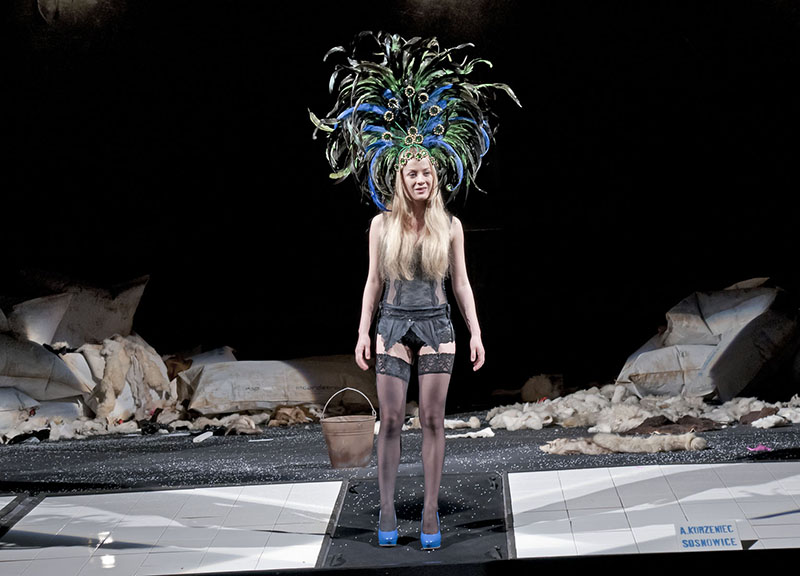
Photo from Korzeniec, dir. Remigiusz Brzyk, Zagłębie Theatre in Sosnowiec, photo by Maciej Stobierski
According to critics, Korzeniec – Brzyk’s show directed for Zagłębie Theatre in Sosnowiec which received awards at all major festivals – was a successful attempt of an ambitious regional theatre, an entertaining form of theatre, but also one posing important social questions. The show was created in 2012, based on Zbigniew Białas’s retro detective story published a year before. On the eve of the First World War, a journalist from a local newspaper tries to solve the mystery of death of Alojzy Korzeniec, a tiler.
In Korzeniec, the director Remigiusz Brzyk and playwright Tomasz Śpiewak found a material for a performance on the thirst for sensation which prevents us from experiencing history. It would seem that they tell a story of a mysterious murder in Sosnowiec with naivety and simplicity, as if nothing really happened. The plot doesn’t even take place in Sosnowiec, but in Sosnowice – following the writing on a tile which inspired Prof. Białas to write the novel, says (‘A. Korzeniec – Sosnowice’). […] The modernly, soberly sentimental Korzeniec by Remigiusz Brzyk and Tomasz Śpiewak combines a detective narrative with a story about how we miss out on actual events when generating the news – in this case, the outbreak of World War One, the actual beginning of 20th century – Joanna Derkaczew wrote in Gazeta Wyborcza.
Korzeniec was also adapted for a film, co-directed by Marcin Koszałka for TVP Kultura channel.
One Upon a Time, there was a Pole, Pole, Pole, and a Devil
Brzyk’s collaboration with Paweł Demirski – one of the major Polish playwrights – reverberated in the expert press. In 2013, at Osterwa Theate in Lublin, he directed a text whose author refers to as a political socialist play – One Upon a Time, There Was a Pole, Pole, Pole, and a Devil. In an interview by Piotr Guszkowski, the director explained:
The most poignant is the fact that Paweł wrote this text a few good years ago. When the play first premiered in Wałbrzych in 2007, it was criticised for its journalistic character, it was said that it would soon become outdated. Meanwhile, these days it is even more painful, bitter, and spot-on in exposing our traumas and insecurities than before. Contrary to some claims, the Polish demons conjured in it do not fade – they are doing great and revel. For me, There was a Pole is an excellent, ironic, humorous diagnosis of our beloved Third Polish Republic. We may not remember anymore who Bishop Paetz was, however the problem of pedophilia in the Church is still present. The number of Euro-orphans keeps growing. There seems to be even more celebrities in our domestic show business and bad taste that emanates from them. Football fans stay strong.
Jarosław Cymerman wrote after the premiere:
Suspended between life and death, we observe the characters struggling with Polish insecurities and traumas, the trivial everyday life blends with the major events of Polish 20th century history, while the colloquial language – with fragments of ambiguous poetry. In this ruthlessly hilarious play, quite serious questions continue to surface – what has happened to our community, what is the contemporary Poland and Poles like?
A contemporary emcee

