Piotr Młodożeniec was one of the first artists in Poland to use technology and the language of computer images in graphics. His designs were influenced by pop art and the emerging Neo-expressionism of the 1980s, as well as the work of two graphic artists, masters of the poster – his father Jan Młodożeniec and Professor Henryk Tomaszewski.
The end of the 1970s and the next decade, which in Poland was dominated by underground art originating from the political opposition to martial law, also left a significant mark on the art of the youngest member of the Młodożeniec family. This is when his urban art was shaped, as he called it in one interview, characterised by the use of templates, spray and screen-printing, simple and powerful means of expression.
This is how Młodożeniec describes his art:
My artistic work can be divided in two categories: painting which I do while thinking about myself and potential viewers, and applied graphic art which I create together with Marek Sobczyk.
Piotr Młodożeniec made his debut in the 1980s, at the same time as the Luxus group from Wrocław and Gruppa from Warsaw. From the very beginning he developed his own poster style based on expressionist aesthetics (influenced by Młode Dziki) and conscious simplification of forms created primarily using templates and computer drawings. The characteristic features of his early prints were angular, template letters, comic characters’ silhouettes, grey, black and white. At that time, Młodożeniec created a short series of posters which he reproduced using the screen-printing technique. From 1981 he designed, printed and distributed Christmas cards and occasional prints, often with a political character (the artist was associated with the underground ‘Solidarity’). Młodożeniec's posters, screen-printed on wrapping paper, were present at most cultural and music events dedicated to independent art in the 1980s. He produced them for the exhibitions of his colleagues, such as Ryszard Grzyb, Paweł Jarodzki, Włodzimierz Umiastowski, Jacek Ziemiński and others.
Młodożeniec's posters remind of street graffiti. The artist himself points out that he does urban art, although he never created classical graffiti on walls, as he prefers to paint on paper.
Młodożeniec designs his posters using a computer, which he learnt to operate even before he started his artistic studies. According to him, the idea for a poster is first born in the imagination, and only then, starting from the marks left by the hand, from the line, does he develop it with the use of computer programs. He creates graphics by transforming severely cut and drawn patterns into vibrating pixels.
Młodożeniec attaches great importance to letters in his posters, sometimes even giving them a leading role. He is the author of the poster Lech Wałęsa. President for the Glory of the Republic, used in the election campaign by the Porozumienie Centrum party. The idea for this poster is based on a play on words with the initials of the future president, which were incorporated to represent the characteristic facial features of Lech Wałęsa. Młodożeniec highly appreciates syntheticity and conciseness in graphic signs.
Since the early 1980s, Piotr Młodożeniec has also been painting. Initially, these were large canvases on which the artist repeated individual motifs. They contained the same expressive graffiti aesthetics as his posters, but at the same time they were different from the prints due to their sharp, loud colours. Młodożeniec's paintings are unusually dynamic; human faces, commercial and emblematic signs, and outlines of urban scenes emerge from the chaos of vibrant colour patches.
I paint quickly, I paint myself as I am at that point. It is a kind of a diary.
– said the artist.
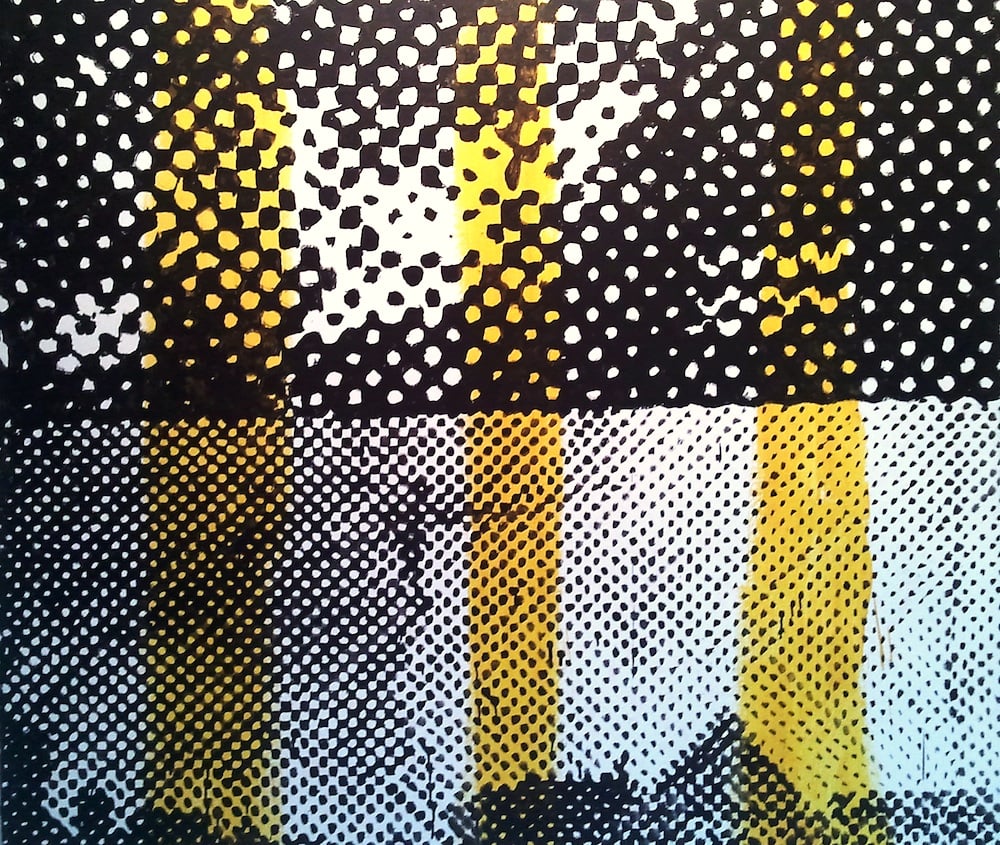
Piotr Młodożeniec, work from the exhibition Canvases, Halftones, photo: press materials
A common theme in his work is the characteristic shape of a schematically painted figure which we see in various painting contexts and graphic scripts. Młodożeniec often uses screen printing, thanks to which he transfers authentic or press photos onto canvas. One of the first such works was Homilies (1984) which contained the multiplied photo of Father Jerzy Popiełuszko, and Mathias Rust in Moscow (1989). Silk-screened prints also appeared in paintings created outdoors in Konstancin in 1991, on which Młodożeniec transferred the silhouettes of old villas. In a series of images created in New York (1997-98), Piotr Młodożeniec presented manhole covers for urban sewers. He transferred them onto canvas using the art reproduction method, and then made them into images that resemble mandalas or circular calendars from prehistory.
The Zafryki company works like an advertising agency, but in contrast to an agency full of anonymous people, here all the work is done by the two artists – Piotr Młodożeniec and Marek Sobczyk. From 1996, Zafryki's illustrations have appeared in Gazeta Wyborcza Magazine, and for some time, the company also did posters for the Rozmaitości Theatre in Warsaw.
Operating as Zafryki, Młodożeniec and Sobczyk design typographies, posters, logos, covers, graphic layouts for books and magazines, and they were also the authors of entire advertising campaigns (for example, Area 0.6 for Coca-Cola, which followed the conventions of graffiti). Their commercial campaigns were not devoid of high artistic value. They were characterised by very clear, recognisable aesthetics, based to a great extent on the expressiveness of painting which emphasises the role of colour, form and gesture. With its help the artists built a strong graphic symbol distinguished by the conciseness of street graffiti and templates. In the works signed by Zafryki text and image have always been treated on an equal footing, reminding of the classic philosophy of oriental ideograms, in which visual form was as important as the meaning carried by the sign. Młodożeniec and Sobczyk put special emphasis on typography, and they created dozens of their own original letter typefaces. Their achievements were based on a dialogue with the Polish avant-garde tradition of graphic art enriched by the language of street art and the possibilities offered by computers. However, it is clearly visible that the artists from Zafryki were not fascinated with the sophisticated techniques of this medium, but on the contrary, using the simplest programs, they found aesthetic pleasure in giving a ‘handmade’ label to computer projects (including working with low resolution, images broken into large pixels).
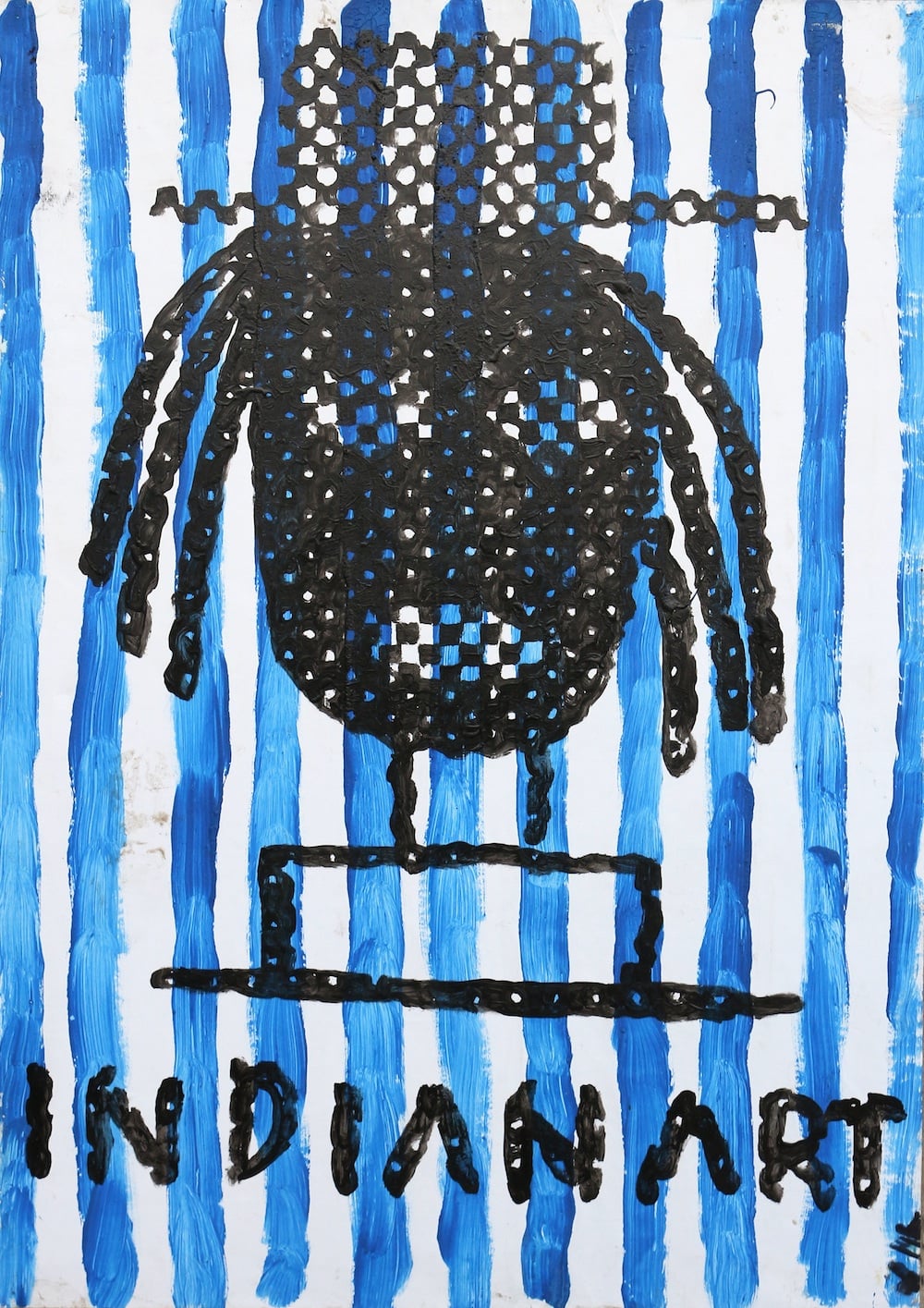
Piotr Młodożeniec, work from the exhibition Canvases, Halftones, photo: press materials
In 2001 Piotr Młodożeniec designed the Coexist sign, using letters linked with symbols of the three great religions in the synthesis of this concept: the Muslim crescent (the letter C), the Christian cross (the letter T) and the Jewish Star of David (‘X’) ☪OE✡IS✝. The work was commissioned by the Museum on the Seam in Jerusalem, as one of the 36 billboards designed by prominent artists from all over the world. Billboards included in the ‘Coexistence’ exhibition were shown in the streets of Jerusalem, Belfast, Sarajevo, Washington, New York, Houston, Paris, London, Sydney and others. Later, the sign created by Młodożeniec had a second life not related to the exhibition. It was used illegally for marketing purposes by companies in the US (such as CafePress and Coexistonline), while the frontman of U2, Bono, was so impressed by it that he included it in the performance design for his band’s 2005 Vertigo world tour and had it printed on his kerchief. As he explained later in an interview, he spotted the Coexist sign sprayed on the wall of a subway station in Chicago.
The 2006 exhibition Cinematograph summarised the last few years of Młodożeniec's work in Krakow's Zderzak Gallery, which the artist had collaborated with for a long time. A key element of the display was a projection of short animated films under the common title Cinematograph, dedicated to the grandfather of the artist Stanisław Młodożeńcow.
Cinematograph is a sequence of fast transformations, no longer than a minute, each of which has its own causes and consequences. The most frequent theme is culture, encoded in mysterious, colourful sticks changing into letter-words. Sticks are used by the animated characters, jumping from a historic bridge into the river, and then quietly retreating into oblivion; they are watched on the TV screen by Western cowboys, occupied mainly with beer consumption, or produced mechanically by an anonymous worker (as it may be presumed: an artist). Movement fits into this narrative – fast, brave and honest as a child. Wildly vigorous, seemingly awkward, but amazingly light: like an elephant in a china store that does not break a single cup. Such a move allows for unexpected stains, paint spills, a thick, confusing contour, and a line, so deep, that seems to pierce the background. In a word, it allows for apparent imperfection. (Quote from materials prepared by the Zderzak Gallery)
During the Polish Days in India project which took place from September 2006 to March 2007, an exhibition called ‘Jan and Piotr Młodożeńcy. Visual Poetry’ was prepared in Chennai and Lucknow. Piotr Młodożeniec showed ten films made with computer animation.
Selected individual exhibitions:
- 1993 - Poster, neon, Friends of AR Gallery, Warsaw
- 1995 - Metal Ball (with Tristan Wolski), School of Arts, Warsaw
- 1996 - Painting, Reszel Castle
- 1996 - Moving Images, Zderzak Gallery, Kraków
- 1999 - New World, Centre for Contemporary Art Ujazdowski Castle, Warsaw
- 2006 - Piotr Młodożeniec Graphic Art and Poster Gallery, Warsaw
- 2006 - Cinematograph Zderzak Gallery, Kraków
- 2007 - Piotr Młodożeniec. Posters, Critics Show Gallery, Warsaw
- 2008 - Piotr Młodożeniec, Entropia Gallery, Wrocław
Exhibitions with Jan Młodożeniec and Stanisław Młodożeniec:
- 1994
- Signiert Młodożeniec, Polish Cultural Institute, Berlin
- Młodożeńcy, Xawery Dunikowski Museum, Warsaw
Exhibitions with Stanisław Młodożeniec:
- 1997
- Stach & Piotr Paintings, Stefania Gallery, New York
- Stach & Piotr Paintings, A.G. Ornoch Gallery Art 80 Spadina, Toronto
- 1999 - Stanisław i Piotr Młodożeniec - paintings, BWA Sopot
Zafryki
- 1996 - Kunst in der neuen Messe, New Fair Grounds in Leipzig
- 1997
- Zafryki Graphik, Pollishe Institut, Leipzig
- Africa Graphics, Leon Wyczółkowski District Museum, Bydgoszcz
- 1998 - Zafryki graphics in Japan, DDD Gallery, Osaka
- 2000
- Africa Graphics, Rozmaitości Gallery, Warsaw
- Zafryki in Toronto, A.G. Ornoch Gallery, Canada
-
2001
- Zafryki in the Park. Lubljana, Slovenia
- The cros`s way, Academia Theatre Gallery, Warsaw
- zafryki.art.pl, artnewmedia gallery, Warsaw
Author: Ewa Gorządek, Centre for Contemporary Art Ujazdowski Castle, February 2005; update: November 2009; transl. Bozhana Nikolova

