Lalewicz was born on November 21st, 1876 in Wyłkowyszki (now Lithuania), and was killed in a mass execution in the second half of August 1944.
After finishing school in Suwałki, he went to study architecture at the Academy of Fine Arts in St. Petersburg, from which he graduated with distinction in 1901. He received a scholarship to study abroad, and he used it to continue his architectural studies in Sweden, Norway, Germany, Austria and Italy. In the years 1903-1918, he taught architectural drawing and art history at the Academy of St. Petersburg, at the Institute of Archaeology and the School of Decorative Arts named after Alexander Stieglitz, and architecture at the Institute of Communications. He also supervised graduate projects in the Polytechnic Institute for Women. In 1918, Lalewicz found himself in Warsaw and two years later he became a professor at the School of Fine Arts and the University of Technology.
Lalewicz had already developed a good reputation as an architect in Russia, designing buildings such as the Styrnyj Market (1906) and the Mertens department store (1913) in St. Petersburg, and the headquarters of the Trieugolnik Society in Moscow (1915).
In the years 1919-1924, at the start of his permanent residence in Poland, Lalewicz got involved in the restoration and reconstruction of historic buildings. He restored a number of palaces in Warsaw, such as Radziwiłł Palace (formerly Namiestnikowski) on Krakowskie Przedmieście Street, built for the needs of the Council of Ministers, and he adapted Ossoliński Palace (Brühl) for the Ministry of Foreign Affairs (rebuilt and enlarged in the first half of the 1930s by Bohdan Pniewski), the Prymasowski Palace on Senatorska Street for the Ministry of Agriculture, and the Raczyński Palace on Długa Street for the Ministry of Justice. In accordance with Antonio Corazzi's design, Lalewicz restored the former classicist look of the palace of the Warsaw Scientific Society (Staszic), which had been rebuilt in a Russo-Byzantine style by Vladimir Pokrovsky in 1892-1895.
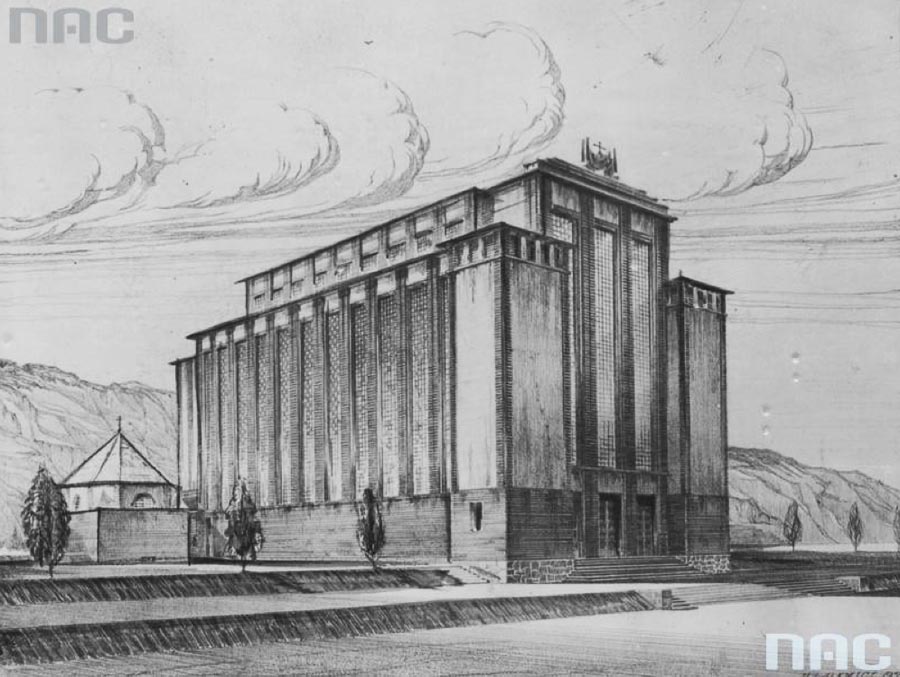
Marian Lalewicz, design for the garrison church of the Navy in Gdynia, photo National Digital Archive (NAC)
Lalewicz also created new buildings in Warsaw in the 1920s in the style of academic classicism, in a modernised form typical for that period. Among the first buildings in Warsaw designed by him are the monumental complex of the Postal Savings Bank on Bugaj and Brzozowa Streets in the Old Town (1921-1923, not preserved), as well as the house of the Ericsson company on 47 Aleje Ujazdowskie (1922). One of the biggest buildings in the capital designed by Lalewicz is the Railway Headquarters complex in Praga, built in the years 1925-1928. It was laid out symmetrically, with courtyards and a Doric portico preceding the main courtyard from the side of Targowa Street. A symmetrical arrangement was also used for the building of the Agricultural Bank on Nowogrodzka Street (1926-1928), with a portico and lateral avant-corps, as well as rustication of the entire façade up to the main cornice. A meeting room is situated on the first floor of the central avant-corps, shaped as a rusticated portico in giant order. Above the main cornice there are upper stories and a cubic belvedere on the main axis. The building, which has been preserved intact along with its original interiors, has been hailed as one of the most successful creations of the Second Polish Republic. In the 1930s it became the seat of the Polish Geological Institute.
Lalewicz designed buildings in other Polish cities as well, such as the branches of the Polish Bank in Sosnowiec, Kalisz, Siedlce, Tomaszów and Brest, a branch of the Agricultural Bank in Łuck, and the Bank of the Association of Credit Companies in Łódź. He also erected the building of the Agricultural Bank in Toruń (1937-1939) and the former Agricultural Bank on Chopin Street in Lublin (1934-1935). In the years 1921-1930 he rebuilt the barracks compound and the Church of the Holy Cross to the needs of the Catholic University of Lublin. After Gdynia started functioning as a port, Lalewicz also worked on projects there. From 1924 to 1930 he created the Fleet Command complex and the naval barracks, the Office of the Maritime Authorities (1927), the hospital in Gdynia-Oksywie (1930) and a classicist-modernist garrison church, designed in 1934-1935.
In addition to his work as an architect Lalewicz was involved in educational and social activities in Poland and abroad. He was a member of the Society for the Protection of Historical Monuments in Warsaw from 1909 and a Chairman of the branch of that society in St. Petersburg. From 1918 he taught art history at the University of Lublin and the Warsaw School of Fine Arts in the years 1923-1924. He cooperated with the Faculty of Architecture of the Warsaw University of Technology, first as an associate professor (since 1918), and then as a professor and chair of the Department of History of Ancient Art and Architecture (1920). He was the dean of the faculty between 1925 and 1927, and in the years 1929-1933 he taught sculpture. In 1930, Lalewicz became the Chairman of the Society for the Protection of Historical Monuments. He was actively involved in the recovery of Polish cultural heritage under the Treaty of Riga. In 1931 he took part in the International Congress of Architects and Technicians of Historic Monuments in Athens. He was a member of the Warsaw branch of the Association of Polish Architects and the Polish Institute of Fine Arts in Kraków. He published a number of works, among them: Building Policy in Warsaw – the Capital of the State (1934) and Caring for Monuments (1935). Lalewicz also delivered a lecture at the First Polish Congress of Engineers in 1937 in Lviv, entitled: Building as an expression of national culture. In 1925 he was awarded the Commander’s Cross of the Order of Polonia Restituta.
During the siege of Warsaw in 1939, Lalewicz was a Technical Rescue Commander. He was also active in the Social Self-Help Committee of the capital. He taught secretly at the Faculty of Architecture of the Warsaw University of Technology. He developed a quadrilingual dictionary of architectural terms and a work on the art of Hellas (both of which were destroyed). From 1942 he gave lectures at the Faculty of Civil Engineering of the National University of Technology which functioned with the permission of the occupying forces. Deported by the Germans from his house on 41 Górnośląska Street, from 1943 Lalewicz lived on 12 Muranowska Street, where the Warsaw Uprising broke out. He was shot in a mass execution on 17 Dzika Street in the second half of August 1944. The symbolic grave of the architect is located in the Powązki cemetery.
Author: Piotr Kibort, transl. Bozhana Nikolova

