Her texts were controversial. They sparked debates and were often harshly criticised, but at the same time, she was very popular and read by almost everyone. She didn't only write poems, but also short stories, sketches, reportages and journalistic texts. She was a literary critic and a translator. In her works, one can find risky subjects, subtle psychological analysis, and a wealth of original narrative forms, innovation and literary skill. The poems she wrote during her stays in Italy and France are undoubtedly among her greatest achievements. She was not only a writer but also a social activist. Coping with many sacrifices, she raised six children by herself. For many years she wandered throughout Europe, though not breaking contact with her country – she was one of the main organisers of the international protest against the cruelty of Prussia towards striking children in Września.
Childhood
She was the daughter of a lawyer, Józef Wasiłowski, and Scholastyka Turska, who died when Maria was only 12. Her father raised the children on his own, providing them with home-schooling. Their home was almost like a convent: they didn't allow guests, didn't speak merrily, and every walk with their father led to the cemetery. This atmosphere of seriousness, patriotism and strict, moral rules had a deep impact on Maria. Wasiłowski read Słowacki, Krasiński, and Mickiewicz to the children, but also his translations of the Psalms or excerpts from Pascal's works. He acquainted them with Greek and Latin authors with Cicero and Sallustius. Between 1855 and 1856 Konopnicka studied with her sisters at a school for girls, at the convent of the sisters of the order of Saint Benedict in Warsaw, where she met Eliza Pawłowska (later: Orzeszkowa). Their friendship, grounded on common literary interests, lasted until Maria's death.
Literary beginnings
In 1862 Maria married Jarosław Konopnicki, bearer of the Jastrzębiec coat of arms, an impoverished landowner 12 years her senior. Old Polish aristocratic customs reigned in her house – it was a life full of meetings, hunts, and noisy feasts. Konopnicka could not bear the limits imposed upon her by her husband. She didn't want to be a dependant housewife. Jarosław, on the other hand, didn't appreciate his wife's literary interests when she made her debut while the marriage still lasted. After selling their ruined mansion in 1872, they moved into a leased manor in Gusin (Łódzkie voivodeship). It's here that the poem O Górach (On the Mountains) was created. It was published in Gazeta Polska. A positive review by Henryk Sienkiewicz made the poet believe in her talent and she decided to take care of her children and of herself on her own. In 1876 she left her husband. A year later she moved to Warsaw. Knowing many languages – German, French, Russian, and later Czech, English, and Italian – she started translating, including works by Heinrich Heine, Paul Heyse, and Edmond De Amicis. In 1882 she travelled to Austria and Italy, and in 1884 in Prague, she met Czech poet Jaroslav Vrchlicky, who translated Mickiewicz's Dziady. They started writing letters and became friends.
Love life
Ludwik Krzywicki called Konopnicka ‘a firmly amorous lady’. Her name was connected to many men, among others to the journalist Jan Gadomski, 17 years her junior. One of her admirers, talented philosopher and historian Maksymilian Gumplowicz, fell in love with the writer when he was 33 and she was 55. He took the rejection very seriously, and, in 1897, he shot himself outside of the hotel in Graz where Konopnicka was staying.
On the 25th anniversary of her literary work (1903) Konopnicka received a manor in Żarnowiec (near Krosno, on the foothills of Carpathian Mountains) as a ‘gift from the nation’. She moved into the house with painter Maria Dulębianka, who organised her atelier in the rooms. The women were great friends, travelling together to Austria, France, Germany, Italy, and Switzerland. Gender and queer researchers claim that for twenty years the women were life partners. The painter, in fact, had a particular impact on strangers.
She is remembered in Żarnowiec as the writer's friend who wore manly clothes and had really short hair.
Konopnicka called her ‘Piotrek’ or ‘Pietrek with threadbare elbows’. Later in life, Dulębianka became a feminist campaigner. Konopnicka supported her efforts, but more as a friend than as an engaged social activist.
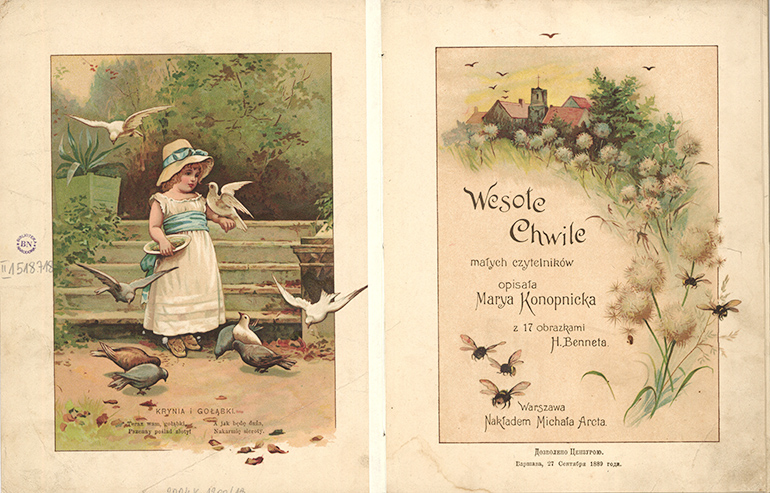
Wesołe chwile (Happy Moments) by Maria Konopnicka, illustrated by H. Bennet, 1889, photo: Polona / www.polona.pl
Literary life
Maria Konopnicka made her debut (under the name of ‘Marko’) in 1870, in the Kaliszanin paper with a poem entitled Zimowy Poranek (A Winter Morning). A series of lyrical poems (In the Mountains) was published in 1876 in Tygodnik Ilustrowany. Very soon her poetry, filled with patriotism and sincere lyricism, was widely acclaimed. Her first volume, Poezje (Poems) was published in 1881, and more followed in 1883, 1886, and 1896.
Z przeszłości: Fragmenty Dramatyczne (From the Past: Dramatic Fragments), published in 1881 and portraying great scientists persecuted by the church, met with a sharp reaction from the conservative press and Catholic milieu. Her thoughts were considered ‘godless and profane’. The attacks on Konopnicka and Orzeszkowa – who dared to publish her friend's works – were to last for the next 25 years.
Between 1884 and 1887 she was an editor of the democratic women's magazine Świt (Dawn). Her attempts at radicalising its programme sparked opposition in the conservative public opinion and from the censors. She also collaborated with suffragette's weekly Bluszcz (Ivy).
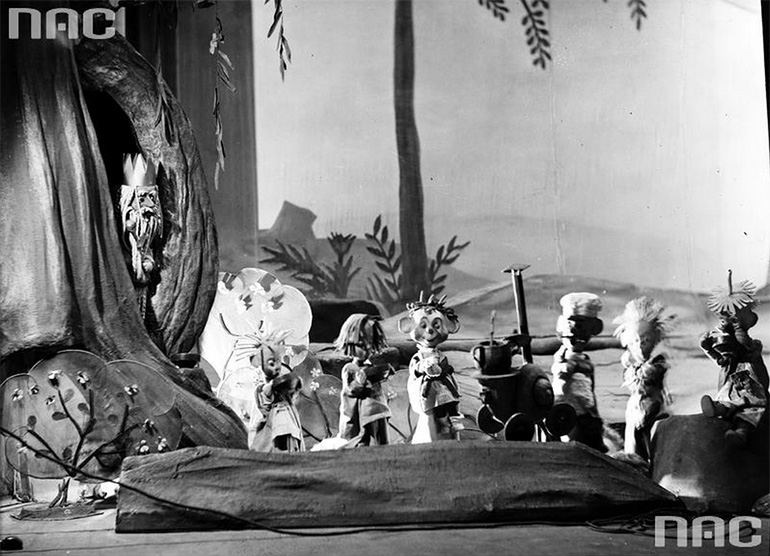
A scene from the tale On Dwarfs and Little Orphan Mary, Teatr Nowej Warszawy / Nowa Warszawa Theatre, 1950, photo: Edward Hartwig / Narodowe Archiwum Cyfrowe / www.audiovis.nac.gov.pl )
She wrote novellas from the 1890s until her death. At first, she drew from the experiences of Prus and Orzeszkowa, and later on, she developed her own ideas. In 1890, when a wave of anti-semitism was spreading in Poland, Eliza Orzeszkowa asked her to take a position publicly. Konopnicka responded with Mendel Gdański (Mendel from Gdańsk), published in the same year in Przegląd Literacki. The main protagonist is an old Jew working as a bookbinder. He's lived in Poland all his life and feels Polish. He is surprised by the anti-semitic movement and rumours that the Jews ‘are to be beaten up’. He doesn't understand why someone would want to take his right to be a full-fledged citizen. His Polish friends save him from the pogrom, but his love for Poland is gone.
From 1881 Konopnicka also worked as a literary critic. After 1890 new subjects appeared in her poetry, especially references to European literature, Bible and romanticism, and also to contemporary poetics of symbolism. Konopnicka's poems for children, first published in 1884, were free from obtrusive didacticism and awakened aesthetic sensitivity in young readers, which was a novelty in this literary field.
In 1901/1902, during one last trip abroad, Maria Konopnicka started coordinating one of the major protests against violent anti-Polish actions in the Prussian Partition. In 1901 Prussian authorities sent a directive that religion should be taught in German. In Września, in Wielkopolska region, parents refused to buy new schoolbooks and told their children not to answer in German. On May 20th 1901 the teachers punished the children, whipping them. When parents tried to intervene, repressions started. During the trial, on November 19th 1901, 24 people were sentenced to many months in prison. Children reacted with a school strike, brutally ended by the Prussian government in 1902. Konopnicka’s works were a protest against every ‘fact of life that hurts’: against social injustice and unfair regimes. They are deeply patriotic and rich in symbols, skilfully dodging the bullets of drastic censorship.
In her literary works, Konopnicka allowed the poor and the uneducated to speak, which was an original literary move. Before, mostly others spoke for them, from the point of view of the intelligentsia.
Maria Konopnicka died of pneumonia on October 8th 1910 in Lviv.
Author: Janusz R. Kowalczyk, November 2014, translated by N. Mętrak-Ruda, October 2015.
Selected works:
- Poezje / Poems, four volumes, (1881, 1883, 1886, 1896)
- Na drodze / On the Road (1893) – a collection of short stories, including: Dym / Smoke, Mendel Gdański / A Mendel from Gdańsk, Nasza Szkapa / Our Hack
- O Krasnoludkach i Sierotce Marysi / On Dwarfs and Little Orphan Mary (1896)
- Na Jagody / Berry foraging (1903)
- Rota (1908)

