His childhood days were spent in Warsaw, but after WWII had ended, his parents decided to move to Lesser Poland. From 1945 to 1967 he lived in Kraków, and then, up until his death, in Lund. In 1950s and 60s he was a usual sight among the artistic societies of Warsaw and Kraków, he took part in the most important modern art exhibitions of the time. From 1957 he was a member of II Grupa Krakowska.
Marek Piasecki was a son of Władysław Piasecki and Aniela Szymańska. From his earliest days he sparked an interest in arts, probably because of the vast library of his father, as well as the contacts with artists kept by his family. During WWII his parents engaged in the underground resistance, which resulted in Władysław’s imprisonment and Aniela’s stay in Pawiak prison. During that time, little Marek went to the secret school, he also drew and painted a lot. That was also a time when he was presented with his first camera – Zeiss Ikon.
After the Warsaw Uprising had failed, the family house of Piaseccy got completely destroyed, which resulted in his family leaving Warsaw and settling in Kraków. Marek suffered from tuberculosis and often visited sanatoriums. That was when he began collecting various gadgets, dolls, toys and books, as well as studying in a public school. Between 1948 and 1949, already a high school student, he interned in a photo lab. He also frequented Fine Arts Academy’s workshops, where he got to know various painting techniques.
He was deeply moved and influenced by 1st Modern Art Exhibition, which took place at the turn of 1948 in the Palace of Art in Kraków. Together with paintings, visitors could see photographs there. Around that time Piasecki, through a family friend met Maria Jarema, and through her got to know Jonasz Stern and other members of Grupa Krakowska.
In 1950 Marek Piasecki had a short episode working in National Museum in Kraków. Two years after that he got accepted into The Jagiellonian University’s department of Art History. However, already in July the same year he got arrested and sentenced to 6 years in prison for his political activity. He was released in 1953 due to his bad health, and after the October of 1956 he was released from serving the rest of the sentence. After his release he spent much time in sanatoriums, mainly in Zakopane and Bukawina. He photographed a lot there, he even had his own dark room in his sanatorium apartment.
Marek Piasecki, Paris Photo 2014, photo courtesy of Asymetria Gallery
Between 1954 and 55 he worked in the library of National Museum in Kraków, where he got familiar with their extensive collections, including collection of works by Feliks “Mangghi” Jasieński. In his apartment he made himself a dark room, as at the time he started experimenting heavily with various types of photography. He took photos of cities and their outskirts, he photographed the interiors, made portraits and acts. Also, his reportages started appearing in Świat Młodych and Stolica. He also began working with photographs on photosensitive paper.
His apartment, completely filled with books and collectibles, with passing years got transformed into a kind of art-habitat. To add to this artistic value, Piasecki often captured the flat in his photos, or organised private exhibitions of his works there.
In 1955 the artist reentered Arts History department on Jagiellonian University. There he met with Miron Białoszewski, who moved him deeply. Untill 1963 he photographed plays and scenography in Theatre at Tarczyńska, and while visiting Warsaw he got close to the artistic circles there. He was a frequent guest to Henryk Stażewki and Maria Ewa Łunkiewicz-Rogoyska, where he met, among others, Artur Sandauer and Erna Rosenstein.
In1955 he made his first heliography pictures, that is traces of liquid or transparent forms captured on photosensitive basis, usually glass pane, or, alternatively, drawings and other mechanical traces on said basis. Thus obtained images were then captured on photographic paper. Between 1955 and 59 he also worked on so-called miniatures, that is paintings with elements of heliography, collage and relief. Miniatures were created by direct contact of chemical reagents with photographic paper, as well as sticking to it pieces of paper, dried plants, and even small fragments of metal. These quite small 3D creations were then placed in heavy frames, behind glass. Jerzy Ludwiński wrote about his works:
I was struck by the conscious coexistence of material things with abstraction. The first provide the artist with some material to work on, enrich his imagination, the second protects from coincidence or automatisation. Anyway, the way these are merged makes it quite a difficult task to find the point where the abstract starts.
Marek Piasecki, Paris Photo 2014, photo courtesy of Asymetria Gallery
Also around 1955 his experimentation with macrophotography started. A year after that three early special constructions came to life – cabinets made using assemblage technique, where the artist placed various different items, often dolls or their fragments. Aside from experimenting, Piasecki continued his reportage work, publishing his photos in magazines Po Prostu and Kierunki.
In 1957 he gave up on university to pursue his artistic desires full time. At the end of the year he took part in II Modern Art Exhibition, the most important display of modern art since 1948, where he showed his heliographs. At the time he became a member of II Grupa Krakowska, even though he was more closely in touch with the Warsaw artistic society then. However, during the Grupa’s exhibition the following year he managed to meet with an informal avant-garde photography group: Jerzy Lewczyński, Zdzisław Beksiński and Bronisław Schlabs. Especially long-lasting friendship grew out of the relationship with Beksiński, with whom he often corresponded and whom he frequently visited in his House in Sanok.
In 1958-62 he worked as a photographer and illustrator for Tygodnik Powszechny. His works, photos, and heliographs appeared in book published by Znak and Wydawnictwo Literackie, as well as in numerous art magazines, for example Fotografia. Sometimes they found their way to more mainstream publications, such as Polska, Poezja, Więź, or Ty i Ja. In his photographic career Piasecki didn’t only experiment, he sometimes came back to more classical techniques, such as portraits, acts, or scenery shots.
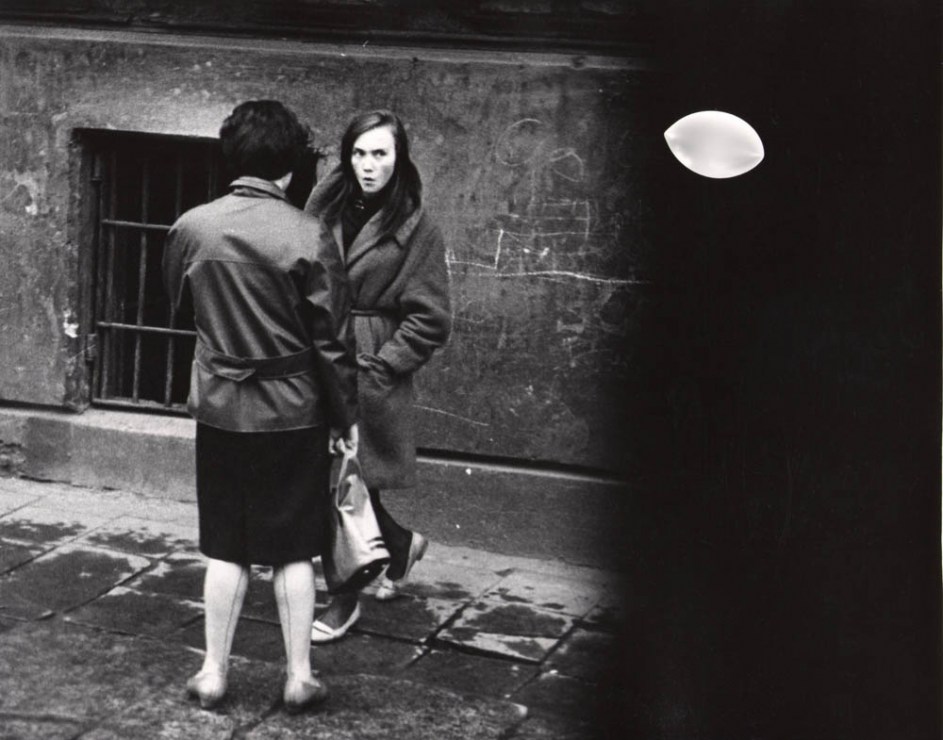
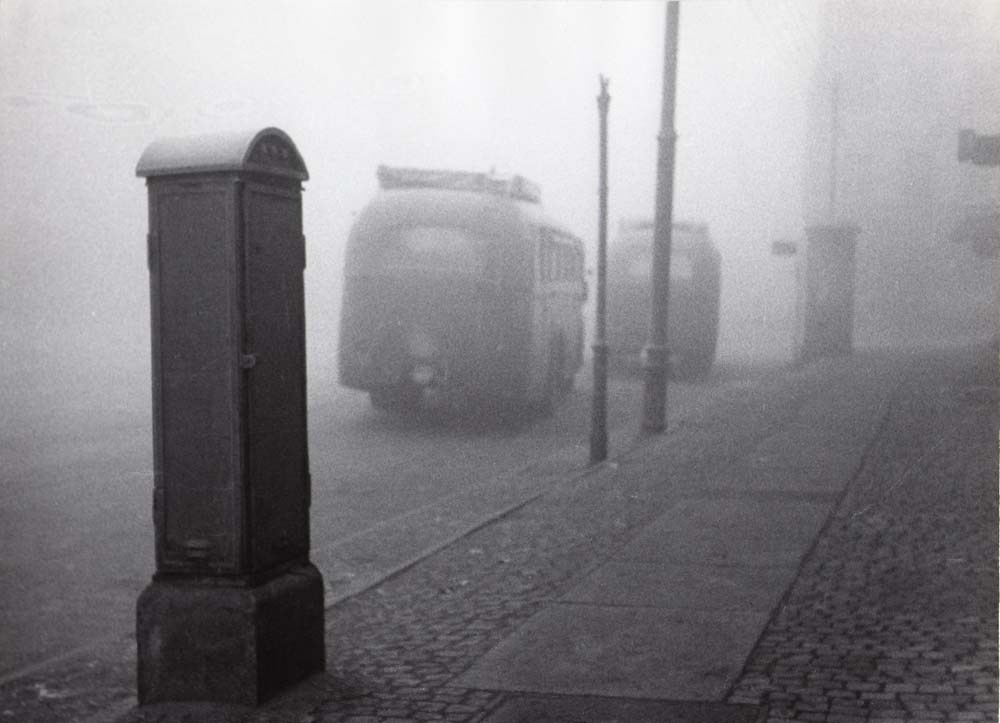
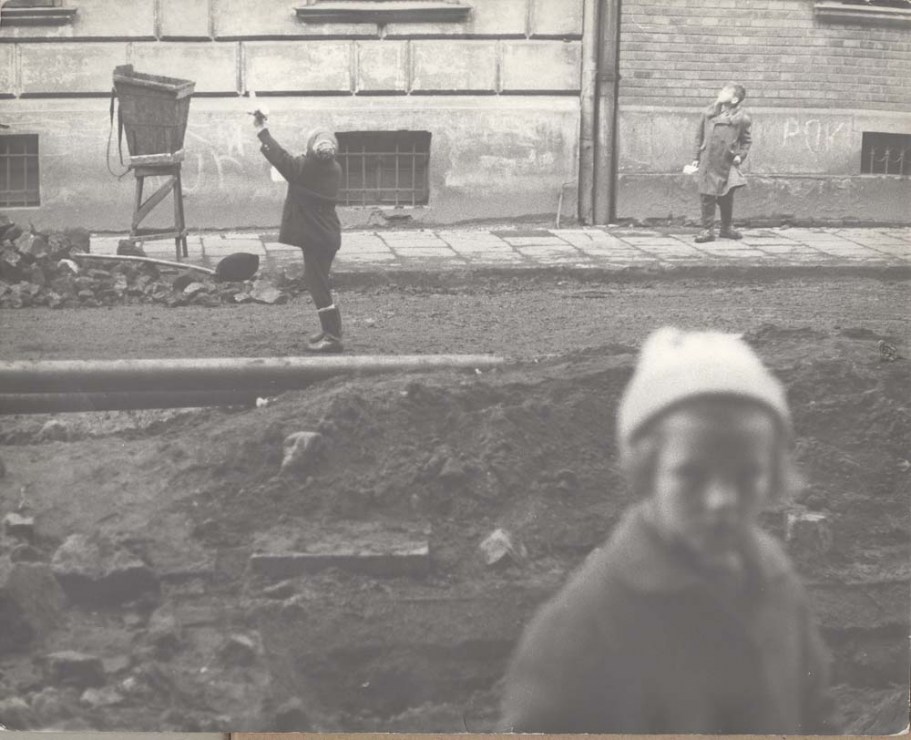
He was also the author of reportage photos, heavily inspired by neorealism then dominant in Italian cinema. Even though he did not think highly of this branch of his, these are nevertheless worth taking a look at. They reveal an outstanding ability of an author to observe and create a kind of suggestive depiction of the surrounding reality. The same goes for his photos of actors and plays from Theatre at Tarczyńska. They are interesting not only artistically, but they are also valuable as a testament of important cultural changes in post-war Poland.
Marek Piasecki, Paris Photo 2014, photo courtesy of Asymetria Gallery
1959 marks the year of the first individual exhibition of Piasecki’s works in Klub Plastyków in Zakopane, as well as first display of his miniatures in Krzysztofory in Kraków. Both expositions met with overwhelming critical response, with critics such as Jerzy Madeyski, Piotr Skrzynecki, Urszula Czartoryska and Janusz Bogucki writing about them. He also got his work to appear at III Modern Art Exhibiton in 1959, and in the following year his miniatures were included in the show organised in Kraków during AICA congress, where they yet again met with a warm critical reception. Janusz Bogucki wrote about his art:
The transformation of things that Marek observes and directs happens because of partial transformation of their appearance and the situation of their surroundings and light, and they are consolidated with the help of photography. The process can be valuated by looking at his dolls (...). Marek plays with them in his own way, dresses them up, poses them, sets them up. He takes this infantile lightheartedness from them, he gives them the burden of moral experiences of the last decades.
When talking about his miniatures and ‘things’, the critics often juxtaposed Piasecki’s work to the American pop-art, French New Realism, and closer to home – to assemblages of Władysław Hasior.
At the turn of 1967 Marek Piasecki organised the exhibition of his works in Swedish Lund, where he decided to live afterwards. At the attic of the manor he was living in he created his own workshop with private gallery, where he could present his art to chosen critics and friends. From that time he often showed his works in Sweden and Denmark, and his works were bought by many museums and private collectors, Moderna Museet in Stockholm being the chief example.
However, not everything was great during that time. In 1973 Polish authorities decided to revoke his passport, making it impossible for him to travel outside Sweden. One other setback was the renovation of the manor he was living in, which resulted in destruction of many of his works.
The last exhibition of Piasecki’s works abroad took place in 1975 in Krognoshuset gallery in Lund. There, the visitors could see several black sculptures, made out of plastic or metal blocks, cones, cubes, or spheres, which were exhibited in concentrations, under glass cloches, on pedestals designed by the artist.
Also in 1975 Piasecki presented his works on the exhibition entitled W kręgu nadrealizmu [trans. In the circle of Surrealism], organised by Mariusz Hermansdorfer in National Museum in Wrocław. It was his doing, together with Urszula Czartoryska and Ryszard Stanisławski, which made Art Museum in Łódź and National Museum in Wrocław buy the artist’s works for their collections. His photographs were also included in two expositions of Polish photography organised by Czartoryska in Zagreb and Milan in 1977.
In the second part of the 1970s Piasecki was forced to rent a much smaller, 2-room apartment in Lund, and the lack of a dark room made it difficult for him to continue his photographic career. From this point forward he created ephemeral installations, which he didn’t think fully-realised art pieces. They were white niches in which the artist placed various items, toys, dolls, or animal figurines. However many of them got destroyed in the fire that engulfed the flat in 1990, others were deconstructed by the artist before that. We know them only from the colour photographs taken by Piasecki himself from 1980s onwards. Apart from pics of the workshop, he also took some city panoramas, but he’d never exhibited these, treating them rather as a kind of sketches or notes.
Marek Piasecki’s output can be categorised as a kind of merger of painting, graphic design and photography. His works relate to various avant-garde traditions of the twentieth century, where photography was a medium for inspiration and search for the new kind of picture. At the same time his heliographics and miniatures are interesting examples of artistic reception of informalism in different medium. Piasecki also experimented with photomontage, a vital part of avant-garde, and his series of works called Dolls relates, both in theme and atmosphere, to traditions of surrealism.
His works also clearly relate to these avant-garde traditions, where the basis of work is an already existing object. He often created his ready-mades with recycled items. His collages and assemblages are clearly situated in the tradition of neodadaism of the 1960s. An excellent example of this period is the series of ‘boxes’, that is special montages using ready-made elements enclosed in characteristic box-like frames, as well as works created during his stay in Sweden – small objects painted black, made out of wood, metal or glass. These were sometimes compared to ‘boxes’ created by Joseph Cornell.
Quite a fascinating piece, an example of art in itself, was artist’s Kraków workshop, unfortunately closed in the 1990s. The place, which survived only in pictures, was a kind of alchemical laboratory of creation, which was filled with the feeling of artistic environment, similar to Merzbau by Kurt Schwitters.
Ever since he left for Sweden, his appearances among Polish artistic circles were few and far between, and his rich and varied oeuvre slowly became forgotten.
In the 1990s the artist took part in a few exhibitions in Poland, mainly group showcases of Grupa Krakowska. In 2004 in Starmach Gallery in Kraków the first exhibition of his pieces for 37 years was organised. It became quite an event among the public, as well as among collectors and galleries, which in turn made his works appear much more frequently on display in Poland. In 2005 Starmach Gallery co-organised an exhibition of Piasecki’s photographs in the Polish Institute in Stockholm, and in 2007 in gallery’s HQ in Kraków heliographics of the artist were shown. At the turn of 2008 in Zachęta in Warsaw a retrospective exhibition Marek Piasecki. Fragile was opened.
Works of the artist may be faound in numerous places, such as the (closed as of yet) artist’s archive near Krakow, National Museum in Warsaw, National Museum in Wrocław, National Museum in Poznań, Art Museum in Łódź, National Museum in Kraków, Malmö Konstmuseum, Skissernas Museum in Lund, as well as Starmach Gallery, Piekary Gallery, Gallery 86, and many private collections.
In September 2011 Piasecki’s photographs, as the only Polish representative, were bought by Museum of Modern Art in New York for their Collection of Photography Around the World. In 2010 and 2011 his works were presented during international photography fair Paris Photo, where they could be bought by foreign collectors.
Author: Magdalena Wróblewska, December 2011. Translated by AS March 2017

