Architecture ran in Marek Dziekoński’s blood – his grandfather, Józef Pius Dziekoński, was an architect in the historism style at the turn of the 19th century, Warsaw University of Technology’ Faculty of Architecture’s first dean, the co-creator of the Towarzystwo Opieki nad Zabytkami Przeszłości (editor’s translation: The Past’s Antiques Care Society). He also designed hundreds of churches, including some very notable ones, such as the Plac Zbawiciela church in Warsaw and the cathedrals in Białystok, Radom, and Warsaw’s Praga. Dziekoński’s father was also an architect, as well as his three sons. His wife, Ewa, was the co-creator of many realisations, including the most prominent one – the rotunda in Wrocław, housing the painting Racławice Panorama.
Marek Dziekoński was born in 1930 in Warsaw. In 1955 he graduated from the Wrocław University of Science and Technology’s Faculty of Architecture and began his career in the city. However, the first place to put its mark on the architect’s work was Zakopane, where Dziekoński lived just after the war. There he made his first steps in construction (he was studying at a Construction High School), he was fascinated by Podhale’s wooden buildings and the Zakopane style. In the socialist realism era, he designed wooden and stone houses, in which he combined the characteristics of the Tatra Mountains’ folk architecture with modernist elements (these projects were never realised, though).
One year after the 1956’s Polish October, when social realism’s doctrine crumbled and modernism got back into favour, Ewa and Marek Dziekoński won first prize competition to design the building in which Jan Styka’s and Wojciech Kossak’s monumental painting Racławice Panorama was to be exhibited. Although the construction was underway for a long time (it commenced in 1966 and ended in 1985), its author’s vision was fulfilled: a high rotunda, accompanied by a horizontal entrance pavilion, was built. Both blocks were concrete-made; the clapboard traces, natural colour and the material’s characteristic texture were consciously preserved. Combined with the edifice’s exposed construction (supporting columns, underdrawn roofs etc.), it rendered the Racławice Panorama one of the most interesting Polish examples of Brutalism. Making it oriented towards a specific function (housing a panorama painting) did not hinder the execution of a brave, expressive form.
In 1959, Marek Dziekoński and his wife moved to Tychy. The city, which had been growing rapidly since 1951, still needed architects – the public Miastoprojekt Nowe Tychy studio, ran by Hanna Adamczewska-Wejchert and Kazimierz Wejchert, became a workplace for many talented creators. Although the architecture of the time was dominated by standardisation and prefabrication, many Tychy-based architects managed to design original objects even within the limitations of state norms. In Tychy, Marek Dziekoński designed buildings in a wide range of sizes and for a variety of functions. In 1964, a glazed pavilion, supported on ceramic pipes resemblant of bamboo shoots, was erected in a district park. In 1961, the architect designed a cemetery fence composed of organic, bending prefabricated concrete segments. He wanted to flesh out the individual characteristics even in seemingly ordinary blocks, e.g., with the use of an askew roof line and bent balcony balustrades. Patryk Oczko writes: ‘Concrete, while not very plastic by nature, was shaped according to the architect’s detailed suggestions, elicited lightness and often bore a dynamic, curvilinear form’.

Hall of an artificial ice rink in Tychy, approx. 1978, photo: the archive of Ewa Dziekońska / materials from the exhibition Koncepcja – Kreacja – Konteksty (editor's translation: Concept – Creation – Context)
Some of Marek Dziekoński’s greatest achievements are public buildings in Tychy. In 1961, he designed the Main Technical Organisation’s Mining Club’s headquarters. The freestanding, multi-storey building seems weightless and lucid, even though it was made from prefabricated concrete. All thanks to the undercut ground floor and the openwork construction drawn out into the exterior in the form of an espalier covered in glass. Dziekoński designed not only the structure, but also the interior and the building's equipment. The geometric cube was decorated with a glazed exterior staircase, a green patio with a pond, ceramic wall decorations, and mosaic wall linings (designed by Zdzisław Stanek and Henryk Bajdur). Unfortunately, the building lost most of its original appearance due to numerous alterations. The artificial ice skating rink, built in the south part of Tychy in 1978 (with the design preceding construction by 10 years), was no less sophisticated and was also destroyed by careless renovations. The big building with characteristic indented corners stood out thanks to its juxtaposed tiles of glass and concrete walls imprinted with a geometric pattern. During a modern renovation most of the glass was replaced by walls and nowadays all one can see is a rugged concrete texture designed by the architect. Dziekoński envisioned the elevation of other buildings in a similar way – e.g., of the Tychy Północne train station pavilion from the mid-1960s, a bank (built in the years 1970-1973), and a gastronomical pavilion in the M housing estate (1972-1977).
Near the end of the 1970s, Marek Dziekański returned to Wrocław to oversee the Panorama Racławicka pavilion’s construction. In the subsequent decades – up to his death in 2002 – he designed churches in the Lower Silesia region, and in the years 1994-2002 the Orbita sports hall in Wrocław. The John Paul II hotel in Ostrów Tumski (2001-2002) was one of the architect’s final creations. The objects erected after 1989 bear the hallmarks of a post-modernist aesthetic.
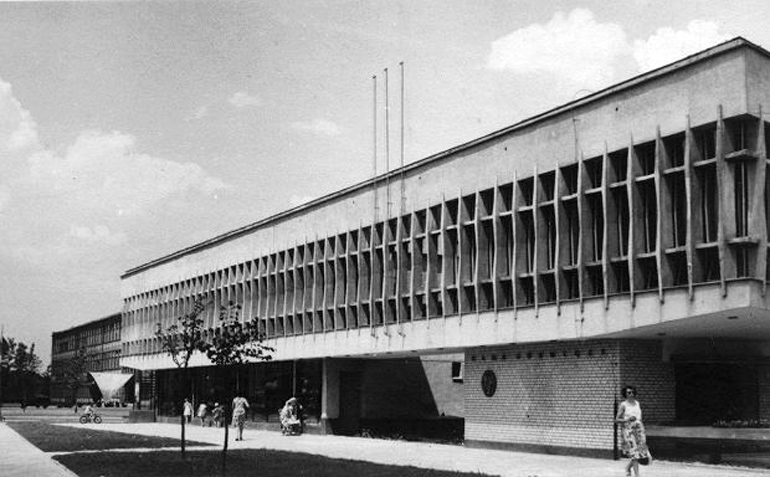
Pavillion of a mountaneering club in Tychy, 1960s, photo: Zygmunt Kubski, collection of the City Museum of Tychy / materials from the exhibition Koncepcja – kreacja – konteksty (editor's translation: Concept – Creation – Context)
Marek Dziekoński was active during several stylistic eras – social realism, modernism, and the architecture of the 1990s, characterised by inspirations from historical styles. Patryk Oczko, the author of a monograph on the architect, titled Marek Dziekoński: Koncepcja –Kreacja – Konteksty (editor’s translation: Marek Dziekoński: Concept – Creation – Context), proves that Dziekoński was able to create functional and original objects in each of these styles. From the contemporary Polish architecture’s point of view, the post-Polish October realisations have the most value – the brutalistic Racławice Panorama pavilion and public buildings in Tychy, contributing to the new city’s public space, sophisticated and refined, testify to Dziekoński’s excellent intuition regarding the material’s plastic qualities. The exhibition in the Tychy City Museum and the publication accompanying it present all these important achievements. May it also contribute to better preservation of Marek Dziekoński’s extant, but often degraded and distorted projects.
Originally written by Anna Cymer, October 2017, translated by Patryk Grabowski, November 2017

