Rejmer is a graduate of cultural studies at the University of Warsaw. She made her début as a poet at the age of thirteen with her Okolica Poetów (The Area Of Poets), while her adult début in prose came with her narrative Poczekalnia (The Waiting Room) in 2006. In 2009, her first full-length novel, Toksymia, was published. In 2013, she wrote Bucharest. Dust and Blood, for which she was nominated for Polityka’s Passport in 2013.
Ugly Début
‘It did not go unnoticed that the elderly man dressed in shimmering nylon, sitting in a tram, is limply sliding off his chair, while stinking like hell‘ – this is how one of the most stunning d ébuts in recent years starts. How did this came about? Rejmer revealed to Wysokie Obcasy Magazine (High Heels Magazine):
I founded the blog, where I posted scraps from the borderline of prose and poetry. Under one of my posts I discovered an anonymous, but very characteristic comment, which I thought might come from Paweł Dunin – Wąsowicz, a well known publisher. Eventually I met him one year later and it turned out that I had been right. I somehow managed to give him my novel, then another one. Soon I was given a grant from the Book Institute for my début and I decided to write something new for that purpose. Paweł said: ‘OK, go on writing but it has to be ready by the end of September‘. It was in June and I was already more than overloaded with work. I was preparing to defend my thesis, preparing for PhD programme entry exams and learning for another master studies entry exams. At that point I decided to... go on holiday to Romania. After I came, back Toksymia was finished in seven weeks. I was in a frenzied state of mind, I cried every day, my cheeks reddened a thousand times a day and I was seeing a strigoi each time I looked into the mirror.
In Toksymia, Rejmer presented the stories of a few characters living in South Praga (a district of Warsaw), whose fates cross at some points, but what is really the secret link between them is their engagement in toxic, deadly relationships with their loved ones. Critics pointed out that long ago we had such a concentration of the macabre and ugliness in Polish literature, as well as, fortunately, humour, by which the whole thing turns into a terrible but funny grotesque.
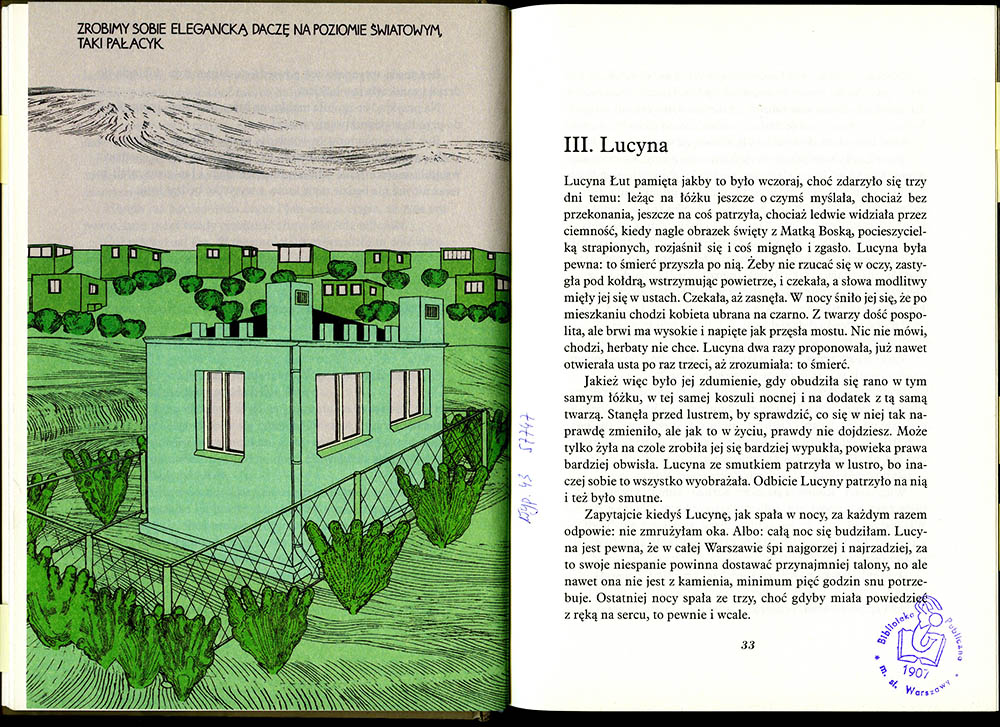
Małgorzata Rejmer's Toksymia, illustrations: Maciej Sieńczyk
Bucharest. Dust and Blood.
This tome of reportages, published by the well-known Czarne publishing house in 2013, is harvested from Rejmer’s multiple stays in the capital of Romania in the last few years and it is proof of her deep fascination with the culture of the country, which Polish people regard as remote and barbarous.
Bucharest is not a classical reportage. The first thing that strikes you is the plan of the book. It starts with a description of the communist period in the history of Romania (or, rather, a fearsome journey through the horror of Romanian communist history, which is even more scary than the Polish one), then it goes back to the Interwar Period to end up in present-day Bucharest: a city of wild dogs, taxi drivers, homeless artists, earthquakes, and cracked houses and their proud inhabitants, who claim to be descendants of Decebal and Trajan.
Macabru ca istorie
In the first, and most shocking, part of the book, we learn about this history through the prism of private (however, this word is inadequate, as it was privacy that was taken away by the communist régime) histories of ordinary families that Rejmer managed to talk to. Their horrific stories make for a brutish chronicle of the régime: from prisons and torture in the post-war period, through a nightmare of civil denunciations and overwhelming surveillance by the Securitate , to an infamous anti-abortion decree in 1966 and Revolution in 1989 (which probably did not happen at all, but what is sure is that there was an execution after it). This part draws a picture of a nation which became so accustomed to everyday terror and violence that even today, echoes of fear can be seen in the behaviour of the younger generations. The evidence comes in two reoccurring phrases, which repeat like a chorus throughout the book: ‘Please, do not give my name‘, which ends every interview and ‘They lied to you‘, which is an answer for every attempt to criticise Ceausescu.
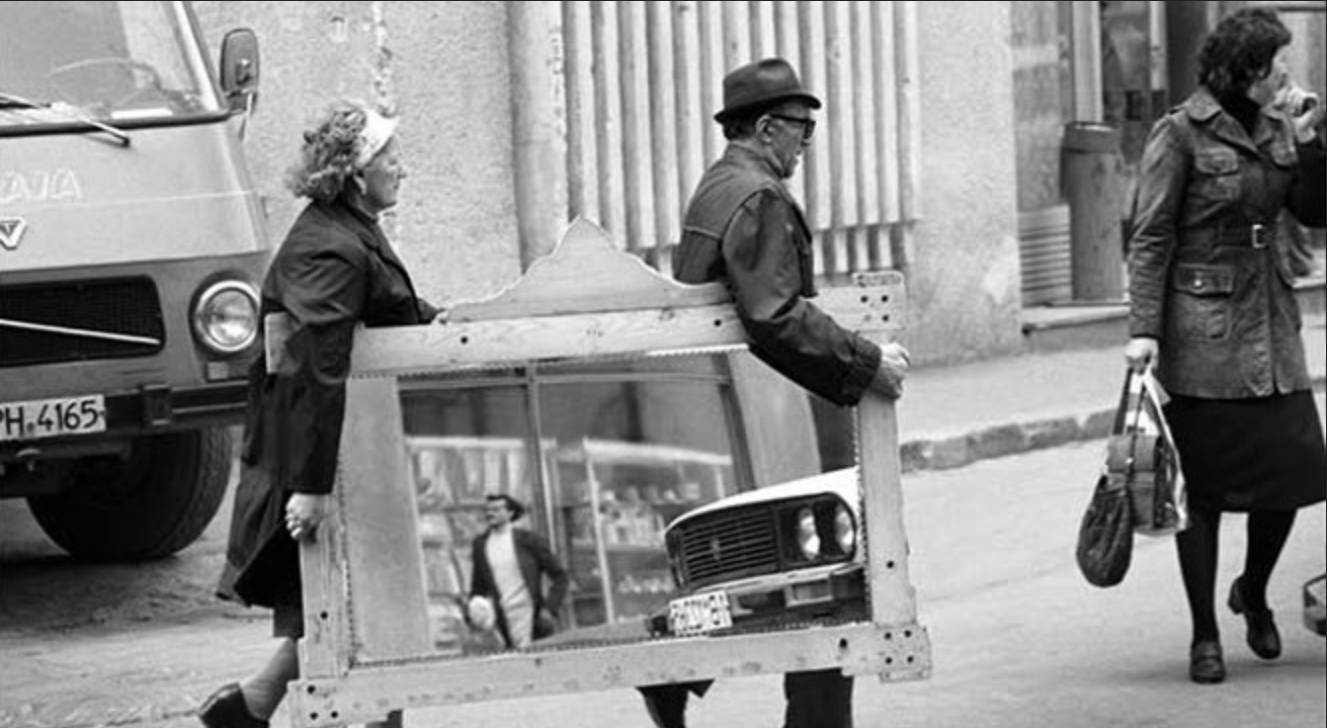
Photo by Andreia Pandele from the cover of Małgorzata Rejmer's Bucharest. Dust and Blood
Multi-genre reportage
The range of genres covered by Bucharest is unusual for a reportage. Grzegorz Wysocki mentioned that in his review for Culture.pl:
What we have her is not only a classical reportage but also a scary ‘Romanian fairy tale‘ (about a boy who decided to become the Romanian Stalin), a five act drama (about the overthrow of a dictator and a tale of the revolution which, according to some, never happened), an adage about the Collectivisation Committee, a ballad, a narrative about a crack in a wall, a report of a train voyage, a collage built from taxi drivers’ monologues, autobiographical inserts, and many signs of historical essays and articles.
Pe culmile disperării...
The chapters devoted to two important texts of Romanian literature seem to be outstandingly interesting, as they reflect, according to Romanians themselves, the character of the Romanian nation. These are: A Ballad About Master Manole and An Epic of Little Lamb – both rather gruesome (in a Ballad.. a bricklayer who walls in his wife to make his construction works go well; in an Epic.. a shepherd who despite his lamb’s warnings, voluntarily chooses to be killed by a bunch of horrible butchers), showing how communities build their identity, or the way they want to think of themselves. This variety of genres and narrations gives us an anthropologically dense and comprehensive description of a place and people that we do not know a lot about.
Books:
- Toksymia, Lampa 2009
- Bucharest. Dust and Blood, Czarne 2013
Awards:
2008 - Grand Prix in Palnete Doc Review contest for the best reportage
2009 - Winner of Univeristy of Gdanks prose contest
2013 - Laureate od Teresa Torańska Award by Newseek for the best nonfiction book for Bucharest. Dust and Blood.
2013 - Gwarancja Kultury award presented by TVP Kultura
2013 - Nomination for Polityka's Passport
2014 - Gryfia Literary Award for Bucharest. Dust and Blood
Translated by W.O. 2014

