Koło Klipsa’s final appearance took place in 1990 at Warsaw’s Zachęta National Gallery, during the Galleries of the 1980s exhibition. Knaflewski put on a solo show the next year at the Obraz Gallery in Poznań. Works displayed at the exhibition were all signed with the nickname Knaf, which the artist continued to use later.
In 1993, a large exhibition of Knaflewski’s works was organized at the BWA Arsenał Gallery in Poznań. It featured spatial, sculptural, and bas-relief structures with ambiguous meanings. The artist commented on the exhibition:
The entire show is based on few simple rules: whether someone misses us or loves us. Passing of time: death, birth. Disappearing and returning to a sheltered space. Are we in the circle of light or beyond it. It is a will to exit the shelter and then return to it.
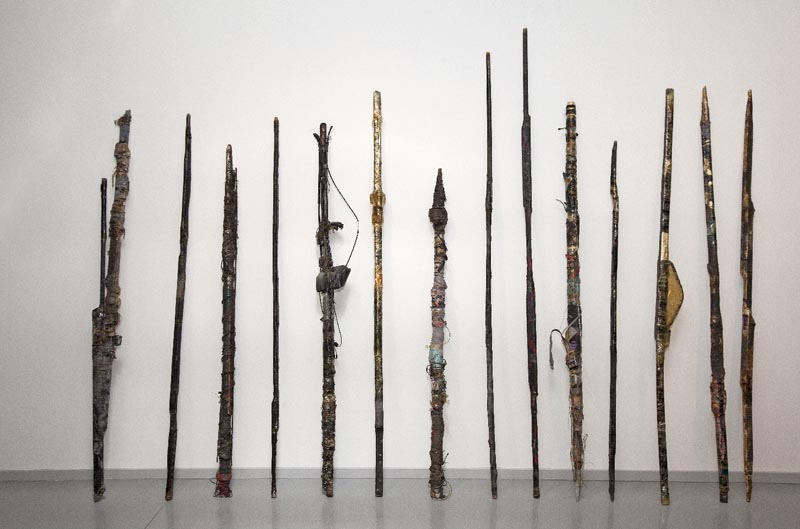
Leszek Knaflewski, Untitled (Spears), 1983, photo: Łódź Art Museum
Knaflewski’s works are not easily interpreted or analyzed, but instead conjure loose associations – their goal is to tease the viewers’ imagination. During the ‘90s, he kept returning to the use of root-like forms in his pieces – treating them as a symbol of the forces of life, growth, and upward expansion. The artist also tended to present them in the form of a cross and present as a metaphor for the human body. In his work Para (A Couple, 1990), two long, wavy roots, topped off with cross-shaped ‘heads’, rest on white sheets strewn around a muddy floor. The life-like roots/crosses resemble a pair of lovers in an intimate position.
In his other works from that period, (Akt/The Nude, 1993, Siedząca/The Sitting Woman, 1994), root-like forms were used to reinterpret the subjects of classical art. The artist also used miniature pieces of plants that looked like spermatozoa. Paintings from the Kalendarz/The Calendar series were made up of hundreds of such mini-roots placed on interfacing flakes. In other works, clusters of roots were intertwined with half-burned matches whose heads faced upwards, laid out on a delicate net made out of hair. In Knaflewski’s works, the natural, organic materials are intermixed with objects borrowed from material culture and transformed into very expressive, yet puzzling figures.
In 1999, Knaflewski began to introduce sound into his works. He built instrument-like objects, such as Trumna elektryczna/The Electric Coffin, which he could play to create acoustic space installations. Initially, the performances with electric coffins also included Partytury/Scores with notes made out of the spermatozoa-roots. He first performed with this instrument-object at the AT Gallery in Poznań. In his following sound performances, he developed the layers of music. Each appearance was entirely unique, as the performances were largely improvised. The sounds, produced with the use of a bell, one string, and the coffin’s body, were amplified. The motif of a coffin also appeared in Knaflewski’s Balet biernego oporu/Ballet of Passive Opposition (2000) – an installation comprising three transparent Perspex coffins, filled with little roots. Above them, he hung a shower head whose hose was finished off with a metal skewer.
A coffin is such an obvious symbol. In my actions, I try to expand its meaning. – the artist explained.
In his subsequent works – Catolic-cola (2001) and Killing me Softly (2005) – Knaflewski set his sights on contemporary consumer culture and clericalism. Catolic-cola is a monumental installation resembling the back wall of a bar. It is made up of a light box with an image of a horse tilling the ground with a cross and a set of shelves with identical mud-filled glasses lined up on top. The glasses and the light box are decorated with a sign based on Coca-Cola’s logo. By turning the cross into a plough, the artist made a reference to the activity of the Catholic Church, which functions in a similar way to superficial popular culture.
The Killing Me Softly cycle (an intentional reference to Roberta Flack’s classic hit) is made up of eight large-format, black & white lightboxes, on which the artist is posing as a priest. The perfectly-designed photo shoot is made to resemble advertisements for luxury products. The figure of the preacher was presented in ambiguous situations – their significance, sometimes controversial or sometimes just obscure, is hard to read in accordance with traditional Christian symbolism. Knaflewski, wearing a custom-made cassock, poses with a balaclava – a clear attribute of terrorists – and a machine gun, with pearls in place of his teeth, or steering the Holy Spirit’s dove (with an antenna on its head) with a joystick. In this multipart piece Knaflewski raises critical questions about the authority of priests and tackles the symbolic dimension of the figure.
The film Spirit (2005) continues the polemic with the official image of the clergy. It is set in a gymnasium in which two girls play basketball – their ball being decorated with the titular word. The artist stars as a priest-giant whose head is linked to the hoop with a long black sleeve. The black-robed and blindfolded figure is the arbiter in this match, which is not so much a sporting event as a power struggle, with erotic undertones.
In 2008, Knafelwski showed a new series of works titled Skrzyżowania przeciwko rondom (Intersections Against Roundabouts) at the Poznań’s Piekary Gallery. The series comprised installations and video works: White Power, Nagłe załamanie turystyki (Sudden Tourism Slump), Złap F (Catch F), Cement, and the titular Intersections Against Roundabouts. In one of them, superimposed symbols of a cross and a circle end up forming a gun sight. The artist directed it not just at the viewer, but also at himself: he tried to encourage a reflection on the social stances and conformist choices leading to a constraint or loss of one’s identity, he bended the image of the role of an artist in a work of art, or in art in general.
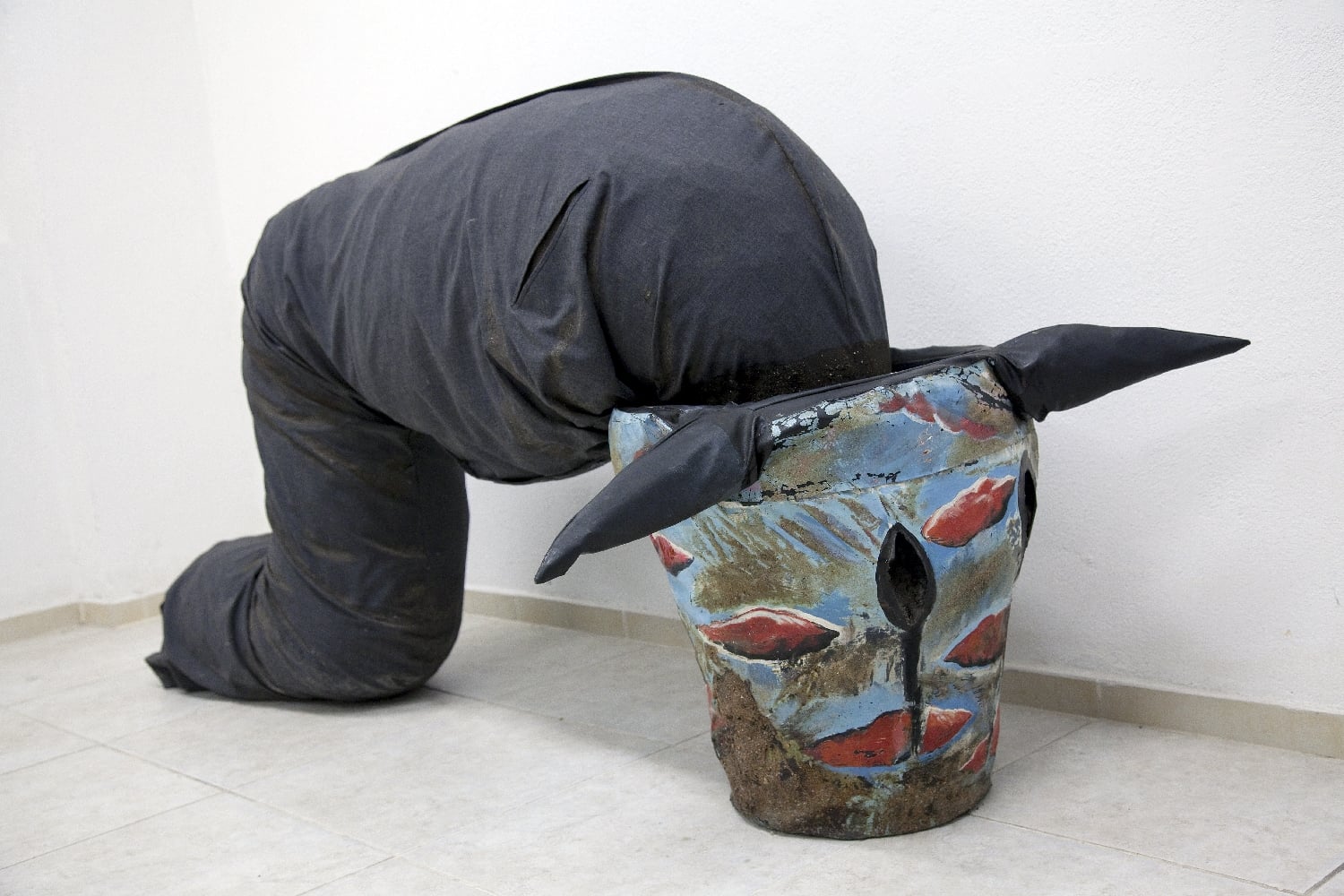
Leszek Knaflewski, Untitled (Buffalo), 1987, photo: Łódź Art Museum
One of Knaflewski’s last projects, Oni śpią za nie (They Sleep For Them, 2010) combines the mediums of photography, video, objects, the meaning of which escapes rational thinking. Knaflewski’s visions, very vivid on a visual level but semantically confusing, evoke difficulties with communication and articulating comprehensible messages. The titular cycle of photograph-objects includes large-format photographs of young women with digitally distorted faces, at the height of which metal rods, resembling perforated masks or muzzles, stick out of the image's surface. In this way, the artist quite directly hints at issues that are impossible to express in words.
In 2013, the Mundin publishing house (founded by the artist Honza Zamojski and Grażyna Kulczyk, an art collector) released the album Frofenia with Leszek Knaflewski’s drawings. The book includes previously unpublished works from the times of the Koło Klipsa group.
Frofenia, a word coined by [the artist] refers us to the sphere of visual language where everything is possible: hybrid creatures inhabiting fictional worlds, unreal situations, and free expression. – we read on the publisher’s page.
Waldemar Baraniewski, art historian, wrote in his essay for the book:
Presented to the public for the first time, Leszek Knaflewski’s drawings from the years 1983–1990 are a unique discovery. Revealing the private sphere, revealing emotions, feelings and images that have retained the energy and power of metaphor, they allow us to study both the author’s visual choices and the complex artistic processes that shaped the Polish art of the era.

