In 2004 critics were drawn to her Rooms, an exhibition that took the form of a photographic installation. “Her Rooms are built from everyday objects, images, sounds and space” – wrote Piotr Wołyński, emphasising in particular that this “latter element possesses a special meaning in the presented collection.” Majak continued her work with space in an exhibition in 2008 entitled Im_placement in Toruń’s Galeria Sztuki Wozownia, which a year later she developed into Im_placement (2) in Szczecin’s urban space. The installation, consisting of tree seedlings, photography, video and music was dedicated to the artist’s father. “My father had two orchards” – Majak remembers. “One large, one small. Both were greatly loved by my father, who spent all his free time there. A buyer was quickly found for the larger of them. My parents sold it in order to buy me a flat in Warsaw’s Praga district.”
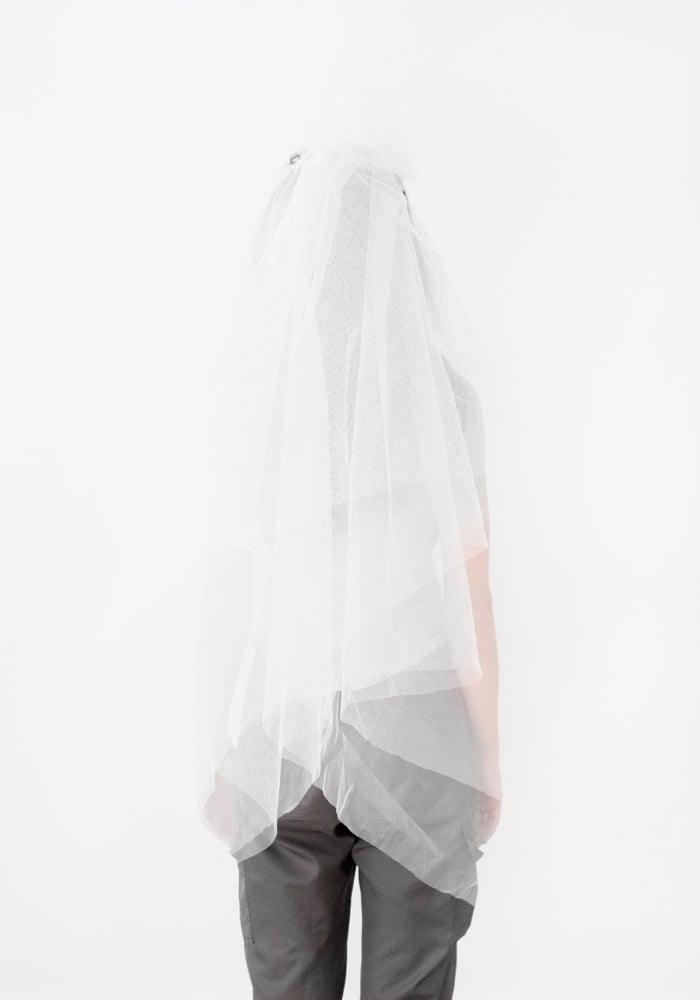
Katarzyna Majak, Veil 1, from the Déchirer series
But Majak’s biographism is present above all in her series of works entitled desire (2008–2009) and déchirer (2009–2010). This artistic diptych is a story about a would-be marriage, from which there remains a white dress – a present from another woman. “The romantic comedy written for a couple changes into a Gothic melodrama with the cursed wedding dress and lonely bride in the main role” – Stach Szabłowski wrote in the catalogue accompanying the desire exhibition. In an interview with Katarzyna Surmiak-Domańska, the artist herself said that her project was – “an examination of marriage as a special ritual enriched by all those kitschy, idealized accessories that usually accompany it and are to be found in all cultures.” The aim of Majak’s efforts was to demystify the social ritual, but also to lift the spell of the “cursed dress”. While the desire project consisted of a series of photographs taken during fictitious wedding celebrations in Poland and India, in déchirer the artist shows the process of decay in a copy of the “cursed” dress. Majak readily alludes to the works of such artists as Sophie Calle or Catherine Opie (Tribute to CO, 2009).
In her latest project, dedicated to the wisdom of old women, Majak breaks away from her own biographism. In 2010 she began travelling around Poland in search of hags, witches, shamans, and hexers. The subject of the resulting portraits, shot against a bright background and with a shallow depth of field, is the existence and gradual disappearance of spiritual paths functioning beyond the Catholic Church.
Katarzyna Majak is now collaborating with Marcin Bociński, who prepares music that constitutes an essential element of her shows.
www.katarzynamajak.com
Katarzyna Majak's project Women of Power, dedicated to the wisdom of old women: www.womenofpower.pl
The original text was published in The Decisive Moment. New Phenomena in Polish Photography Since 2000, Karakter, 2012
Author: Adam Mazur, October 2012

