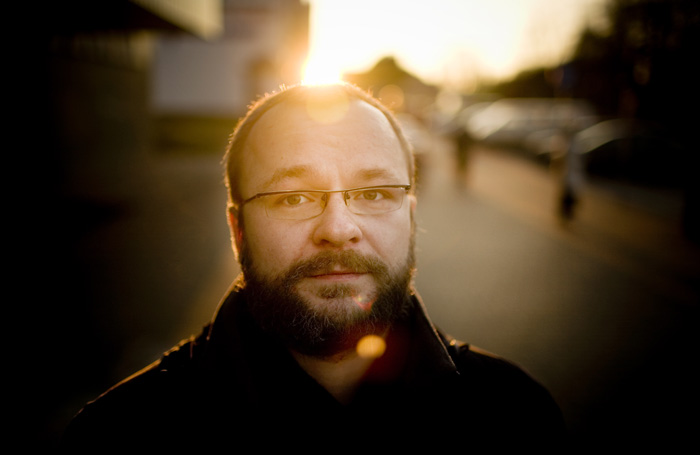
While fans and cheerful critics waited for another crazy book by Karpowicz, in 2008 the author wrote a completely different type of story. Gestures is not the quintessence of crazy imagination, but a story about loneliness written ‘piously’, without irony, yet with sincerity coming close to kitsch. Its protagonist, Grzegorz, abandons Warsaw life to spend some time with his dying mother in Białystok.
Gestures divided critics. Dariusz Nowacki from Gazeta Wyborcza attacked the novel, comparing Karpowicz to Janusz Leon Wiśniewski, author of widely read but not very sophisticated books. However, the sincerity of the prose delighted some critics.
Jan Strzałka from Polityka wrote: "Karpowicz and Grzegorz pose Fundamental Questions – precisely like this, with capital letters – about what happiness, time, memory, and the body are, whether a person can die before he is even born. Great prose, and at the same time Karpowicz surprises us with an unexpected ending..." The writer said in an interview with Agnieszka Wolny-Hamkało from Gazeta Wyborcza:
In my opinion, Gestures is the bravest of my texts. First of all, I disappointed readers who liked Niehalo and Cud, and therefore the joyful mixture of grotesque and humour which masks despair. Secondly, the adopted convention, or, negatively speaking, the psychological and existential nonsense, had its consequences. I – the author had nowhere to hide any more. I was not protected by distance, nor helped by irony, nor rescued by language games. It turned out that I was utterly exposed. I was easy to hit. I was easy to defeat. It was easy to laugh at me.
In Gestures, Karpowicz performed ‘exercises in sincerity’, talking about a family which does not provide support because it is a collection of empty social forms, about literature as ‘plagiarism of life’, and about loneliness, which is inborn, like skin tone or eye colour. In 2009, he was once more nominated for the Nike Literary Award for his novel, and two years later, Gestures was translated into Lithuanian.
People in Homeopathic Doses
After years of travelling, Karpowicz returned to his homeland. He lived in a small village in Podlasie in a house without a phone or hot water. Asked by Justyna Sobolewska from Polityka whether he likes people, the author replied:
I like them in small doses and not too often (...). Sometimes I don’t see any new people for a month or more and then I start to think that they are nice and good. I just start loving people (...). And then when I have come to love them very much (...), then I know that I need to urgently go to the city, because I have lost touch with reality. That I need to see real people. After just two days in Warsaw, I already know what people really are.
Karpowicz has been living in his native Słuczanka for years, keeping private. He's stopped travelling. "I can find the same things in my countryside as in Ethiopia. Besides, my countryside is cheaper," joked the writer upon receiving the Polityka Passport Award for Balladyny i Romanse (Balladynas and Romances, trans. by A.P.).
He also took the occasion to thank his publisher for the ‘phraseological tricks’, thanks to which Balladynas and Romances was published. In his fifth novel, Karpowicz returned to booming aesthetics. This is a book which is a triumph of the imagination, and which manages to dress the deep truths about contemporary culture in a pop culture costume. Here, language is a tool for experimentation, and the vibrant phrases deconstruct language patterns and arrange words in new surprising configurations.
But it is not just words that are combined in surprising ways. The same applies to ontological frameworks. The world of ordinary characters: a spinster, gay couples, an adolescent hooligan and girls interested in younger lovers, collides with the world of gods. Jesus dressed in a hippie shirt with the slogan ‘Make love, not war’ plays Mortal Kombat, and Athena and Osiris watch the series Six Feet Under. One day, as suggested by Zeus, gods from different cultures: Nike, Aphrodite, Jesus, Lucifer, Osiris, Athena, Eros, Ares, Apollo, and the Fates, descend to the Earth (to Poland) and they are joined by the pop culture characters from Winnie the Pooh.
Balladynas and Romances, which received a Polityka Passport Award in 2010, is a story about a world without gods, in which values are blurred, and moral codes are subject to redefinition. In this reality, gods become mortal, and religion is replaced by pop culture myths. Karpowicz explains:
It is often said that pop culture is stupid. This suggests that at some point people used to be smarter than they are now. I don’t think this is the case. Pop culture did not kill high art. After all, it is not like 60 years ago every worker went to the opera once a week. It has never been like this and it is not at the moment. In the pop cultural environment in which we live there is a wealth of options and everyone can choose what pleases them and fits their needs.
Balladynas and Romances turned out to be a great literary success – unanimously praised by critics, awarded, and recently translated into Hungarian.
Being a Voodoo Shaman
The work of Karpowicz is not limited to novels. In 2012, the writer of Niehalo became a co-author of the documentary The Art of Disappearing directed by Bartek Konopka and Piotr Rosołowski. The film is about a voodoo shaman, who, thanks to Jerzy Grotowski, arrived in Poland during the Communist period, and died after his return to Haiti without leaving many memories and relationships behind.