During the Zapraszam 24 na dobę (editor’s translation: Welcome 24 a day) performance, realized during the artloop festival in Sopot, Martin spent 72 hours in a tent arranged in a sublet apartment. There she invited more or less casual guests. During these visits Martin was completely silent, not reacting to any provocations and attempts to make contact. Anybody could enter, remain in this space and stay with Martin in an atmosphere which was weirdly intimate, but very awkward at the same time.
In another action, the artist sat in a baby stroller, spending four hours in uncomfortable positions. The audience, which at the beginning didn’t notice the curled up person, after some time started coming nearer and reacting to Martin’s presence, treating her as if she was a baby. Oppressive actions took the form of symbolical violence.
In her actions Martin often uses the strategy of socialization and modern practices of sharing, that have their roots in the gift economy. She talks about the social contract, constituted by help, sacrifice, and dependencies that are the result of the relations between the donor and the recipient. An example is the work Come and Take What You Want, in which Martin invited the audience to her own apartment, encouraging everyone to take whatever they like. After a few hours it was completely empty.
Another theme Martin is interested in is hospitality. The artist starts relations with casual people, abusing her own, and sometimes their trust, she arranges situations of social exchange, among other things renovating by herself the façade of a destroyed building which had a questionable reputation. About the work Kopernika 14 she says:
The inhabitants warned me that this is the worst building in the whole town. Thankfully their predictions turned out to be wrong and the idea gained a lot of support.
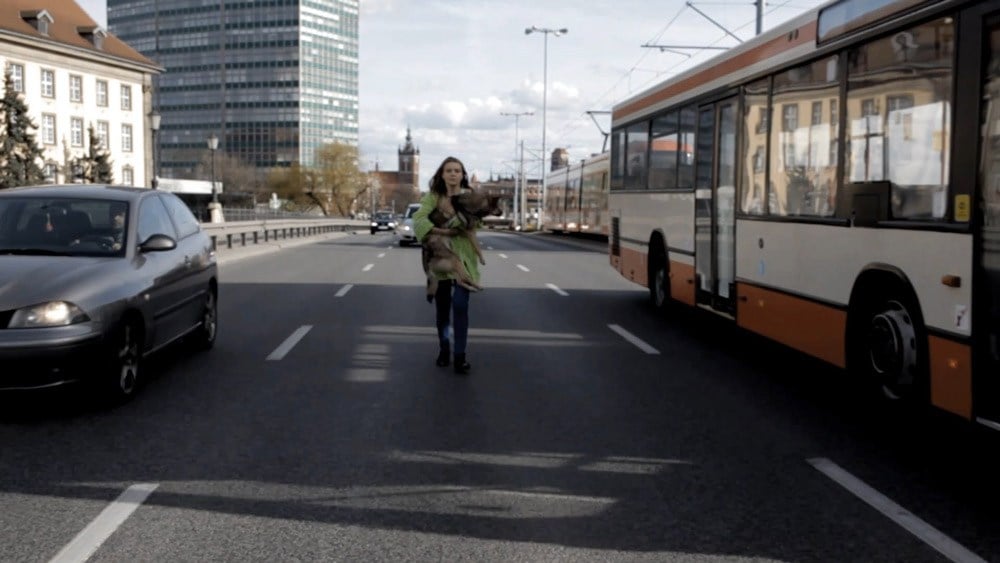
Still from the video Honorata and Sasko, photo: Kamila Chomicz
The most famous of Honorata Martin’s works to date was Going out into Poland (2013), a two-month solitary journey, started in Gdańsk and finished in Dzierżoniów in Lower Silesia. The project was realized for the Curator Libera exhibition in Wrocław’s BWA. Later – in the form of drawings, maps, photos and videos – she also presented it in Warsaw’s Galeria Raster as part of the exhibition Społeczeństwo jest niemiłe (editor's translation: Society isn’t nice). As we read in the exhibition’s catalogue:
Martin left her apartment on July 15th without any precise destination or route. She went further into the country without any assumptions about the time she wants to spend travelling. Her motivation was great fear she felt when thinking of a lonely march and of a situation when reality and every new day verifies her plans. Martin wandered for around two months, with the goal of observing the world and the people around. It soon became evident that what she observes is her functioning in a casual surrounding, in her relationships with people and places.
Venturing around Poland can be considered a secular pilgrimage, resulting from the deepest spiritual needs, where the destination is not a concrete, holy place, but reaching one’s limits. The solitary journey of the artist could be compared to an ascetic, mystic, constant wanderer.
In 2015, invited by The Museum of Modern Art in Warsaw, Honorata Martin realized the performance Make yourself at home, during which for a few weeks she camped in the Sculpture Park in Bródno. This work has been a realization of the postulate of ‘social sculpture’, where the material are social relations. Targówek’s inhabitants had the chance not only to watch the process of creating the work of art, but also be a part of it, sharing their doubts and ideas.
Honorata Martin’s performance in the Sculpture Park in Bródno is connected to the questions of survival, exchange, hospitality, and escapism. It’s foundation is the sequence of events, interactions, what happens without the public and what – with the participation of casual witnesses.
– say the curators Sebastian Cichocki and Katarzyna Karwańska.
Honorata Martin’s art, as in her previous realizations, took place in real time, 1:1. The artist, as a radical performer, used a non-radical material: the world around her, her own emotions and experience.

