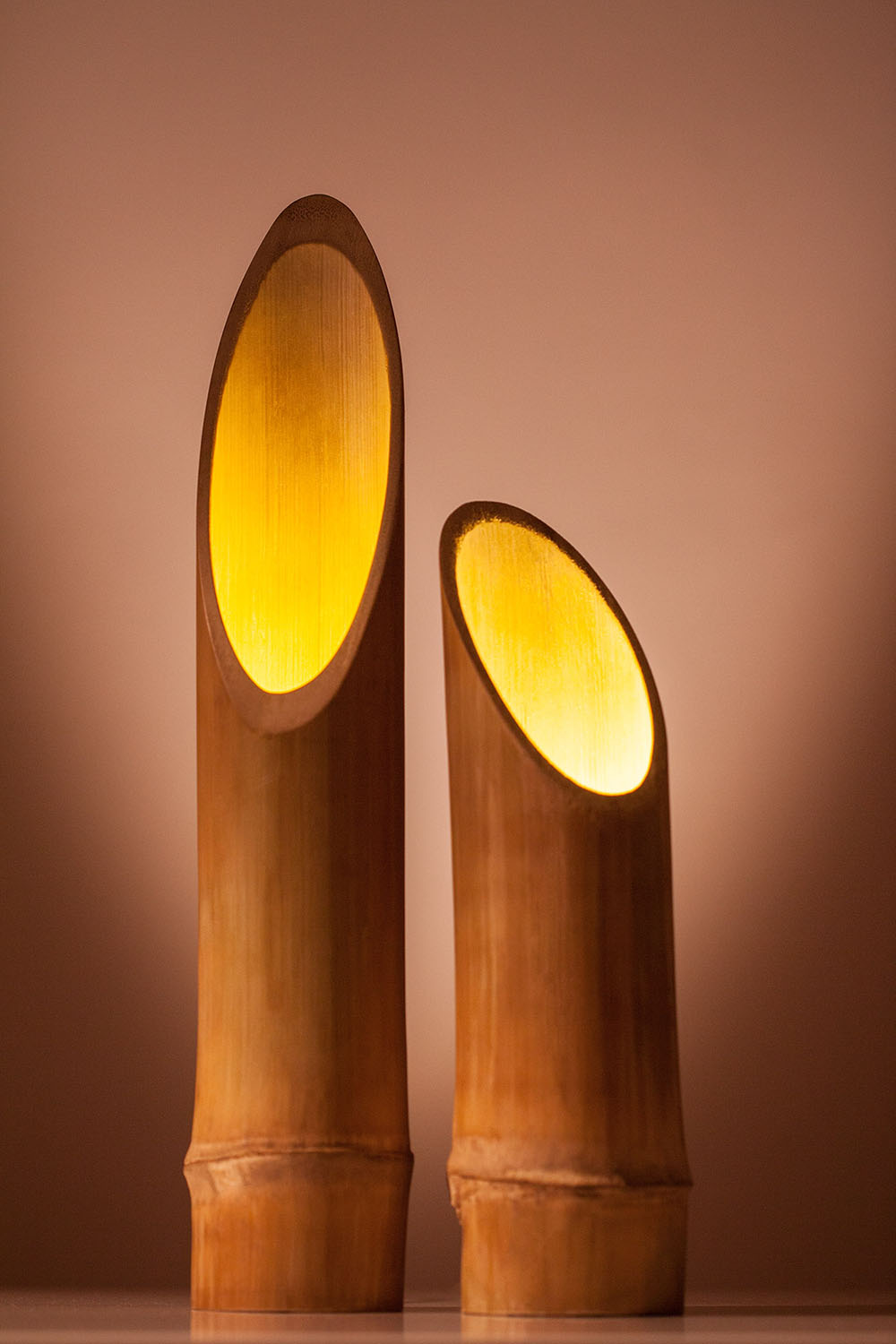
Czernek studied product design at the Academy of Fine Arts in Warsaw. She also studied at the Bezalel Academy of Arts and Design in Jerusalem and Warsaw University – where she pursued Hebrew Studies. Combining her interests in design and Jewish heritage, her work is concerned with representing the relationship between the past and the present. She embraces and promotes Jewish identity with her modern aesthetic and clean and thoughtful designs.
Chopin in the City
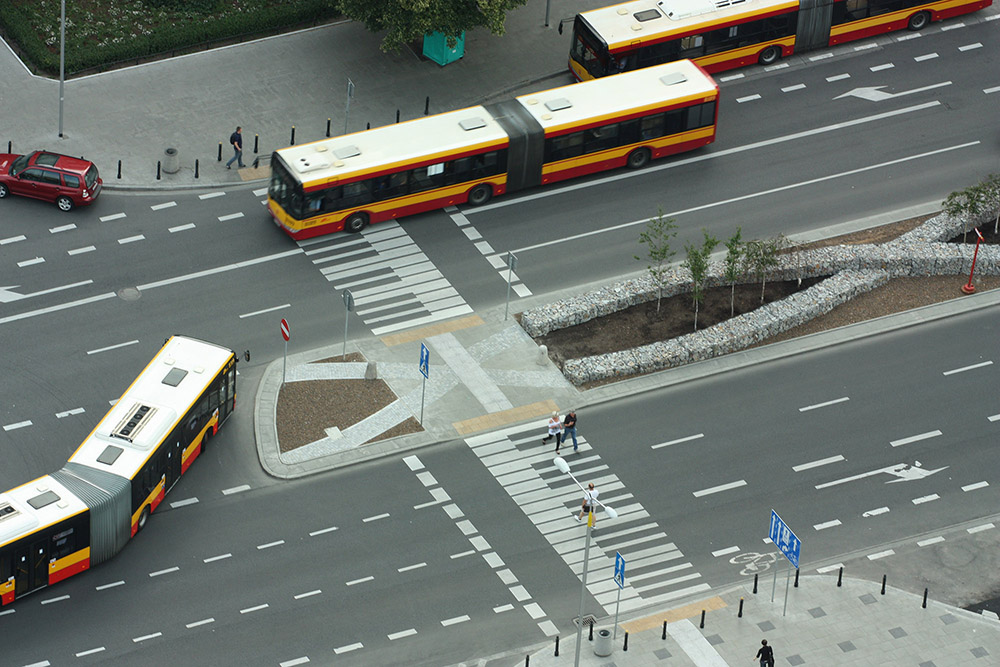
Helena Czernek, Zebra Crossing - Pianokey, photo courtesy of the artist
To many Poles, Czernek’s best known work likely is her award winning design for Zebra crossing – pianokey – a crosswalk painted in the distinctive black and white pattern of a piano keyboard. This project, a collaboration with Klara Jankiewicz, was awarded 1st place in a competition for designs promoting the 2010 “Year of Chopin” in Warsaw. After its selection, the design was painted on the busy Emilia Plater Street in Warsaw. It was also featured on streets in Hungary, Slovakia, Romania, and Moldova. While this eye catching and large scale design may have vaulted Czernek’s work into a public spotlight, it is but a glimpse at the creativity and beauty evident in much of her other work.
Studies in Contrast: Inner/Outer. Past/Present.
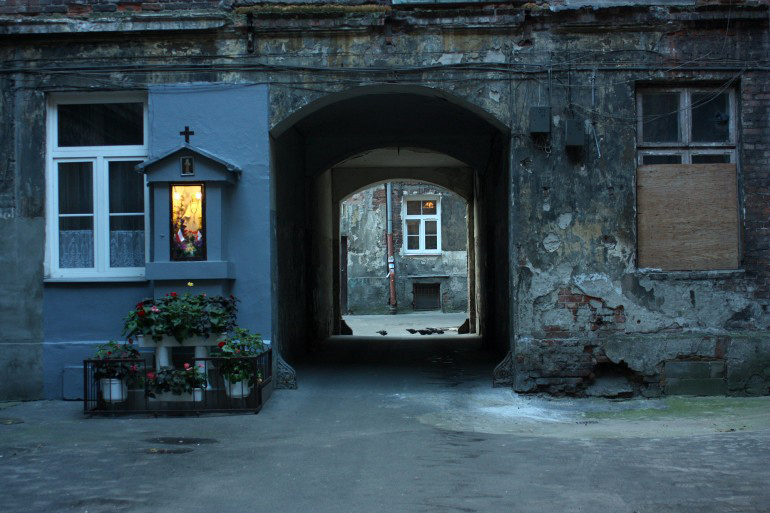
Helena Czernek, photograph from series The place, where I walk
What interests me the most in design is dealing with contrasts. By confronting the opposites I acquire new functions and meanings. In my work I often fall back on Jewish tradition, which helps me to learn and experience Judaism. The dialogue between Europe and Middle Eastern culture, future and the past, folklore and modernity are important to my projects. [Helena Czernek]
Czernek’s work is deeply engaged in exploring contrast and the ways in which opposing elements can be represented simultaneously. Exterior views reveal interior lives and present forms are seen as records of past experiences.
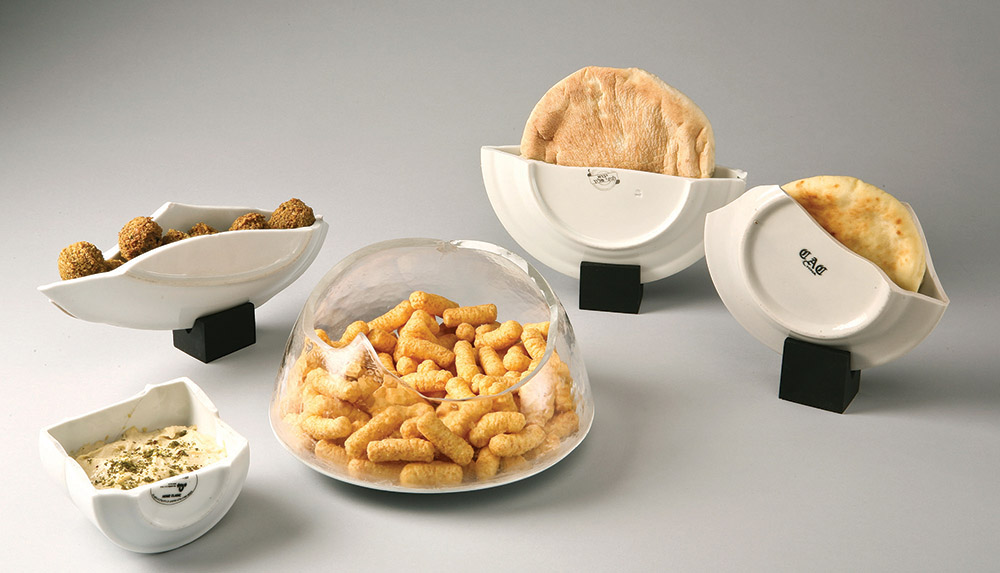
Helena Czernek, Broken Dishes, photo: Bezalel Archive
As a student at Bezalel Academy of Arts in Jerusalem, Czernek designed a collection she calls Broken Dishes. Reassembling piece of broken plates and bowls, Czernek created new dishes, made specifically to serve popular Israeli foods such as humus, pita, and falafel. In so doing, she brought traces of the past into the present, repurposing the scraps of history into something useful for the present. Of the project, Czernek notes,
The main idea…was how to give a second life to broken dishes – how to make useless things useful once more.
Exploring again the ways in which objects of the past can be reimagined in the present, Czernek’s Remembering Desk is a true study in contrast – it is both smooth and sharp, objects are at times obscured and at times made visible, and – most strikingly – it is a window from Czernek’s present to her family’s past. The design for the desk was based on a photograph of her great-grandmother’s desk. While the photographed desk featured a large glass pane under which Czernek’s great-grandmother stored photographs, the contemporary product finds most of its utility hidden below the surface. Designed to allow pencils, books, and a glass to rest below the surface – thus creating a smooth exposed plane and an uneven underside – the desk reimagines the use of space. In further homage to her great-grandmother’s desk, Czernek added a small glass panel like that which adorned the original, under which she placed a photograph of her great-grandmother.
As a reminder of the past and the original desk – which was my inspiration – I made a small place with a flat, glass square where a photo can be placed. It is a window between the past and present, and between the contrasting worlds – and surfaces – of the desk.
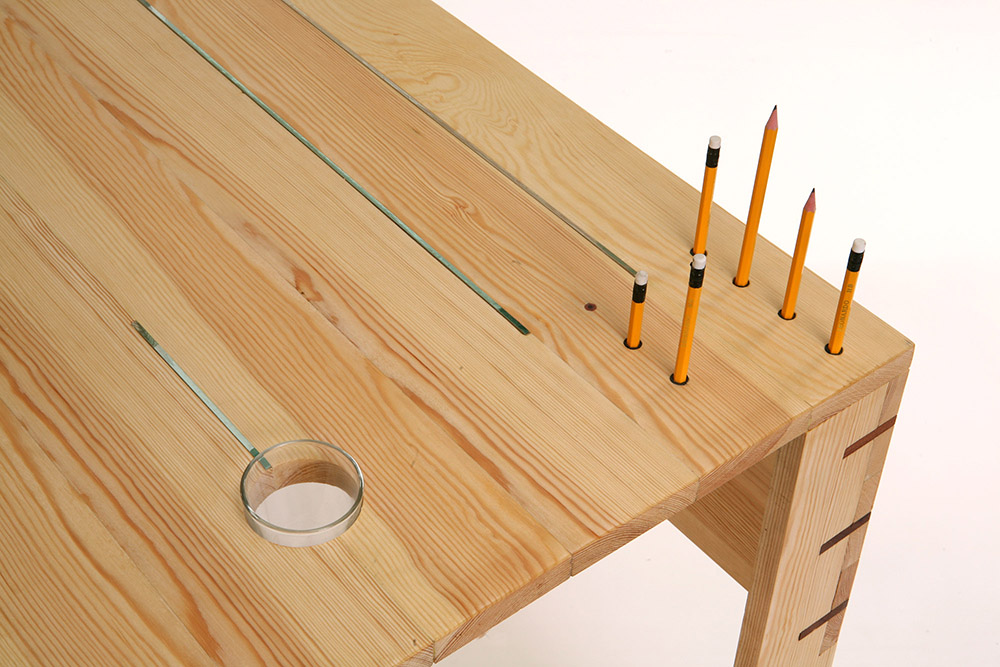
Helena Czernek, Remembering Desk, photo: Bezalel Archive
One sees a similar interest in exposed versus hidden space and past alongside present in Czernek’s photography. Her collections The Burnt House I, The Burnt House II (a photographic story of the remains of burnt house), The place, where I walk (photos of Praga, Warsaw), and The walls of villages all explore contrasts. In the destruction of the burnt house, Czernek captures glimpses of the life once lived there – both in the material traces and evoked memories.
Mi Polin. Z Polski. Jewish Design from Poland.
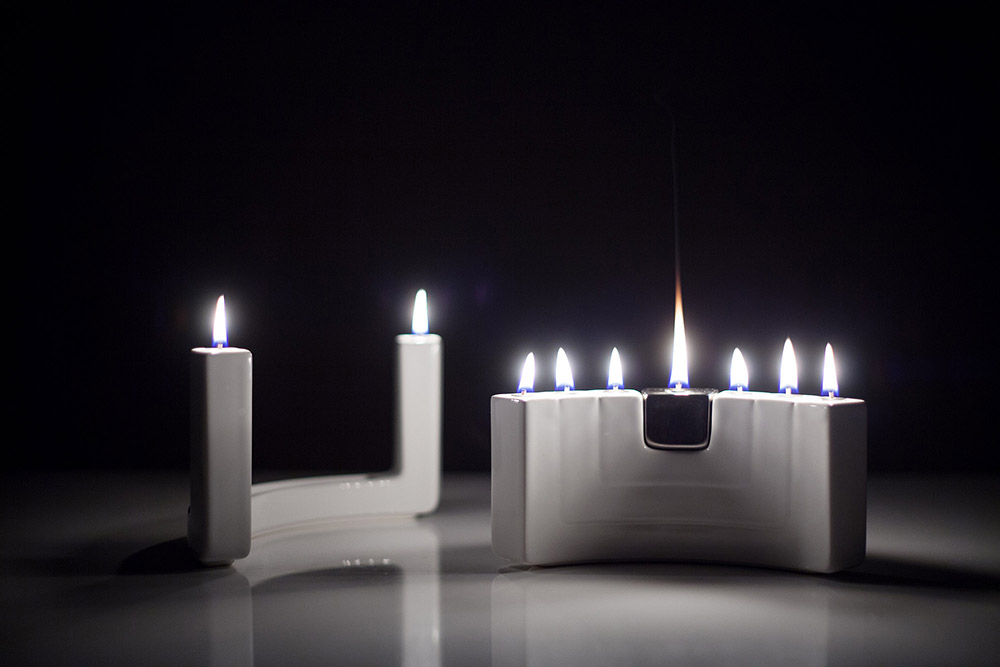
Helena Czernek, Menokiah, photo: courtesy of the artist
„Jewish design” is an attempt to combine two of my greatest passions: design and Judaism.
Much of Czernek’s design work is focused on this project of “Jewish Design” – of brining contemporary design to traditional Jewish objects. Of the title of this project, on which she has collaborated with Aleksander Prugar, Czernek explains,
„Mi Polin” in Hebrew means „From Poland.” According to the legend, the word Polin (Poland) comes from the words Po Lin – “rest here.” A few hundred years ago, Jews escaping from Spain perceived these words as a sign sent from heaven. They interpreted that as a good sign and from that moment they started to settle in Poland.
Much as the title ties her project with the long history of Judaism in Poland, her designs – for menorahs and mezuzahs – bridge modern design with Jewish tradition. Though beautiful, Czernek’s judaica designs are also explorations of the artist’s quest to convey meaning through design.
I try to make sure my projects are not just pretty. I appeal to hiddur mitzvah, which tells that ritual objects should be beautiful. For me, however, this is not enough – I’m always looking for some extra, hidden meaning.
One of the first pieces in this collection – Menokiah– is surprisingly a practical reflection of Czernek’s own Jewish practice. She recalls,
We did not have a decent home Hanukkah Menorah, so I decided to make one myself.
Czernek’s Menokija creatively serves the needs of many Jewish occasions, as it incorporates the three traditional Jewish lamps – the double-branched lamp for Shabbat, the menorah with seven lights, and the nine-light Hanukkah Menorah. The sleek lamp – available in a number of finishes – comes in two pieces (two and seven lights) that can be nested to create the Hanukkah Menorah.
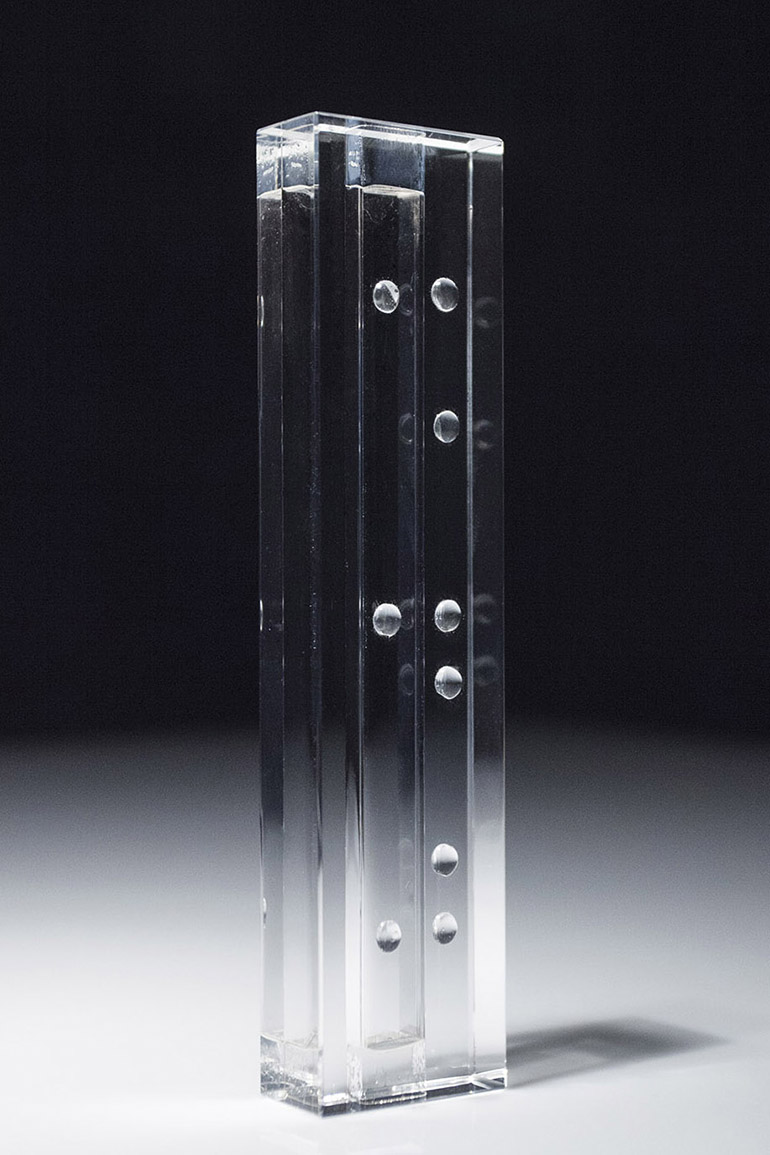
Helena Czernek, The Mezuzah for the Blind, photo: Aleksander Prugar
The collection also features a number of designs for mezuzahs (the Torah verses affixed in cases to the doorframes of Jewish homes), created in collaboration with Aleksander Prugar. Her Mezuzah for the Blind is made of made of crystal glass and features “Shaddai” (one of the names of God) written in Braille. Touching the mezuzah has important meaning in Judaism – it is a reminder of the commandments – and in Czernek’s Mezuzah for the Blind touch not only reminds, but informs.
Returning to mezuzahs for a competition of the Museum of The History of Polish Jews, Czernek designed a copper mezuzah with the mark of three fingers visible on the patina surface. The pattern rubbed in the copper represents not only the gesture of touch, but also forms the Hebrew letter Shin. As in Mezuzah for the Blind, here that which is tactile becomes visible. The fingerprints on the copper also serve to evoke the memory of those who have touched the mezuzah before, thus creating a link between visitors that stretches deep into the past.
Though her mezuzah was not selected to adorn the Museum of The History of Polish Jews, she did collaborate with them on Daffodils – a project that commemorated the 70th anniversary of the Warsaw Ghetto Uprising in 2013. The design was also adapted and used on the occasion of the 71st anniversary. Czernek’s small yellow paper flowers – to be worn on lapels or otherwise displayed – evoke the memory of Marek Edelman, a leader of the Ghetto Uprising. For years, Edelman received yellow daffodils from an anonymous person on the anniversary of the Ghetto Uprising, and every year he placed them at the monument to the Heroes of the Ghetto Uprising. The memorial paper daffodils were distributed across Poland and abroad. The design was also available as a template on the Museum’s website, so anyone could make their own. In Warsaw, a group of volunteers produced over 50,000 of the paper flowers. Czernek was also responsible for the design of a map that showed the sites of the Ghetto Uprising, released in concert with anniversary commemorations.
While practical, these works of “Jewish design” are also deeply personal. Of the projects, Czernek comments,
My designs highlight the place where I came from, where I work, and through which I connect with the future.
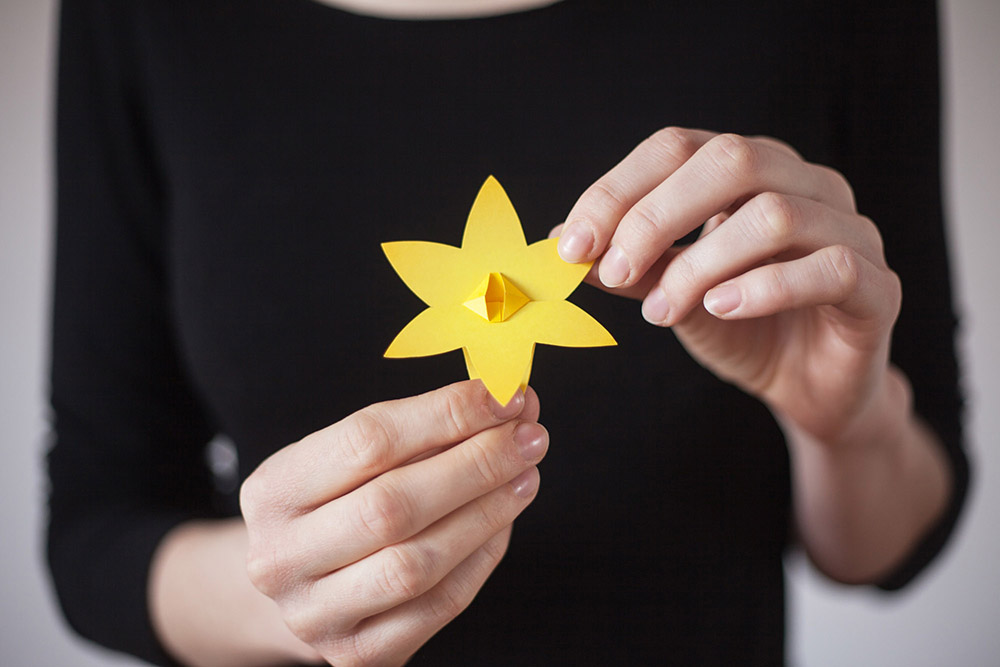
Helena Czernek, Daffodil, photo: Aleksander Prugar
Traces of the Past
Czernek’s most recent project finds her again exploring the Jewish past and the traces of history left that remain visible today. The work – undertaken in collaboration with Polish documentary photographer Aleksander Prugar – was inspired by the trace of a mezuzah Czernek observed on ul. Mostowa in Kraków. In the void, Czernek saw both the history of Jewish life in the city and its present absence.
We began to wonder what could be done to commemorate the traces of mezuzah preserved on the door frames of Jewish homes. There are fewer and fewer of them.