Between 1984 and 1989 the artists published a fanzine called Oj dobrze już / Oh, it’s fine already, in which they published their poems, commentaries, sketches and drawings (nine volumes were released, including a special edition, published in 2002, on the occasion of Gruppa’s exhibition in Warsaw’s Program Gallery). In June 1989 six painters from Gruppa painted the fence of Solidarność’s polling station on Plac Konstytucji in Warsaw. This collective action, called Głos przyrody na Solidarność / Nature’s vote for Solidarność, is considered a symbolic end to Gruppa’s story.
Gruppa’s history and us, immersed in it, is a story about infatuation. Love at first sight. Talking about this story is like looking into a very deep well – on the one hand you want to see sky from inside, on the other – you are afraid of falling inside.
Gruppa is one of the most interesting manifestations in Polish art of the 1980s. It was more of a collective of individuals, connected by artistic friendship and underlining their separateness, than work done according to a homogeneous programme. The artists were connected by a common position and mutual inspiration, but not by a superior vision of art. At the beginning, the artists didn’t think of themselves as a group; they renounced a common artistic identity and programme. The strategy of exhibiting together seemed effective when they debuted, especially because of the political context of martial law.
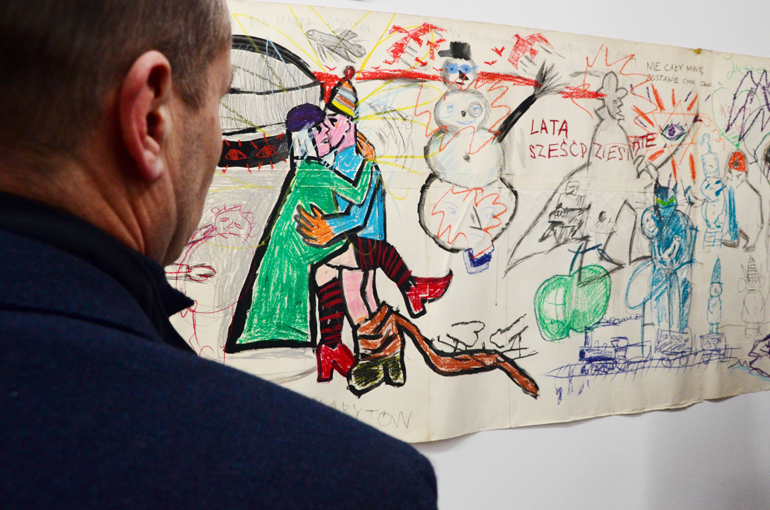
The vernissage of Oh, it’s fine already exhibition, by Gruppa in Propaganda Gallery, photo: Mariusz Gaczyński / East News
Only in 1985 did the artists accept their group identification and the name Gruppa.
The artists who formed Gruppa fit stylistically into the international artistic context of the 1980s. Their works were aesthetically similar to the popular wave of New Expression or Neue Wilde in Germany. They painted figurative, gaudy images, consciously anti-aesthetic. When confronted with the 1980s greyness, these colourful paintings seemed to scream. Their neo-expressive style was adapted to the tense political situation in Poland. The wildness of Gruppa’s painting was not only a revolt against martial law, but also against the boredom of post-avant-garde art, which had entered the stage of idle academism. The members of Gruppa felt the need of collective action, of showing their emotions and views in their art. They treated reality as absurd and grotesque, as a time deprived of authentic values. They answered political brutality with ‘wild’ paintings. Freedom was manifested in their work as anarchy, provocation, bitter irony, and obscenity. Gruppa’s members didn’t want to function in the official, PRL circulation, but they also didn’t identify with neo-romantic martyrization of the artists connected to the catholic and Solidarity opposition. Their art was far too aggressive for the church vestibule. Gruppa tarnished sanctities and felt at their best using the categories of transgression, mockery, and breaking taboos. The artists chose a position of irony and absurd. This created an area of freedom and allowed them to demythologize and demystify both the present time and history. They painted a lot and quickly, wanting to capture every moment and express every emotion. They chose counter-cultural life, being and painting together, writing provocative texts.
Gruppa’s paintings created a world of magnified absurd, using childish stylistics reminiscent of Gombrowicz. Art became an area of alternative reality, based on allusions presented through motives, iconography, symbolism, literary associations (in the titles).
Gruppa’s first collective exhibition, entitled Zawieszenie metafizyczne / Metaphysical suspension was planned for 13th December 1982, in Warsaw’s Dziekanka gallery. The organizers’ feared repression from the authorities, and so the opening was moved to January 1983, and the exhibition was finally presented under the title Las, góra, a nad górą chmura / A forest, a mountain, and a cloud above the mountain. The five painters who took part in the exhibit (Grzyb, Kowalewski, Modzelewski, Pawlak and Woźniak) were joined by Marek Sobczyk two months later.
Gruppa’s history begun with engaged images, deeply connected to political and social reality of that time.
Gruppa’s early years, 1983-84 was characterized by the domination of subjects wherein reality plays a major part. I think that the pressure of events, which we all witnessed and took part in, was not indifferent. They became a fuse for many decisions, artistic ones too. We were wondering about our place in this world and created paintings out of this cogitation.
– said Ryszard Woźniak
Exhibitions organized at the time were complemented by readings and music. Gruppa was then called ‘Military, genitalia and Indians’. Their paintings were filled with emblems such as stars, flags, Victoria symbols, big phalluses, copulating motives and Indian symbols, written into a political and national context.
In 1985 and 1986, the collective painting sessions organized in Dziekanka Gallery were important for the group. Three such actions took place, during which the artists lived and worked at the gallery, creating many works on paper at the time. Gruppa’s members also repeated this model of work in the church on Żytnia Street in 1985 and, for the last time, in 1988. Collective painting on sheets of paper was initiated by Sobczyk and Modzelewski during their stay in Germany, when first four such works were created. ‘Papers’, painted colourfully, casually and dashingly, gave the possibility of full artistic expression.
Gruppa’s work was diverse when it comes to subjects and style, and the painters had different artistic dispositions. In addition, diverse inspirations and referenced traditions influenced the heterogeneous image of the artists’ work. As Marek Sobczyk recalls:
Our biggest fascination was Malewicz and his similar. And not only the best known Malewicz – from the times of the ‘black square’, but also his later years, when he was referencing rennaissance. (…) We had an appreciation for Katarzyna Kobro – a great woman and artist. We dedicated many paintings to her memory. Pawlak referenced Strzemiński, Grzyb spoke about Cwenarski, who fascinated him in Wrocław. Jurry Zieliński as a legend and as an underappreciated painter was also important. We were in love with Wróblewski (…) I personally also appreciate Marek Włodarski, a Lviv surrealist from before the war.
Spontaneous art by Ryszard Grzyb, which was created mostly on cartons painted with gouache and distemper, presented a world of war and battles between fantastical human and animal creatures (Pojedynek na szparagi/Asparagus duel, Bulterier przebił świnię / A bull terrier pierced a pig, Walka Jakuba z aniołem / Jakub fighting with an angel, Zarzynanie czarnego koguta / Slaughtering of a black cock). Amongst fighting and violence, coarse eroticism was also present in his work (Szlifierz nocnych diamentów / Polisher of night diamonds) as well as scatology (Sranie ku wolności / Shitting for freedom). In the following years, Grzyb started to paint with oil on canvas, and the subject was most often a critical commentary about the present social and political reality (Wstydzę się, że jestem Polakiem / I am ashamed to be a Pole, Matka Boska z kokardkami / Mother of God with bows, Chleb, masło, mleko i marmelada to molekuły mojego człowieczeństwa / Bread, butter, milk and marmalade are the molecules of my humanity).
Paweł Kowalewski’s paintings were most provocative and pungent, which is why they were also most often censored (like Psalmy / Psalms on paper, 1984). The major themes were historical and patriotic (Ja na górze, ty na dole / Me on the top, you on the bottom, "Mickiewicz i Słowacki tchną ducha romantyzmu w Polaków / Mickiewicz and Słowacki fill Poles with romantic spirit, Opowieści lasku katyńskiego / Tales from the Katyń woods, Hitler, Stalin, Piłsudski, the Lithuanian series.
Jarosław Modzelewski’s paintings were situated the furthest from the stylistics of the New Wild Ones. His figurative compositions respected the rules of realist art, although they didn’t treat reality literally. In his early paintings emblems and templates dominate (Bieg czerwonych ludzi / Red people running, Akrobaci / Acrobates). In 1985 a series of paintings inspired by book illustrations and Russian manuals was created, showing simple everyday activities. Later Modzelewski’s works are metaphorical and symbolic, which creates an effect reminiscent of surrealism (Fotograf. Fotograf / Photographer. Photographer, Zamaszyste zmartwychwstanie / Sweeping Resurrection, Niewidomy obsługujący centralkę telefoniczną / A blind man operating a telephone switchboard.
Włodzimierz Pawlak, always a little different to the other members of Gruppa, connected his critical view on political reality with artistic form in a very mature way:
I want the surface on which I paint to be a documentary of absurd reality, a document of pointlessness of living in it.
In his graduation work from 1985, called Obrazy zamalowane / Paintings painted over, Pawlak referenced the actions of anonymous creators of political writings on the wall. During his diploma exam he intended to paint over his own works, but it didn’t happen. He returned to this idea in his works from 1986 and 1987 (Nie mówię, nie widzę, nie słyszę / I don’t speak, I don’t see, I don’t hear, Skąd przychodzimy, kim jesteśmy, dokąd idziemy / Where do we come from, who we are, where we’re headed, Łamanie szklanych rurek / Breaking of glass straws). Pawlak’s later works took the form of didactic boards, on which the artist displayed a conceptualized history of 20th century culture and art through ideograms and pictures taken out of encyclopedias (Tablice dydaktyczne / Didactic boards).
Marek Sobczyk’s paintings were elaborate puns, and the artist connected many symbols and threads of thought. Their composition was very dynamic, their shapes – monumental and often hieratic, and the colours – intense and seductive. They were dominated by erotic, religious and also literary subjects (Obraz o namiętności / A painting about passion, Kobieta płonie / A woman burns, Biczowanie Chrystusa / Flagellation of Christ, Boże narodzenie / Christmas, Bruno Schulz obcina i zakopuje penisa w jamce / Bruno Schulz cuts and buries a penis in a pit, Walka Gombrowicza z Conradem o swoją wybitność / A fight between Gombrowicz and Conrad for their greatness).
Ryszard Woźniak’s work was characterized by possibly the greatest diversity of forms and themes. He painted non-figurative, poster, emblematic paintings (Nowa fala popierdala / New wave dashes, Czerwony rogalik co ranek na śniadanie / A red croissant for breakfast every morning), naive canvasses (Wchodzi słoneczko po niebie i znów brak mi ciebie / The sun enters the sky and you are still not mine), as well as expressionist compositions with deformed design and sharp, unnatural colours (Człowiek góra człowiek chmura / Man as mountain, man as cloud, Trzygłowy egzekutor / Three-headed executioner, Portret budowniczego arki / A portrait of the builder of the ark, Pojedynek o kość biodrową / A duel for the hipbone). In the later period Woźniak’s paintings became more symbolic and metaphorical, and often religious (Dziewięć przykazań / Nine commandments, Bramy raju / The gates to paradise, Upadły anioł / Fallen angel, Mistrz i uczeń / Master and disciple).
- Ryszard Grzyb was born on 17th July 1956 in Sosnowiec. Between 1976 and 1979 he studied at the PWSSP in Wrocław,at the Painting, Graphics and Sculpture Department. Since 1979, he had studied at the Fine Arts Academy in Warsaw. He graduated in 1981 under Professor Rajmund Ziemski. During his studies in Wrocław he also made his poetic debut, and kept writing at the same time he painted. He lives and works in Warsaw.
- Paweł Kowalewski was born on 20th September 1958 in Warsaw. Between 1978 and 1983 he studied painting at the Fine Arts Academy in Warsaw, and graduated in Stefan Gierowski’s atelier.
- Jarosław Modzelewski was born on 8th October 1955 in Warsaw. Between 1975 and 1980 he studied painting at the Fine Arts Academy in Warsaw, and graduated in Stefan Gierowski’s atelier.
- Włodzimierz Pawlak was born on 15th April 1957 in Korytów near Żyrardów. Between 1980 and 1984 he studied painting at the Fine Arts Academy in Warsaw , and graduated in Rajmund Ziemski’s atelier.
- Marek Sobczyk was born on 30th November 1955 in Warsaw. Between 1975 and 1980 he studied painting at the Fine Arts Academy in Warsaw, and graduated in Stefan Gierowski’s atelier.
- Ryszard Woźniak was born on 13th June 1956 in Białystok. Between 1975 and 1980 he studied painting at the Fine Arts Academy in Warsaw, and graduated in Stefan Gierowski’s atelier.
Author: Ewa Gorządek, Centre for Contemporary Art at Ujazdowski Castle, December 2006, translated by: N. Mętrak-Ruda, November 2015.

