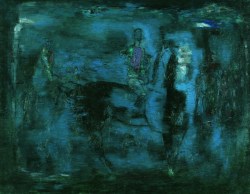
Błękitny obraz / Blue Image (1967) oil on canvas, 114x146 cm,
collection of the National Museum in Wrocław.
Photo: National Museum in Wrocław
He began his artistic education in 1908 at Leonard Stroynowski School in Kraków. At the same time he undertook legal studies at the Jagiellonian University. He continued studying painting in the years 1912-1914 and 1918-1920 at the Academy of Fine Arts in Kraków under the supervision of J. Malczewski and S. Dębicki.
He spent the period of World War I in exile in Orenburg near the Urals and he also served in the Polish Eastern Corps in Russia. Between 1925 and 1928 he held a scholarship from the Association of Polish Artists in Paris, where he exhibited his work at the Autumn Salon (1925, 1927, 1928). Individual exhibitions of his paintings took place in the Parisian galleries Au Sacré du Printemps and Carmine (1926-1927). In 1928 Geppert returned to Kraków. He exhibited his works at the Society of Friends of Fine Arts in Kraków (1918, 1919, 1921, 1928, 1932, 1946), the Warsaw Society of the Zachęta Fine Arts (1926, 1929, 1957, 1964, 1978), the Institute of Artistic Propaganda (1932, 1935, 1938) the Garliński Salon (1929, 1930), and in Lviv (1932). He was a member of the Nowa Generacja and Zwornik groups.
In 1932 he participated in an Olympics-related art show in Los Angeles, and in 1938 he took part in the Pittsburgh International Art Exhibition. He took a number of study trips to France, Germany, Belgium, and Italy. In the years 1932-1939 he collaborated with the magazines Czas and Głos Plastyków, and after the war with Przegląd Artystyczny. In 1946 he settled in Wrocław, where he created the organisational framework of the State Higher School of Fine Arts in which he worked as a professor. Until 1950 he was rector of the university; He lectured until 1961. In 1962 he became a founding member of the Wrocław Group. In 1977 a retrospective exhibition of the artist was organised at the National Museum in Wroclaw. Geppert also published books: Formalne i Nieformalne Zagadnienia w Malarstwie Polskim (editor’s translation: Formal and Informal Issues in Polish Painting, 1947), Moja Droga (My Path, 1968) and Przeszłość Daleka i Bliska (The Far and Near Past, 1977).
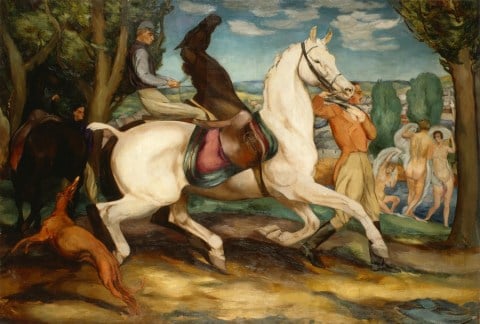
Pobudka (Wake-up Call, 1924) oil on canvas, 119,5x174,5 cm, collection of the National Museum in Wrocław. Photo: Arkadiusz Podstawka
Geppert’s artistic stance was influenced by Malczewski’s patriotic iconography. A frequent motif in his early work was the silhouette of the horsemen in the landscape, monumentalised and captured with a bold perspective, foreshortening, and fast movements. The contour surrounded the structure is enhanced by solid white highlights; while the smooth, disciplined texture was enriched with light impulses; The dark, gloomy colour schemes deepened the dramatic mood of the scene.
Geppert's art was centred on the theme of national liberation struggles and insurrections. The artist presented Polish light cavalry and cavalry units in various forms, as well as Uhlan regiments. He referred to the convention of battle painting, continued the tradition of the art of Piotr Norblin, Juliusz Kossak, and Wojciech Kossak; He drew inspiration from Piotr Michałowski’s paintings, transposed compositional schemes of the canonical images of Polish romanticism, showing the tumult and heroism of the Battle of Somosierra. He also imagined scenes from hunting and horse racing (Koń Przed Gonitwą / Horse Before a Race); He reached into mythological threads, giving them a contemporary dimension (Myśliwy i Trzy Gracje / The Hunter and Three Graces).
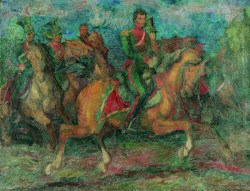
Mój pradziadek / My Great-grandfather (1937)
oil on canvas, 101x132,8 cm, collection of the
National Museum in Wrocław. Photo: National Museum in Wrocław
In the way of rhythmising and synthesising the forms embedded in the balanced structure of the image, it was close to the tendencies of the new classicism spreading in Europe in the early 1920s (Pobudka / Wake-up Call, 1924; Jeździec na Koniu / Horse Rider, 1924; Kompozycja z Białym Koniem / White Horse Composition, 1924).
In Paris, Geppert was fascinated by the art of the mature Renaissance, mainly Veronese’s work, as well as paintings by Géricault, Delacroix, the Impressionists, and the Fauves (Orszak / Procession, ca 1925). His palette was enriched with pure and bright tones, built upon contrasting elements (Pagazy / Pegasuses); He created also paintings with loose compositional structure and rich paintwork ‘woven’ from emerald green, blue, brown, and red, shimmering with bright colours (Jeźdźcy / Horsemen). An interest in Cinquecento is visible both in the Renaissance costumes of actors presented in scenes as well as in decorative composition and developed narrative.
After his return to Poland Geppert returned to the basic source from which he drew inspiration for creative transformations – Michałowski’s art. In the 1930s, the figures depicted in his paintings transformed into stained ideograms, dematerialised by fusing with the surrounding landscape (Mój pradziadek / My Great-grandfather, 1937). In his still lifes, however, he was inspired by folklore. Gradually, the expressive streaks of paint began to fade in favor of harmonised, balanced compositions dominated by bright green and clear blue applied with light brush touches. After the war Geppert’s frequent motifs were views of Wroclaw. These landscapes were stylistically associated with Paul Cézanne’s art. During his stay in Paris in 1957, Geppert was influenced by Raul Dufa’s work. In his paintings appeared a vivid line describing forms regardless of the patch of colour. In the second half of the 1950s, Geppert's mature style of painting was similar to that of allusive abstraction. The women’s nudes, the folk sculptures and the silhouettes of the riders now existed in the unreal world of artistic vision. The colour of the canvases was marked by green, blue and brown tones and textures built of dense horizontal streaks of paint (Błękitny Obraz / Blue Image, 1967)
Author: Irena Kossowska, Art Institute of the Polish Academy of Sciences, January 2003.

