Elżbieta Cieślar (née Dembińska) was born on 3rd December 1934. She lives in St. Jeoire in France. She started her studies at the Academy of Fine Arts in Kraków and graduated summa cum laude from the Academy of Fine Arts in Warsaw with after studying under Professor Jerzy Jarnuszkiewicz. After graduating, she worked as an industrial designer (1961-1968). She was one of the founders of the Industrial Form Designers’ Association, created in 1963.
Emil Cieślar was born on 22nd May 1932 in Rougemont le Château (France), and he resides in St. Jeoire (France). Between 1953 and 1959 he studied at the Academy of Fine Arts in Warsaw. He studied under Professor Jerzy Jarnuszkiewicz and also graduated summa cum laude. The same year he started his teaching practice as Oskar Hansen’s assistant. Between 1964 and 1976 he worked in his own independent atelier at the Interior Design Department of his school. He designed many projects for the electrical and automotive industries. In 1963 he was one of the founders and leaders of the Industrial Form Designers’ Association.
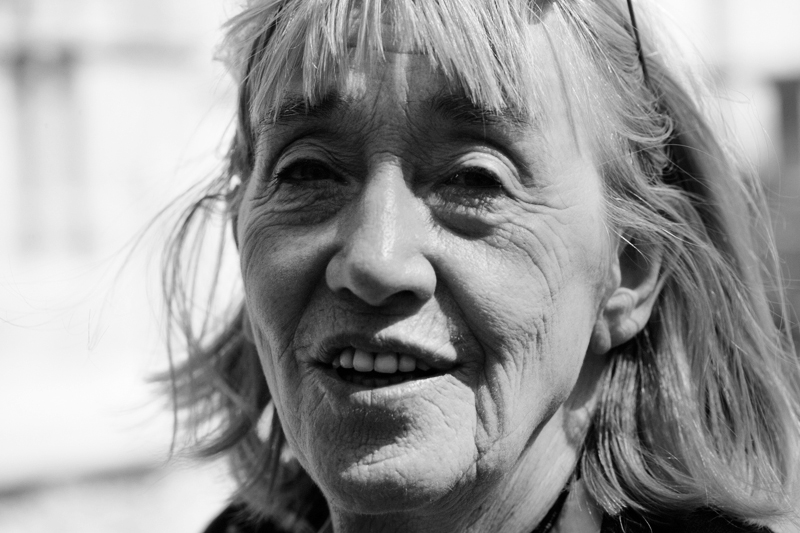
Elżbieta Cieślar, photo courtesy of the artist
The Cieślars’ education at the Warsaw academy provided them with a specific proto-conceptual technique (Hansen) and an awareness of the need for ethical and expressive qualities (Jarnuszkiewicz). Continuing the tradition of modern avant-garde movement with its progressive, social and inquiring ethos was a natural choice, and that’s what the artists did in the beginning of their independent work. Elżbieta Cieślar’s individual search was characterized by an analytical view of the mutual relations between plastic elements in space (Czas, przestrzeń, materia / Time, space, matter, 2 versions, 1957-1959). Emil Cieślar’s early work used Oskar Hansen’s Open Form in the realm of monumental fine arts (the collective project Monument to the Heroes of Warsaw, 1959). Works designed together by Elżbieta and Emil Cieślar included studies of the construction, composition and mutual relations between pure visual structures. This phase lasted until 1968, when it was summed up by the presentation of the light installation Punkty / Spots in Foksal Gallery.
A breakthrough in their artistic path came in 1973 when they took charge of the Repassage Gallery in Warsaw. A shift in the characteristics of their works occurred, which from then on have been presented almost exclusively in this gallery. The sculptural object stopped being a field of purely artistic exploration, and instead became an element of reaching out to another human being (Kalejdoskop – Popatrz przez rurę / Kaleidoscope – Look Through the Pipe, 1972, the action Zbiór butów używanych / A Collection of Used Shoes, 1975, a series of performances, mostly aimed at the artistic world Karuzela postaw / A Carousel of Attitudes, 1975-1976). In another group of works, created at the same time (Wykroje krawieckie / Tailor patterns, 1972; Słoń / Elephant, 1973, the Labirynt / Labyrynth series, 1973/1974; Camera obscura, 1974), they mostly focused on creating a visual metaphor, awaking an emotional reaction in spectators. In the last years of their stay in Poland, both Elżbieta and Emil Cieślar also started creating political interventional works (Elżbieta Cieślar’s concert Wape rum, 1977; a duo of performances Dobrze-Stańczyk / Well-Stańczyk, 1977).
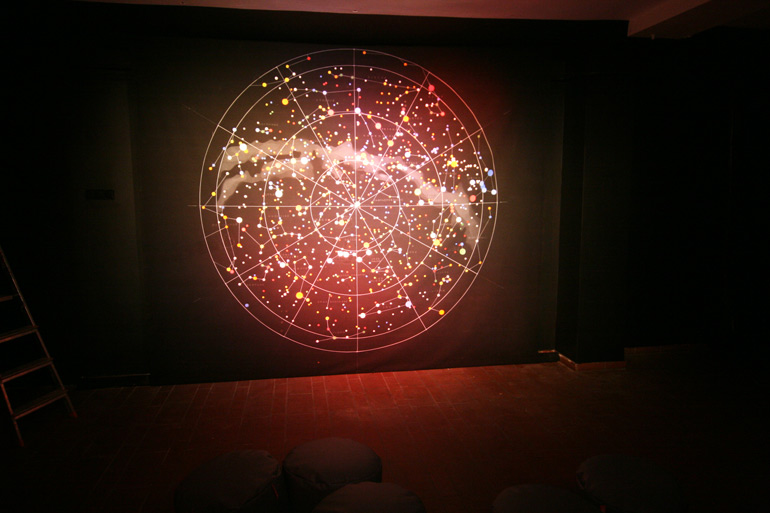
Emil Cieślar's work presented at the Ars Polonia exhibition W przestrzeni / In Space, Galeria Sztuki Współczesnej w Opolu / Contemporary Art Gallery in Opole, 2010, photo by Rafał Mielnik / Agencja Gazeta
Questioning art as an institution and creating a border between the artist and the viewer was a subject of the Cieślars’ theoretical works (the series of texts Prasować? – Przejść ponownie? – Cerować / Ironing? – Repassing? – Darning published in Repassage catalogues between 1974 and 1977; the brochures Karuzela postaw / A Carousel of Attitudes, 1976; O roli intuicji, twórczości i instytucji sztuki w życiu / On the Role of Intuition, Creation and Art Institutions in Life, 1976). The milieu of artists and amateurs gathered around the Repassage gallery was one of the most important groups of the counter-culture faction of the Polish neo-avant-garde of the 1970s.
In the beginning of 1978, the artists moved to France. In 1979 they presented a rebellious action (Trumna Malewicza / Malewicz’s Coffin) aimed against the Paris-Moscow exhibition, exposing the hypocrisy of both official partners. Their performance Pokój olimpijski (Olympic Peace), repeated outside of the Centre Pompidou in Paris during the Olympics in Moscow in 1980, focused on the subject of the war in Afghanistan, also had a strong political message. In 1980 the artists joined the French Committee for Solidarity with Solidarity. After martial law was introduced, they raised the subject of the political situation in Poland (Pochód i płyta / Parade and Plate, December 24th 1981, an action in Assemblée Nationale against the visit of French members of the Parliament to Poland in 1984, numerous posters and flyers). On a more private scale, they continued the thread of collective social work between friends (Portret Grupy / Group Portrait, 1985) or addressed to local communities (Słoń – realizacja II / Elephant – 2nd realization, 1988).
In his individual work since 1982, Emil Cieślar has been conducting research on colour. At the beginning he created a “Colour Collection” as a basis for further combinatorial action. In 1985 he started to build an instrument called The Music of Colorus, which he has shown to the public many times, including at exhibitions in Poland. Between 1985 and 1989 Elżbieta Cieślar sculpted the Karuzela sióstr (A Carousel of Sisters) group of seats; in 1990 – Karuzela ty – tutaj – dzisiaj / Carousel You – Here – Today, and other works which continued the idea of the Carousel of Attitudes from the 1970s. Together they realized Schody pamięci / Memory Stairs (1988-1989), which were reminiscent of their experiences from the time of underground Solidarity in Poland.

